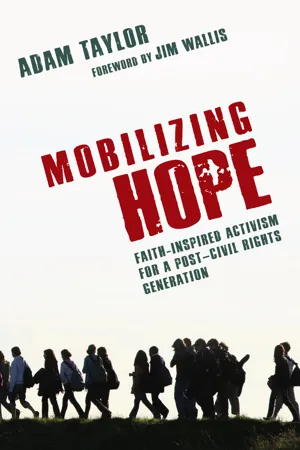
Martin Luther King Jr. read the words of the apostle Paul to the church in Rome--"Be transformed by the renewing of your mind"--as a call not to retreat from the world but to lead the world into the kingdom of God, where peace and justice reign. In King's day the presenting problem was entrenched racism; the movement of God was a revolution in civil rights and human dignity. Now Adam Taylor draws insights from that movement to the present, where the burden of the world is different but the need is the same. Jim Wallis writes in the foreword,
Mobilizing Hope "is a story of how Adam and many of his cohorts are shaping the next strategies for faith-based social change; a theology for social justice; a spirituality for young activists; a handbook for those who want to experiment with activism and search out their own vocation in the world; and a strategy manual that draws lessons from past movements for change."See what today's transformed nonconformists are doing at home and abroad to keep in step with the God of justice and love, and find ways you can join the new nonconformists in an activism of hope.
During my second year as a graduate student at the Kennedy School of Government, I took a course titled “Organizing People, Power and Change” with Professor Marshall Ganz. Ganz has been my exacting and tough-minded mentor in community organizing, having spent decades working with Cesar Chavez in the United Farm Workers movement and other similar struggles. In one semester, Ganz opened my eyes to the ways in which organizing people for social change is both an art form and a science. Before taking his course, I was a novice when it came to understanding the nature of power and the architecture of building effective campaigns.
From Ganz I learned that collective action represents the safeguard of our democracy and an antidote to the misuse and abuse of power. I also learned that successful campaigns require much more than the personal charisma of a leader; they also require an understanding of the role that public narrative plays in fueling social change. Too often history is taught in a way that feeds our culture’s fixation and fascination with iconic leaders like Dr. King. This trend renders invisible the unsung heroes who served as the foot soldiers of the civil rights movement. While we remember the oratorical genius of Dr. King, countless people learned to tell their public story in ways that elicited both sacrifice and commitment from others. The use of storytelling or public narrative through countless face-to-face meetings was the lifeblood of recruiting and sustaining participation in bus boycotts, voter registration campaigns and sit-ins.
The first act of becoming creatively maladjusted is to reclaim your own story, which is an act of both empowerment and self- actualization that involves a deliberate process of reflecting on the experiences that have shaped your identity and influenced your life the most. Telling our story, or public narrative, represents the lifeblood of activism. Our public stories are more than simply our testimonies, which describe our personal encounters with God’s grace and goodness. Public stories link our personal stories to the stories of others in order to inspire collective action.
According to Ganz, “public narrative is a leadership art through which we translate values into action: engaging heart, head, and hands.”[1] Public narrative weaves together Aristotle’s three components of rhetoric—logos, pathos and ethos. The logos is the logic of the argument; the pathos is the feeling the argument evokes; and the ethos comes from the credibility of the person who makes the argument. Shocking statistics and compelling facts are almost never enough to inspire people to take action. Personal stories are needed to evoke emotion and trigger empathy.
A good public story is drawn from spiritual markers or choice points that compose the “plot” in our lives. The plot names the challenges we have faced, the choices we have made in the midst of these challenges and the outcomes we’ve experienced as a result.[2] Choice moments represent footholds that bring our public narrative to life.
Public narrative is composed of three components: a story of self, a story of us and a story of now. The first century sage Rabbi Hillel captured the relationship between these core elements when he said, “If I am not for myself, who is for me? And if I am for myself alone, what then am I? And if not now, then when?”[3] In other words, what are your core values, who constitutes your community and what do you feel so passionate about that you are willing to sacrifice time and energy to change?
The “story of self” is composed of key moments in our lives when our values are formed and we have to choose a course of action in the face of uncertainty.[4] This story is composed of a series of footnotes in our background, upbringing and life experience that form our character, values and convictions. For some of us, our parents play a leading role; for others it may be a grandparent, teacher, neighbor or mentor. Our race, ethnicity, gender and socioeconomic background also play a key role in underwriting this story. While our story of self should never be reduced purely to these attributes, we shouldn’t be afraid to articulate the ways in which they’ve shaped our identity and story.
Why our community, organization, movement and so on has been called to achieve a set of goals forms the “story of us.” Community stories include the challenges we have faced collectively and why we stood up to them based on our shared values, religious traditions and political and economic beliefs. We repeat community stories as folk sayings, popular songs, religious rituals and community celebrations, such as Easter, Passover and the Fourth of July.[5] Ganz says that “learning to tell a ‘story of us’ requires deciding who the ‘us’ is, which values shape that identity, and which of those values are most relevant to the situation at hand.”[6]
Transformed nonconformists can’t lose sight of the “us” they are connected to—in some cases making decisions to be connected to one “us” over another, ultimately for the sake of all of us. For instance, Moses chose Israel’s story over Egypt’s story in accepting God’s assignment to free the Israelites from the bondage of slavery. Like Moses, the “us” for people of faith must always be aligned with God’s special concern for the weak, the vulnerable and the marginalized. Therefore, no matter our station in life, our “us” is always inclusive of and concerned about God’s chosen “us.”
The urgent challenge we are called to face now, the choices we must make to act now and the change we might achieve as a result form the “story of now.” The challenge must convey immediacy as we are called upon to act now because of whose we are and the preferred future we aspire to create together. The intersection between the stories of self and us and the pressing injustices in the world gives birth to the story of now. A good story of now breaks us out of inertia and offers an imperative for taking action.
In cases in which we fail to author our own story, others will often fill in the blanks for us. The 2004 presidential campaign of Senator John Kerry provides a haunting example of this in the political realm. The Kerry campaign initially remained silent while a couple of conservative bishops attacked Kerry’s Catholic faith due to his pro-choice position, threatening to deny him communion. Thus, this negative storyline became the dominant frame in the media and the public’s mind rather than a positive image of Kerry as a devout Catholic believer and churchgoer. The Swift Boat Veterans ads also cast doubts and aspersions upon Kerry’s military service. While the campaign had noble reasons for trying to stay above the fray, these negative stories disturbed the narrative, in part because the campaign failed to tell its story as effectively and persuasively as its critics. Authoring our own story starts with identifying the watershed moments in our lives that often determine our trajectory and form our character.
Burning Bush Moments
Moses wrestled with the stories of self, us and now in his struggle to accept God’s calling upon his life to free the Israelites from the yoke of slavery and lead them into the Promised Land.[7] While we know little about Moses’ early life, we do have evidence of his intolerance toward injustice. For example, in Exodus 2, Moses strikes down and kills an Egyptian who he sees brutally beating a Hebrew slave, leading to his forced exile from Pharaoh’s court. Moses’ dual Egyptian and Hebrew identity enables him to understand the ways and means of Pharaoh’s court while also identifying with the oppressed Hebrew slaves. Moses is faced with a painful but conscious choice to either turn a blind eye to oppression and hold on to his life of comfort and privilege, or decide to get in the way of injustice and risk losing everything. Creative maladjustment often means making similar choices, making common cause with the oppressed, and using our status or privilege to fight injustice.
Years later something bizarre and extraordinary happens. God turns Moses’ world upside down when he sees the angel of the Lord appear in a flame of fire out of a burning bush. At the burning bush Moses engages in a heated debate with God, asking, Why me? Who is calling me? Why these people? And why now? These questions echo the stories of self, us and now. What I love about Moses is how much we can relate to his response. His initial reaction to God is one of fear and trepidation. Moses asks, “Who am I that I should go to Pharaoh and bring the Israelites out of Egypt?” but God replies, “I will be with you” (Exodus 3:11-12 nrsv). God’s reply represents all the reassurance we should need, serving as a reminder that God never leaves nor forsakes us, yet Moses still isn’t convinced. He then asks, “If I come to the Israelites and say to them, ‘The God of your ancestors has sent me to you,’ and they ask me ‘What is his name?’ what shall I say to them?” (Exodus 3:13 nrsv). God replies, “I am who I am” (Exodus 3:14 nrsv). God reminds Moses that his identity is inextricably linked to his faith. Moses’ story of us is bound together with the plight of the Israelites and God’s promise to deliver them. In the end, Moses chooses Israel’s story over Egypt’s because the twisted logic of Egypt was at odds with God’s covenantal promise to Abraham.
When was the last time you experienced a burning bush moment? Typically our burning bushes aren’t as dramatic as the one that Moses faced, but there are more subtle moments in our lives when God commands our greatest attention, sometimes in an abrupt instance and other times far more gradually. Burning bush moments are deep encounters with God’s will and calling. We may not always see God in the moment, but if we look deep beneath the surface of our experiences, we can see God’s presence and purpose become manifest. Burning bush experiences test and try us, stretching our sense of calling and presenting us with crossroad moments.
How Far Does the Rabbit Hole Go?
In a systematic theology course taught by Dr. John Kinney, dean of the Samuel Proctor School of Theology, I was charged with selecting and analyzing any popular movie through a theological lens. Movie watching has never been the same since as I now drive my wife nuts with my post-movie theological commentary. Almost every film is chock-full of theological themes and references. Since theology at its core deals with the human condition, the relationship between people and God, and conceptions of afterlife, evil and sin, almost every film constitutes a treasure chest just waiting to be discovered.
In the first groundbreaking movie of the Matrix trilogy, a computer hacker named Neo is tracked down by Morpheus, the leader of a revolutionary band of freedom fighters on a mission to free humanity from the captivity of machines who have enslaved the world. In the film, Neo appears almost as a Christlike figure, referred to by Morpheus as “the One.” One of my favorite scenes is the pivotal moment in which Neo is given a life-altering and paradigm-shattering choice of whether to swallow one of two pills. With the blue pill he will wake up with his memory of his encounter with Morpheus erased, stuck in a dream-induced existence within the Matrix, which is generated by the machines. With this choice he will remain in a blissful sleep, never having to confront the fact that his current reality is just an illusion. Or he can choose the red pill and according to Morpheus “remain in Wonderland and see how far the rabbit hole goes.” In other words, he can join a small group of humans freed from the machines who are waging a campaign to liberate humanity. One path offers comfort and security, even if it is a false one. The other offers incredible risk and danger but leads to true emancipation. Neo chooses the red pill and the rest is cinematic history. We may not face decisions as stark as this one, but even in those more subtle moments in which God offers us the red or blue pill, we must ask ourselves which pill do we swallow?
Over the course of our faith journey, God presents us with many Matrix-like moments. In these watershed moments, we are often confronted by injustice and have to make a deliberate and conscious choice about what to do in response. If you excavate the experiences of your life, I’m confident that you have had at least a few of these life-changing moments. In these choice moments, the scales are removed from our eyes and our community or world suddenly looks different. Jesus also experienced some of these moments in his ministry, like the moment when he overturns the tables of the money changers in the temple (Mark 11:15-18); when he confronts the Pharisees for their hypocrisy by challenging them to cast the first stone toward a woman adulterer (John 8:1-11); when he conquers temptation by the devil after forty days of fasting in the desert (Matthew 4:1-11); or when he refuses to deny his identity as the Son of God when questioned by the Sanhedrin (Mark 14:60-65). These are defining choice moments in Christ’s ministry that reveal his true character and mission. These decisions also place Christ on a trajectory toward a destination called Calvary’s cross to redeem and save humanity.
Sadly, even after accepting Christ into our lives, many of us continue to choose the blue pill despite the transformational opportunities that God puts in our path. We prefer to live our lives protected by walls of comfort and convenience that separate us from the often bitter realities of pain and suffering that lie just outside our purview. We grow deaf to the cries of the world’s dispossessed and disinherited. But true discipleship is akin to choosing the red pill, which enlists us in God’s redemptive and liberating purposes in the world. Matrix-like moments form the backbone of our public narrative.
Public narrative helps us make sense of the world and ease the movement from patterned thinking to creative maladjustment and transformed nonconformity. While telling your public narrative may seem like a shameless effort to trumpet your own autobiography, I’ve experienced the impact this exercise can have in building deeper relationships and forming stronger bonds of community. It has taken me some time, practice and reflection to realize that sharing my story is not about pride, ego or self-aggrandizement but is about sharing the most precious and meaningful parts of myself with others. Authenticity and vulnerability counteract coming across as overly self-promoting or self-serving.
Through the exercise of putting together your public narrative, you get to put together scenes from your life that compose an entire plot. In this case you get to play the leading role, direct the shots and edit the film. I realize that this process can be intimidating and uncomfortable. As much experience as I’ve gained in public speaking, it wasn’t until Ganz pushed me before a Sojourners Training for Change conference in 2008 that I became more accustomed and adept at sharing my story through the medium of public narrative. Sharing my story through this method will hopefully enable and empower you to better tell your story as well.
Coming of Age
I grew up believing I was born in the wrong era. The same year that Dr. King’s life was tragically cut short, my parents made the controversial decision to get married as an interracial couple. My story, which is drenched in the history of the civil rights struggle, intersects with the challenges facing a post–civil rights generation.
My African American mother, Saundra Taylor, grew up in segregated Louisville, Kentucky, was a classmate of Cassius Clay, later known as Muhammad Ali, and became the only black woman to graduate from Depauw University in her class. She later served as the vice president of student affairs first at Western Washington University and then at the University of Arizona.
My middle name, Russell, comes from my mother’s father, who died of a heart attack before I was born. Despite never meeting him, I feel as though Russell is constantly with me as I seek to emulate his commitment to public service when he served as a bridge-builder and civic leader in Louisville, Kentucky. Russell was a humanitarian. He would often paraphrase a poem by James Henry Leigh Hunt called “Abou Ben Adhem,” saying, “when I die I want to be remembered because I loved my fellow man.” After twenty years of working for the Louisville Defender newspaper, my grandfather left to work with a new federally funded program called Urban Renewal. The program helped to relocate disadvantaged people, mostly African Americans, from high-crime and high-drug-use areas to better homes and neighborhoods. It was very controversial and highly political. Most African Americans were suspicious and hostile to the relocation idea. But Russell was very persuasive and effective in reassuring them due to his tremendous people and communication skills. He had a very compassionate heart and worked tirelessly to help people who were disadvantaged. For this reason many people trusted him and would listen to how the program could benefit them. However, dealing with this intense level of conflict and distrust took its toll on him. At the age of fifty-four he had a massive heart attack that he survived, but that left him very weak and unable to continue working. He took a disability leave. Two years later he died from a second massive heart attack.
My father, Christopher Taylor, grew up in white America on a farm outside of Cleveland, Ohio. My dad is not the type who follows convention. He is always looking for a great bargain, negotiating upgrades and taking the path less traveled. I admire his charm, wit, compassion and incredible work ethic, even if I sometimes can’t fully appreciate his sense of humor. My dad served as an inspiring and dynamic college professor, having taught courses in psychology to thousands of students over the course of his teaching career.
Part of any story of self is the story of our ancestors and parents. The story of self includes the people who had a particular influence on how we perceive the world and conduct ourselves in it, the people whose decisions had an impact on our birth and upbringing: these people contribute materially to the story that we need to claim for ourselves. Whether your parents, siblings, other relatives, a neighbor, a pastor, a friend, highlighting a few of these people will shed greater light on who was instrumental in shaping and inspiring you. My story begins with a reference to my grandfather Russell because he has had such a profound impact on my ...
Table of contents
Cover
Copyright
Contents
Foreword
Introduction
1 Activism Is a Story of Faith
2 Getting to the Root Cause of Injustice
3 Following a Holistic Jesus
4 Pragmatic Solidarity and Hopeful Activism
5 The Character of Transformed Nonconformism
6 Redeeming the American Dreay
7 New Wine for a Changed World
8 Racial Reconciliation and Racial Justice
9 From Narrow Nationalism to Global Leadership and Citizenship
10 From Solely Service to Civic Discipleship
Conclusion
Epilogue
Notes
Afterword
Transformed Nonconformists
Acknowledgments
About the Author
Trusted by 375,005 students
Access to over 1.5 million titles for a fair monthly price.
Study more efficiently using our study tools.
Frequently asked questions
Yes, you can cancel anytime from the Subscription tab in your account settings on the Perlego website. Your subscription will stay active until the end of your current billing period. Learn how to cancel your subscription
No, books cannot be downloaded as external files, such as PDFs, for use outside of Perlego. However, you can download books within the Perlego app for offline reading on mobile or tablet. Learn how to download books offline
Perlego offers two plans: Essential and Complete
Essential is ideal for learners and professionals who enjoy exploring a wide range of subjects. Access the Essential Library with 800,000+ trusted titles and best-sellers across business, personal growth, and the humanities. Includes unlimited reading time and Standard Read Aloud voice.
Complete: Perfect for advanced learners and researchers needing full, unrestricted access. Unlock 1.5M+ books across hundreds of subjects, including academic and specialized titles. The Complete Plan also includes advanced features like Premium Read Aloud and Research Assistant.
Both plans are available with monthly, semester, or annual billing cycles.
We are an online textbook subscription service, where you can get access to an entire online library for less than the price of a single book per month. With over 1.5 million books across 990+ topics, we’ve got you covered! Learn about our mission
Look out for the read-aloud symbol on your next book to see if you can listen to it. The read-aloud tool reads text aloud for you, highlighting the text as it is being read. You can pause it, speed it up and slow it down. Learn more about Read Aloud
Yes! You can use the Perlego app on both iOS and Android devices to read anytime, anywhere — even offline. Perfect for commutes or when you’re on the go. Please note we cannot support devices running on iOS 13 and Android 7 or earlier. Learn more about using the app
Yes, you can access Mobilizing Hope by Adam Taylor,Adam R Taylor in PDF and/or ePUB format, as well as other popular books in Theology & Religion & Religion. We have over 1.5 million books available in our catalogue for you to explore.