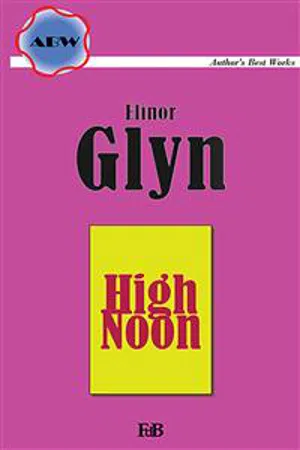
eBook - ePub
High Noon
About this book
"High Noon" was published in 1909 by D. Appleton and Company as a new sequel to "Three Weeks" (1911). This ebook contains a detailed bibliography including all the publications of the Author.
This interactive digital edition includes: Interactive Notes and Chapters, News about the Author, News about the Book, a very interesting Tag cloud of the Book and a link to connect to the Goodreads community to ask questions and share comments and opinions.
Information
Subtopic
ClassicsIndex
LiteratureElinor Glyn
High Noon
I.
It was Springtime in Switzerland! Once more the snow-capped mountains mirrored their proud heads in sapphire lakes; and on the beeches by the banks of Lake Lucerne green buds were bursting into leaves. Everywhere were bright signs of the earth's awakening. Springtime in Switzerland! And that, you know — you young hearts to whom the gods are kind — is only another way of saying Paradise!
Towards Paradise, then, thundered the afternoon express from Paris, bearing the advance guard of the summer seekers after happiness. But if the cumbrous coaches carried swiftly onward some gay hearts, some young lovers to never-to-be-forgotten scenes, one there was among the throng to whom the world was gray — an English gentleman this, who gazed indifferently upon the bright vistas flitting past his window. The London Times reposed unopened by his side; Punch, Le Figaro, Jugend had pleased him not and tumbled to the floor unnoticed.
There seemed scant reason for such deep abstraction in one who bore the outward signs of so vigorous a manhood. Tall, well-formed, muscular as his faultless clothes half revealed, half hid, his bronzed face bearing the clear eyes and steady lips of a man much out of doors, this thoughtful Englishman was indeed a man to catch and hold attention. No callow youth, was he, but in the prime of life — strong, clean, distinguished in appearance, with hair slightly silvered at the temples; a man who had lived fully, women would have said, but who was now a bit weary of the world.
Small wonder that the smart American girl sitting opposite in the compartment stared at him with frank interest, or an elegantly gowned Parisienne demi-mondaine (travelling incognito as the Comtesse de Boistelle) eyed him tentatively through her lorgnette.
So Sir Paul Verdayne sat that afternoon in a compartment of the through express, all unconscious of the scrutiny of his fellow travellers; his heart filled with the dogged determination to face the future and make the best of it like a true Englishman; somewhat saddened — yes — but still unbroken in spirit by the sorrows that had been his.
Many years ago it was, since he had vowed to revisit the Springplace of his youth, Lucerne, a spot so replete with tender memories, and each succeeding year had found him making anew his pilgrimage, though a sombre warp of sorrow was now interwoven in the golden woof of his young happiness.
This year he had decided should be the last. Not that his devotion to his beloved Queen had lessened — far from that — but the latent spirit of action, so innate to true British blood was slowly reasserting itself. For Paul romance might still remain, but as a thing now past. He was frank with himself in this respect, and he would be frank with Isabella Waring too.
One more visit he would pay to the scenes of his love-idyl, to the place where his beloved Imperatorskoye had come into his life, there to commune again with her in spirit, there to feel her regal presence, to seek from her that final supreme consolation which his wounded heart craved — this was Paul's quest. And then he would return to England — and Isabella.
It was the consideration of this resolution which shut the flying scenery from his gaze, which drew fine lines about the corners of his firm lips, and set his face to such a look of dominant strength as made the high spirited American girl muse thoughtfully and brought a touch of colour to the face of the pseudo Countess which was not due to the artifice of her maid.
Such men are masters of their own.
Paul Verdayne was not a man to shirk responsibilities. It is true, dark days had come to him, when a crushing burden had well-nigh smothered him, and a bullet to still his fevered brain had seemed far sweeter to Paul than all else life might hold for him. But Paul was strong and young. He learned his lesson well — that Time cures all and that the scars of sorrow, though they form but slowly, still will heal with the passing of the years.
Paul was still young and he had much to live for, as the world reckons. He was rich (a thing not to be lightly held), one of the most popular M. P.'s in England, and the possessor of a fine old name. It would be a coward's part, surely, to spend the rest of his life in bemoaning the dead past. He would take up the duties that lay near at hand, become the true successor of his respected father, old Sir Charles, and delight the heart of his fond mother, the Lady Henrietta, by marrying Isabella Waring, the sweetheart of his boyhood days.
So Paul sat communing with himself as the train rushed noisily on, sat and settled, as men will, the future which they know not of. Alas for resolves! Alas for the Lady Henrietta! Alas for Isabella! For Paul, as for all of us, the mutability of human affairs still existed. Were it not so, this record never would have been written.
II.
With much grinding of brakes and hiss of escaping steam, the express at last stopped slowly in the little station and the door of Paul's compartment was swung open by the officious guard with a "Lucerne, your Lordship," which effectually aroused him from his reverie.
Paul quietly stepped out of the car, and waited with the air of one among familiar scenes, while his man Baxter collected the luggage and dexterously convoyed it through the hostile army of customs men to a fiacre. In the midst of the bustle and confusion, as Paul stood there on the platform, his straight manly form was the cynosure of all eyes. A fond mamma with a marriageable daughter half unconsciously sighed aloud at the thought of such a son-in-law. A pair of slender French dandies outwardly scorned, but inwardly admired his athletic figure, so visibly powerful, even in repose.
But all oblivious to the attention he was attracting, Paul waited with passive patience for the survey of his luggage. For was not all this an old, old story to him, a trifling disturbance on the path of his pilgrimage? When one travels to travel, each station is an incident; not so to him who journeys to an end.
But Paul was not destined to remain wholly uninterrupted. As the other travellers descended from the carriage and formed a little knot upon the platform, the Comtesse de Boistelle, now occupied with a betufted poodle frisking at the end of a leash, strolled by him. As she passed Paul she dropped a jewelled reticule, which he promptly recovered for her, offering it with a grave face and a murmured "Permettez moi, Madame."
The Comtesse gently breathed a thousand thanks, allowing her carefully gloved hand to brush Paul's arm.
"Monsieur is wearied with the journey, perhaps?" she said in a low voice. And her eyes added more than solicitude.
Paul did not deny it. Instead, he raised his green Alpine hat formally and turned impassively to meet his man, who had by then stowed away the boxes in the Waiting fiacre.
In the group of Paul's late companions stood the American girl who had sat facing him all the way from Paris. He was no sooner out of earshot than —
"Did you see, Mamma?" she whispered to the matron beside her.
"See what, Daisy?"
"That French creature — she tried to talk to my big Englishman, but he snubbed her. What a fine chap he must be! I knew he had a title, and I'm just dying to meet him. Do you suppose he'll stay at our hotel? If he does, I'll find somebody who knows all about him. Now I understand why so many American girls marry titled Englishmen. If they're all as nice as this one, I don't blame them, do you?"
"Hush, child, hush!" her mother reproved. "How can you run on so about a total stranger?"
But the girl merely smiled softly to herself in answer, as she watched Paul's straight back receding down the platform.
Overwhelmed with a rush of memories, Paul climbed into the carriage. It was a fine afternoon, but he did not see the giant mountains rearing their heads for him as proudly in the sunshine as ever they had held them since the world was new.
For Paul just now was lost in the infinite stretches of the past, those immeasurable fields through which the young wander blithely, all unconscious of aught but the beautiful flowers so ruthlessly trampled on, the luscious fruits so wantonly plucked, the limpid streams drunk from so greedily, and the cool shades in which to sink into untroubled sleep.
Ah! if there were no awakening! If one were always young!
The fiacre stopped; and soon Paul found himself in the hall of the hotel, surrounded by officious porters. The maître d'hôtel himself, a white-haired Swiss, pushed through them and greeted him, for was not Sir Paul an old and distinguished guest, who never failed to honour him with his patronage each year? Himself, he showed Paul to the same suite he always occupied, and with zealous care conferred with milord over the momentous question of dinner, a matter not to be lightly discussed.
"And the wine? Ah! the Tokayi Imperial, of a certainty. Absolutely, Monsieur, we refuse to serve it to anyone but yourself. Only last week it was, when a waiter who would have set it before some rich Americans — but that is over, he is here no longer."
Paul smiled indulgently at the solicitous little man. It was good to be here again, talking with Monsieur Jacques as in the old days.
"One moment, more, Monsieur, before I go. Is it that Monsieur desires the same arrangements to be made again this year — the visit to the little village on the lake, the climb up the Bürgenstock, the pilgrimage to the Swiss farmhouse? Yes? Assuredly, Monsieur, it shall be done, tout de suite."
And then with a confident air as of complete and perfect understanding on the part of an old and trusted friend, the bustling little maître d'hôtel bowed himself out.
Paul proceeded, with his usual care, to dress for dinner, pausing first to stand in the window of his dressing-room and gaze wistfully upon the lake he loved so well, now dimming slowly in the Spring twilight.
The last time! Ah, well, so be it, then. There must come an end to all things. And Paul turned away with a sigh, drawing the draperies gently together, as if to shut out the memories of the past.
How well he succeeded, we shall soon know.
He was the last to enter the restaurant, which was well filled that evening. On his way to his accustomed place he passed the table at which sat Miss Daisy Livingstone, his American fellow-traveller, dining with her mother; and another where the Comtesse, by courtesy, sat toying with a pâté. To Paul's annoyance, he was greeted further down the room by a member of his club; Graham Barclay was not a particular favourite of his, at any time, and furthermore Paul had no desire, just now, to be reminded of London. As civilly as he could, he declined an invitation to join the party, pleading fatigue from his long journey, and moved on to the end of the room, where his old waiter, Henri, stood, with hand on chair-back, ready to help him to a seat.
"Deuced fine fellow, Verdayne," explained Barclay in parentheses to his friends. "A bit abstracted sometimes, as you see. But he'll be all right after tiffin. We'll gather him in for billiards later."
The eyes of more than one guest followed Paul as he walked the length of the restaurant, for Verdayne possessed that peculiar quality — that spiritual attraction — magnetism — (call it what you will, a few elect mortals have it) that stamps a man indelibly. But of all those who marked him as he moved among the tables, none regarded him more closely than a lady who sat alone in a small recess, screened from prying eyes by a bank of greenery.
A marvellous lady she was, with hair as black as the sweep of a raven's wing, crowning a face as finely chiselled as any Florentine cameo. And if the diamonds about her smooth white throat had wondrous sheen they were not more lustrous nor more full of sparkling fire than her opalescent eyes.
Unseen by the preoccupied Paul, she leaned across the cloth, scarcely whiter than her pale face, and gazed at him with wonder — was it more than that? With a slight movement of her tapering hand she dismissed the liveried servant stationed behind her, and stayed on, with food and wine untouched. And Paul knew it not.
So near to us can lie the hidden path of our strange destinies until the appointed hour.
III.
The next morning Paul breakfasted on the terrace. The gay greetings of old friends, the pleasant babble in the breakfast room ill suited his reflective mood.
And as he sat alone under the fragrant pergola enjoying his cigarette and dividing his attention between his coffee and the Paris Edition of the Herald, a pale, dark-haired lady passed by as she sought the terrace for an early stroll. Paul's eyes were on his paper at that moment — and if the lady's well-bred glance lingered on him for a brief instant as he turned the pages of the daily, he was all unconscious of her presence.
Perhaps the lady may have seen something about the strong, wholesome, well-groomed Englishman that pleased her, perhaps she was simply glad to be alive upon that glorious morning, with the bracing breeze blowing fresh from the lake, and the sun sending his welcome rays down upon the mountainside. At all events, her lips parted in the merest shadow of a smile as she walked along the gravelled path with the veriest air of a princess.
Alas! the smile and the dainty picture which the dark-haired lady made as she moved down the flower bordered path in the sunshine, her morning gown clinging gracefully about her slender figure, were alike lost on the engrossed Paul. With his eyes glued to the criticism of a sharpened writer on the last measure before Parliament, he read on, all oblivious to his surroundings. Even here, at his beloved Lucerne, the man of affairs could not escape the thrall of the life into which he had thrown the whole effort of his fine mind.
Sir Paul had not quite finished the breezy article when, with an all pervading blast of a sweet-toned, but unnecessarily loud Gabriel horn, a big green touring car came dashing up to the gate of the little hotel, and with a final roar and sputter, and agonized shriek of rudely applied brakes, came to a sudden stop. From it there emerged, like a monster crab crawling from a mossy shell, a huge form in a bright green coat — a heavy man with a fat, colourless face and puffy eyes, and Paul, glancing up at the ostentatious approach, recognized in him a nouveau riche whom a political friend had insisted on introducing in London a few days before.
Schwartzberger, his name was (Paul had a peculiar trick of remembering names) — the fellow was said to have made a fortune in old rags — no, it was tinned meats — in Chicago. It was his proud boast that he started in the business as a butcher's errand boy but a few years ago, and now, no supper bill at the Moulin Rouge, no evening's play at Monte Carlo, had ever made a material depletion in the supply of gold that always jingled in the pockets of his loud clothes. His was the fastest car and the gayest coloured on all the Continent, and he was alike the hero and the easy dupe of every servant.
As the stout American came waddling uncertainly up the walk, with a certain elephantine effort at jauntiness, he nearly collided with the foreign lady who had crossed his path to reach the further limits of the terrace. Not having a cautioning horn attached to his anatomy to warn heedless trespassers from his way, the large person was forced to give ground, but had some difficulty in veering from his course sufficiently to avoid an accident. However, the grande dame slipped past him quickly and disappeared amid the shrubbery — but not before her extraordinary beauty had dazzled the pork-packer's beady eyes.
He turned and stared at her.
"Gee! What a peach!" he murmured aloud, in words which came wheezing from between thick lips. "I wonder if that's the Countess's lady friend she spoke of."
Then, catching sight of Verdayne, and knowing him at once for the swell English guy he had met at the Savoy, he panted up and slapped Paul's shrinking back with his fat, white hand.
"Hullo, Verdayne! Just the man I'm looking for! I didn't know you were in this part of the world. Hurry up with your breakfast and join me and my friend, the Countess de Boistelle, in a spin around the lake. Perhaps you know her already. No? That's easy arranged — she's a particular friend of mine, and she's got a chum of her's staying here too, I guess. Make up a foursome with us and I'll promise you this old place won't be half slow. When it comes to making things hum, nobody's got anything on the Countess."
"Damned bounder!" growled Paul under his breath; and aloud: "Thanks, I have an engagement. Awfully sorry, and all that, you know." And he rose, as if to end the interview.
"I'll bet you've got a date with that queen you were just talking to. Verdayne, you're the foxy one. Well, I can't say you haven't got good taste, anyhow, though she's a little too quiet for me."
"Talking with whom?" inquired Paul, in a cold voice.
"Why, that lady that just left here. She nearly ran into me getting away."
"Schwartzberger," answered Paul, with great deliberation, as he folded his newspaper, "I believe that a lively imagination is as necessary to the ideal management of the pork-packing industry as to all other business activities. Permit me to observe that I can predict for you no cessation of the remarkable results you have achieved in your chosen profession." And with a short nod he started down the path.
Schwartzberger's bead...
Table of contents
- Description
- Biography
- Index
- Foreword
- High Noon
- Bibliography
Trusted by 375,005 students
Access to over 1.5 million titles for a fair monthly price.
Study more efficiently using our study tools.
Frequently asked questions
Yes, you can cancel anytime from the Subscription tab in your account settings on the Perlego website. Your subscription will stay active until the end of your current billing period. Learn how to cancel your subscription
No, books cannot be downloaded as external files, such as PDFs, for use outside of Perlego. However, you can download books within the Perlego app for offline reading on mobile or tablet. Learn how to download books offline
Perlego offers two plans: Essential and Complete
- Essential is ideal for learners and professionals who enjoy exploring a wide range of subjects. Access the Essential Library with 800,000+ trusted titles and best-sellers across business, personal growth, and the humanities. Includes unlimited reading time and Standard Read Aloud voice.
- Complete: Perfect for advanced learners and researchers needing full, unrestricted access. Unlock 1.5M+ books across hundreds of subjects, including academic and specialized titles. The Complete Plan also includes advanced features like Premium Read Aloud and Research Assistant.
We are an online textbook subscription service, where you can get access to an entire online library for less than the price of a single book per month. With over 1.5 million books across 990+ topics, we’ve got you covered! Learn about our mission
Look out for the read-aloud symbol on your next book to see if you can listen to it. The read-aloud tool reads text aloud for you, highlighting the text as it is being read. You can pause it, speed it up and slow it down. Learn more about Read Aloud
Yes! You can use the Perlego app on both iOS and Android devices to read anytime, anywhere — even offline. Perfect for commutes or when you’re on the go.
Please note we cannot support devices running on iOS 13 and Android 7 or earlier. Learn more about using the app
Please note we cannot support devices running on iOS 13 and Android 7 or earlier. Learn more about using the app
Yes, you can access High Noon by Elinor Glyn in PDF and/or ePUB format, as well as other popular books in Literature & Classics. We have over 1.5 million books available in our catalogue for you to explore.