eBook - ePub
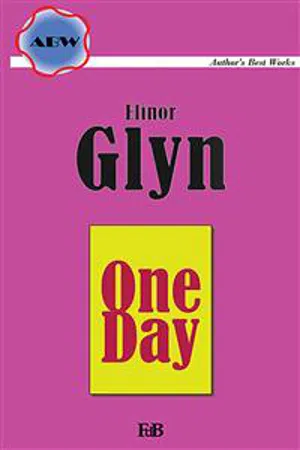
One Day
About this book
"One Day" was published in 1909 by D. Appleton and Company as a sequel to "Three Weeks" (1907). This ebook contains a detailed bibliography including all the publications of the Author.
This interactive digital edition includes: Interactive Notes and Chapters, News about the Author, News about the Book, a very interesting Tag cloud of the Book and a link to connect to the Goodreads community to ask questions and share comments and opinions.
Information
Subtopic
ClassicsIndex
LiteratureElinor Glyn
One Day
I.
The Prince tore the missive fiercely from its envelope, and scowled at the mocking glint of the royal crown so heavily embossed at the top of the paper. What a toy it was, he thought, to cost so much, and eventually to mean so little! Roughly translated, the letter ran as follows:
Your Royal Highness will be gratified to learn that at last a satisfactory alliance has been arranged between the Princess Elodie of Austria and your royal self. It is the desire of both courts and councils that the marriage shall be solemnized on the fifteenth of the May following your twenty-first birthday, at which time the coronation ceremony takes place that is to place the crown of the kingdom upon the head of the son of our beloved and ever-to-be-regretted Imperatorskoye. The Court and Council extend greetings and congratulations upon the not far distant approach of both auspicious events to your Royal Highness, which cannot fail to afford the utmost satisfaction in every detail to the ever-beautiful-and-never-to-be-sufficiently beloved Prince Paul.
Imperator-to-be, we salute thee. We kiss thy feet.
The letter was sealed with the royal crest and signed by the Regent — the Boy's uncle — the Grand Duke Peter, his mother's brother, who had been his guardian and protector almost from his birth. The young prince knew that his uncle loved him, knew that the Grand Duke desired nothing on earth so much as the happiness of his beloved sister's only son — and yet at this crisis of the Boy's life, even his uncle was as powerless to help as was Paul Verdayne, the Englishman.
"The Princess Elodie!" he grumbled. "Who the devil is this Princess Elodie, anyway? Austrian blood has no particular charm for me! They might at least have told me something a little more definite about the woman they have picked out to be the mother of my children. A man usually likes to look an animal over before he purchases!"
Known to London society as Monsieur Zalenska, the Prince had come up to town with the Verdaynes, and was apparently enjoying to the utmost the frivolities of London life.
At a fashionable garden party he sat alone, in a seclusion he had long sought and had finally managed to secure, behind a hedge of hawthorn where none but lovers, and men and women troubled as he was troubled, cared to conceal themselves.
The letter, long-expected and dreaded, had finally crossed the continent to his hand. It was only the written confirmation of the sentence Fate had pronounced upon him, even as it had pronounced similar sentences upon princes and potentates since the beginning of thrones and kingdoms.
While the Prince — or Paul Zalenska, as I will now call him — sat in his brooding brown study, clutching the imperial letter tightly in his young hand, his attention was arrested by the sound of voices on the other side of the hawthorn hedge.
He listened idly, at first, to what seemed to be a one-sided conversation, in a dull, emotionless feminine voice — a discourse on fashion, society chit-chat, and hopeless nonentities, interspersed with bits of gossip. Could women never talk about anything else? he thought impatiently.
But his displeasure did not seem to affect the course of things at all. The voice, completely unconscious of the aversion it aroused in the invisible listener, continued its dreary, expressionless monotone.
"What makes you so silent, Opal? You haven't said a word to-day that you didn't absolutely have to say. If all American girls are as dreamy as you, I wonder why our English lords are so irresistibly attracted across the water when in search of brides!"
And then the Boy on the other side of the hedge felt his sluggish pulse quicken, and almost started to his feet, impelled by a sudden thrill of delight; for another voice had spoken — a voice of such infinite charm and sweetness and vitality, yet with languorous suggestion of emotional heights and depths, that he felt a vague sense of disappointment when the magnetic notes finally died away.
"Brides?" the voice echoed, with a lilt of girlish laughter running through the words. "You mean 'bribes,' don't you? For I assure you, dear cousin, it is the metallic clink of American gold, and nothing else, that lures your great men over the sea. As for my silence, ma belle, I have been uncommunicative because there really seemed nothing at all worth saying. I can't accustom myself to small-talk — I can't even listen to it patiently. I always feel a wild impulse to fly far, far away, where I can close my ears to it all and listen to my own thoughts. I'm sorry if I disappoint you, Alice — I seem to disappoint everybody that I would like to please — but I assure you, laugh at my dreams as you may, to me my dream-life is far more attractive and beautiful than what you term Life. Forgive me if I hurt you, cousin. I'm peculiarly constituted, perhaps, but I don't like this twaddle, and I can't help it! Everything in England is so beautiful, and yet its society seems so — so hopelessly unsatisfactory to one who longs to live!"
"To live, Opal? We are not dead, surely! What do you mean by life?"
And so her name was Opal! How curiously the name suited the voice! The Boy, as he listened, felt that no other name could possibly have matched that voice — the opal, that glorious gem in which all the fires of the sun, the iridescent glories of the rainbow, and the cold brilliance of ice and frost and snow seemed to blend and crystallize. All this, and more, was in that mysteriously fascinating voice.
"To live, Alice?" echoed the voice again. "To live? Why, to live is to feel! — to feel every emotion of which the human soul is capable, to rise to the heights of love, and knowledge, and power; to sink — if need be — to the deepest depths of despair, but, at all costs, at all hazards, to live! — to experience in one's own nature all the reality and fullness of the deathless emotions of life!"
The voice sank almost to the softness of a whisper, yet even then was vibrant, alive, intense.
"Ah, Alice, from my childhood up, I have dreamed of life and longed for it. What life really is, each must decide for himself, must he not? Some, they say, sleep their way through a dreamless existence, and never, never wake to realities. Alice, I have sometimes wondered if that was to be my fate, have wondered and wondered until I have cried out in real terror at the hideous prospect! Surely Fate could not be so cruel as to implant such a desperate desire in a soul that never was to know its fulfilment. Could it, Alice? Tell me, could it?"
The Boy held his breath now.
Who was this girl, anyhow, who seemed to express his own thoughts as accurately as he himself could have done? He was bored no longer. He was roused, stirred, awakened — and intensely interested. It was as though the voice of his own soul spoke to him in a dream.
The cold, lifeless voice now chimed in again. In his impatience the Boy clenched his fists and shut his teeth together hard. Why didn't she keep still? He didn't want to miss a single note he might have caught of the voice — that other! Why did this nonentity — for one didn't have to see her to be sure that she was that — have to interrupt and rob him of his pleasure?
"I don't understand you, Opal," she was saying. (Of course she didn't, thought the Boy — how could she?) "I am sure that I live. And yet I have never felt that way — thank goodness! It's vulgar to feel too deeply, Mamma used to say, and as I have grown older, I can see that she was right. The best people never show any excess of emotion. That is for tragedy queens, operatic stars, and — the women we do not talk about! Ladies cultivate repose!"
("Repose! — mon Dieu!" thought Paul, behind the hedge. He wished that she would!)
"And yet, Alice, you are — married!"
"Married? — of course! — why not?" and the eavesdropper fancied he could see the wide-open gaze of well-bred English surprise that accompanied the words. "One has to marry, of course. That is what we are created for. But one doesn't make a fuss about it. It's only a custom — a ceremony — and doesn't change existence much for most women, if they choose sensibly. Of course there is always the chance of a mésalliance! A woman has to risk that."
"And you don't — love?"
The Boy was struck by a note that was almost horror in the opaline voice so near him.
"Love? Why, Opal, of course we do! It's easy to love, you know, when a man is decent and half-way good to one. I am sure I think a great deal of Algernon; but I dare say I should have thought as much of any other man I had happened to marry. That is a wife's duty!"
"Duty! — and you call that love?" The horror in the tones had now changed to scorn.
"You have strange ideas of life, Opal. I should be afraid to indulge them if I were you — really I should! You have lived so much in books that you seem to have a very garbled idea of the world. Fiction is apt to be much of a fairy tale, a crazy exaggeration of what living really consists of!"
"Afraid? Why should I be afraid? I am an American girl, remember, and Americans are afraid of nothing — nothing! Come, cousin, tell to me, if you can, why I should be afraid."
"Oh, I don't know! really I don't!" There was a troubled, perplexed note in the English voice now. "Such notions are apt to get girls into trouble, and lead them to some unhappy fate. Too much 'life' — as you call it — must mean suffering, and sorrow, and many tears — and maybe, sin!"
There was a shocked note in the voice of the young English matron as she added the last word, and her voice sank to a whisper. But Paul Zalenska heard, and smiled.
"Suffering, and sorrow, and many tears," repeated the American girl, musingly, "and maybe — sin!" Then she went on, firmly, "Very well, Alice, give me the suffering and sorrow, and many tears — and the sin, too, if it must be, for we are all sinners of greater or less degree — but at any rate, give me life! My life may still be far off in the future, but when the time comes, I shall certainly know, and — I shall live!"
"You are a peculiar girl, Opal, and — we don't say those things in England."
"No, you don't say those things, you cold English women! You do not even feel them! As for sin, Alice, to my mind there can be no worse sin under heaven than you commit when you give yourself to a man whom you do not love better than you could possibly love any other. Oh, it is a sin — it must be — to sell yourself like that! It's no wonder, I think, that your husbands are so often driven to 'the women we do not talk about' for — consolation!"
"Opal! Opal! hush! What are you saying? You really — but see! isn't that Algernon crossing the terrace? He is probably looking for us."
"And like a dutiful English wife, you mustn't fail to obey, I suppose! Lead the way, cousin mine, and I'll promise to follow you with due dignity and decorum."
And the rustle of silken skirts heralded the departure of the ladies away from the hedge and beyond Paul's hearing.
Then he too started at an eager, restless pace for the centre of the crowd. He had quite forgotten the future so carefully arranged for him, and was off in hot pursuit of — what? He did not know! He only knew that he had heard a voice, and — he followed!
As he rejoined the guests, he looked with awakened interest into every face, listened with eager intensity to every voice. But all in vain. It did not occur to him that he might easily learn from his hostess the identity of her American guest; and even if the thought had presented itself to him, he would never have acted upon it. The experience was his alone, and he would have been unwilling to share it with any one.
He was no longer bored as earlier in the afternoon, and he carried the assurance of enthusiasm and interest in his every glance and motion. People smiled at the solitary figure, and whispered that he must have lost Verdayne. But for once in his life, the Boy was not looking for his friend.
But neither did he find the voice!
Usually among the first to depart on such occasions as these, this time he remained until almost all the crowd had made their adieux. And it was with a keen sense of disappointment that he at last entered his carriage for the home of the Verdaynes. He was hearing again and again in the words of the voice, as it echoed through his very soul, "When my time comes, I shall certainly know, and I shall — live!"
The letter in his pocket no longer scorched the flesh beneath. He had forgotten its very existence, nor did he once think of the Princess Elodie of Austria. What had happened to him?
Had he fallen in love with a — voice?
II.
It was May at Verdayne Place, and May at Verdayne Place was altogether different from May in any other part of the world. The skies were of a far deeper and richer blue; the flowers reached a higher state of fragrant and rainbow-hued perfection; the sun shining through the green of the trees was tempered to just the right degree of shine and shadow. To an Englishman, home is the beginning and the end of the world, and Paul Verdayne was a typical Englishman.
To be sure, it had not always been so, but Paul had outlived his vagabond days and had become thoroughly domesticated; yet there had been a time in his youth when the wandering spirit had filled his soul, when the love of adventure had lent wings to his feet, and the glory of romance had lured him to the lights and shadows of other skies than these. But Verdayne was older now, very much older! He had lived his life, he said, and settled down!
In the shade of the tall trees of the park, two men were drinking in the beauties of the season, in all the glory and splendor of its ever-changing, yet ever-enduring loveliness. One of them was past forty, the ripeness of middle age and the general air of a well-spent, well-directed, and fully-developed life lending to his face and form an unusual distinction — even in that land of distinguished men. His companion was a boy of twenty, straight and tall and proud, carrying himself with the regal grace of a Greek god. He was a strong, handsome, healthy, well-built, and well-instructed boy, a boy at whom any one who looked once would be sure to look the second time, even though he could not tell exactly wherein the peculiar charm lay. Both men were fair of hair and blue-eyed, with clear, clean skins and well-bred English faces, and the critical observer could scarcely fail to notice how curiously they resembled each other. Indeed, the younger of the pair might easily have been the replica of the elder's youth.
When they spoke, however, the illusion of resemblance disappeared. In the voice of the Boy was a certain vibrant note that was entirely lacking in the deeper tones of the man — not an accent, nor yet an inflection, but still a quality that lent a subtle suggestion of foreign shores. It was an expressive voice, neither languorous nor unduly forceful, but strangely magnetic, and adorably rich and full, and musical, thrilling its hearers with its suggestion of latent physical and spiritual force.
On the afternoon of which I write, those two were facing a crisis that made them blind to everything of lesser import. Paul Verdayne — the man — realized this to the full. His companion — the Boy — was dimly but just as acutely conscious of it. The question had come at last — the question that Paul Verdayne had been dreading for years.
"Uncle Paul," the Boy was saying, "what relation are you to me? You are not really my uncle, though I have been taught to call you so after this quaint English fashion of yours. I know it is something of a secret, but I know no more! We are closer comrades, it seems to me — you and I — than any others in all the world. We always understand each other, somehow, almost without words — is it not so? I even bear your name, and I am proud of it, because it is yours. But why must there be so much mystery about our real relationship? Won't you tell me just what I am to you?"
The question, long-looked-for as it was, found the elder man all unprepared. Is any one ever ready for any dire calamity, however certainly expected? He paced up and down under the tall trees of the park and for a time did not answer. Then he paused and laid his hand upon the shoulder of the Boy with a tenderness of touch that proved better than any words how close was the bond between them.
"Tell you what you are to me! I could never, never do that! You are everything to me, everything!"
The Boy made a motion as if to speak, but the man forestalled him.
"We're jolly good friends, aren't we — the very best of companions? In all the world there is no man, woman or child that is half so near and dear to me as you. Men don't usually talk about these things to one another, you know, Boy; but, though I am a bachelor, you see, I feel toward you as most men feel toward their sons. What does the mere defining of the relationship matter? Could we possibly be any more to each other than we are?"
Paul Verdayne seated himself on a little knoll beneath the shade of a giant oak. The Boy looked at him with the wistfulness of an infinite question in his gaze.
"No, no, Boy! Some time, perhaps — yes, certainly — you shall know all, all! But that time has not yet come, and for the present it is best that things should rest as they are. Trust us, Boy — trust me — and be patient!"
"Patient!" ...
Table of contents
- Description
- Biography
- Index
- Foreword to my american friends
- One Day
- Bibliography
Trusted by 375,005 students
Access to over 1.5 million titles for a fair monthly price.
Study more efficiently using our study tools.
Frequently asked questions
Yes, you can cancel anytime from the Subscription tab in your account settings on the Perlego website. Your subscription will stay active until the end of your current billing period. Learn how to cancel your subscription
No, books cannot be downloaded as external files, such as PDFs, for use outside of Perlego. However, you can download books within the Perlego app for offline reading on mobile or tablet. Learn how to download books offline
We are an online textbook subscription service, where you can get access to an entire online library for less than the price of a single book per month. With over 1.5 million books across 990+ topics, we’ve got you covered! Learn about our mission
Look out for the read-aloud symbol on your next book to see if you can listen to it. The read-aloud tool reads text aloud for you, highlighting the text as it is being read. You can pause it, speed it up and slow it down. Learn more about Read Aloud
Yes! You can use the Perlego app on both iOS and Android devices to read anytime, anywhere — even offline. Perfect for commutes or when you’re on the go.
Please note we cannot support devices running on iOS 13 and Android 7 or earlier. Learn more about using the app
Please note we cannot support devices running on iOS 13 and Android 7 or earlier. Learn more about using the app
Yes, you can access One Day by Elinor Glyn in PDF and/or ePUB format, as well as other popular books in Literature & Classics. We have over 1.5 million books available in our catalogue for you to explore.