- English
- ePUB (mobile friendly)
- Available on iOS & Android
eBook - ePub
Sacred Places In China
About this book
TABLE OF CONTENTS
ACKNOWLEDGMENT.
EARLY BUDDHISM IN HWANG MEI
NGN REN TSZ—THE MONASTERY OF BENEVOLENCE
KIU HUA SHAN—OR THE NINE-LOTUSFLOWER MOUNTAIN
POOT'OO: CHINA'S SACRED ISLAND
THE WHITE DEER GROTTO UNIVERSITY
THE MANDARIN'S GRAVE
LUNG-HU SHAN—THE DRAGON-TIGER MOUNTAIN
CONCLUSIONS
Trusted by 375,005 students
Access to over 1.5 million titles for a fair monthly price.
Study more efficiently using our study tools.
Information
Topic
ArchitectureSubtopic
Religious ArchitecturePOOT’OO: CHINA'S SACRED ISLAND
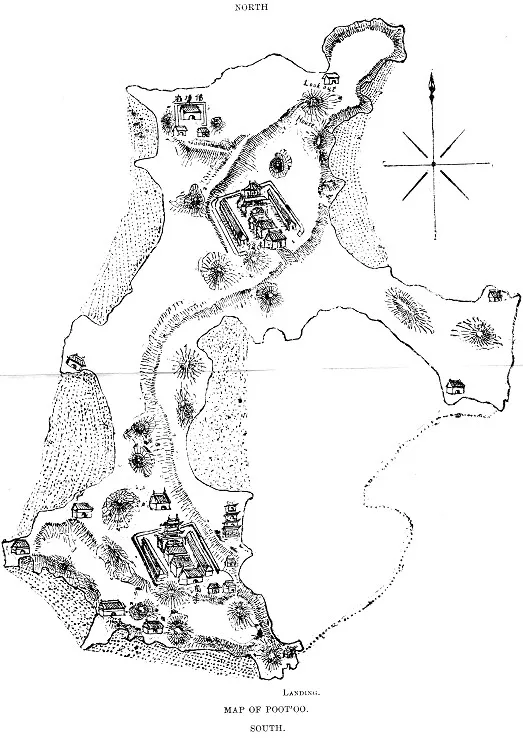
MAP OF POOT'OO
This islet is one of the Chusan Archipelago, situated in the 30° North latitude and 122° 25´ East longitude. This archipelago includes over one hundred islands and takes its name from Chusan, the longest of the group, which is over twenty miles long and six to ten miles wide. Poot’oo lies a little over one mile east of the Whang Head, is irregular and curiously shaped, about four miles long and very narrow at some places. The ceaseless march of the ocean tide has washed away all arable soil until the bare granite rocks along the shore resisted their incursion, except in a few small sheltered bays, where sandy beaches offer delightful sea bathing. Above the jaggy beach, however, enough soil remains, covering the coarse granite, to produce a rich foliage to the summit. The view from Lookout House, the highest point, about 970 feet above the sea-level, athwart the ridges and down the valleys upon the bestudded main, is highly picturesque and extremely delightful.
On approaching the island the visitor is landed at the southern point upon a well-built stone jetty, from which a broad, well-paved road leads to the three main temples. The front is called Universal Salvation Temple. The rear is called Rain-Producing Temple, and there is another called Wisdom's Salvation Temple. Smaller roads branch off in all directions, leading to grottoes, temples, and shrines of all sizes and shapes. As of ancient Judah, it can indeed be said that "in the high places and on the hills and under every green tree" the gods are worshiped, and even in the rocks images are hewn. These walks are lined with large, shady trees, and aromatic shrubs diffuse the air with a pleasant fragrance.
The numerous inscriptions chiseled into rocks along the pathways are an evidence that the whole island is devoted to the propagation of the doctrine of the Goddess of Mercy. Here are a few specimens:
"With a reverent heart take a look. The Law of Buddha has sacred affinity. The Goddess regards all men with kindness. Even the stupid stones bow their heads. The Buddhist kingdom together ascends. Ascend and enter the region of formlessness. Ascend and behold the Bodhi—supreme wisdom. Illusory light rises in the East."
On a stone tablet set on the top of a hill are the following inscriptions:
"There is a sacred island on the sea. Over the sea there is a Buddhist kingdom. I put my trust in Amida Buddha. There is another world." On the opposite side of the tablet is the following:
"Only virtue is original. There is also Wisdom's Salvation Temple. With reverence be cautious not to kill living creatures. Do not pour hot water upon the ground, lest living creatures be injured, and when walking, be careful not to step on anything living. Such is the heart of the Great Conveyance and of Supreme Wisdom, necessary to the enlightenment of Buddha. With uprightness of heart cultivate the body. Be most careful to guard against avariciousness. If these worldly desires are not entirely exhausted the sacred fruit is not complete. Let all under heaven give reverence, and ascend to the other shore. Read good books and speak good words. Do good deeds and be good men. Imitate good examples and retain a good heart. Read the Buddhist ritual and worship Buddha. Abstain from meat with a reverent purpose, and do good in abundance."
In a conspicuous place the following exhortation is inscribed:
"In a Buddhist Classic there is a law in which it is said, 'kill not.' In explanation of this observe: above there are all kinds of gods, holy men, teachers, monks, and parents; below there are four footed beasts, birds, wriggling worms, and small insects. All that has life should not intentionally be killed. In this classic it is also said: `The winter months breed lice, take them and put them into a bamboo joint, keep them warm with cotton, and give them oily food to eat lest they might freeze or starve.' Such is the doctrine of the Goddess of Mercy."
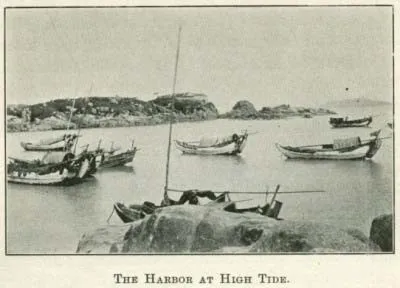
THE HARBOR AT HIGH TIDE
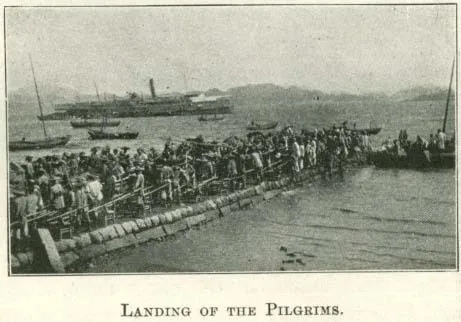
LANDING OF THE PILGRIMS
Following the path that leads eastward along the shore until the northeastern point is reached, a place of unusual interest is seen, called the Fan Yin Tung (Buddhist Echo Cave). In an almost perpendicular rock, over one hundred feet high, is a wide cleft extending back into the rock so far that the end can not be seen from the temple bridge built across the chasm about midway. When the waves dash. against the rocks at the bottom of this cliff, and the sun shines upon the spray and mist rising up into the clefted rock, a natural phenomenon appears, the colors similar to those produced by the sun's rays falling upon raindrops are seen. The devout Buddhists firmly believe that this natural appearance is a living Buddha. A priest said to us, "Only believers can see him." When visiting this place, two elderly women were worshiping upon this temple bridge. After making their prostrations facing the cleft, the old Taoist recluse in charge of this shrine directed their attention to the place where the Buddha would appear. They looked, and they looked, until nature was in their favor, and the sun broke through the clouds, and they saw their heart's desire—the Living Buddha —a fraction of the rainbow.
Because of this belief, in the early days of Buddhism, many devout believers cast themselves down over this precipice in the hope of thus attaining to Buddhahood. A magistrate of Ting-hai, hearing of this, wrote a proclamation in which he exhorted the people not to act so foolishly. He assured them that all who cast themselves down over this precipice would not be protected by the goddess, and would obtain no benefit; but the people did as before. Then he wrote a book and called the attention of the public to the moral nature of this abuse. "They who injure their bodies," said he, "injure their parents, and can not be considered filial. Think of the harm to yourselves in throwing your bodies among those rocks, where they will be dashed in pieces by the waves and eaten by the fish. And think of your families, your fathers and mothers, your wives and children. You came here to worship the Goddess of Mercy, to obtain blessings for your home, and word comes that you have destroyed yourselves. What grief! What sorrow! The goddess does not want such offerings; she herself will be distressed. If any want to sacrifice their lives, let them do so upon the altar of their country, and all will know that some good has come to the world through their devotion. As your official, I consider it my duty thus to exhort you." This book had its desired effect.
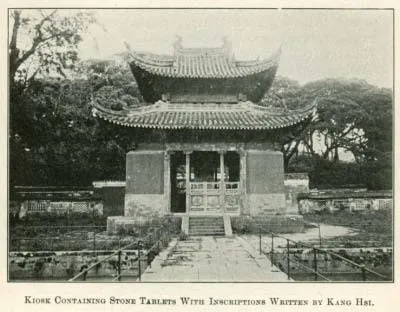
KIOSK CONTAINING STONE TABLETS WITH INSCRIPTIONS WRITTEN BY KANG HSI.
Since then the government of this island has become independent of civil jurisdiction, being ruled by the abbots of the chief monasteries. The abbot of the Rear Temple seems to possess more than ordinary business ability, judging from the clean and orderly condition of this temple. He is said to be an ex-compradore of Ningpo and Shanghai. Their mode of government is much the same as the civil government. A priest at Futing-san told us that even the power of administering capital punishment was in their hands, but the island being the home of supernatural beings and so many gods spreading spiritual light, corporeal punishment was seldom required. This priest had an exalted opinion of the deep spiritual enlightenment of their fraternity. When he was asked whether the older priests admonished and exhorted the younger, he indignantly replied: "How can we be exhorted when we have once comprehended the doctrine!"
The next point of interest was the many miraculous legends told and believed by the people. The most of them have the coloring of historical authenticity, giving names and dates, but they lack in credibility. The oldest reach back as far as the T’ang Dynasty. We can only give a few:
The Emperor Tai Ho, who reigned near the middle of the ninth century, 827–836, was said to be passionately fond of holi, a species of clam. So the people of these isles yearly sent him all they could gather, even greatly overtaxing themselves for their Emperor. One day, as he was eating of his favorite dish, he found one with a hard shell which he could not open. He cleaved it with a knife and found within an image of the Goddess of Mercy. When he saw this he was frightened, and commanded that the image be incased in a sandalwood casket, overlaid with gold, and placed in the Imperial palace. Then he asked a priest named Wei Chen what this meant. The priest replied: "The goddess desires to open thy heart that thou mayest be temperate in all thy desires." Whereupon the Emperor no longer pressed the people to send him clams, and issued a proclamation that an image of the goddess should be placed in every temple.
Another story is told of the same period, that a priest burned his fingers to show his zeal for the goddess. When his fingers were almost burned off, she appeared to him and comforted him for his faith and devotion.
During the Posterior Liang Dynasty, in the reign of Chen Ming, 915, a Japanese priest named Hui Ngo brought an image of the goddess from Wutai, and was going with it to his home in Japan. When his boat came into the sea of the water lilies, near Poot’oo, it was in danger of being wrecked. So the priest prayed to her and said: "If it is thy pleasure to go with me to my country, I am willing to go with thee wheresoever thou wilt have me to go." After this the boat smoothly glided on its way, and soon came to the landing in front of the Chao Yin Tung, the Tidal Echo Cave. Below the cave lived a man named Chang, who gave his own house to the priest for a temple, and the temple was named "The Unwilling to Depart Goddess of Mercy Temple." It is not now in existence.
In the Sung Dynasty, the Emperor Yüan Fêng, in the third year of his reign, 1081, sent a minister named Wang Shun-fung to Corea. On his way he encountered a terrific storm, and a large sea monster came to overthrow his boat. Terrified he prayed; as he was looking intently toward the cave in the distant island he saw the goddess coming out of the cave, dressed in gold apparel and adorned with rich jewels. Immediately the monster left him and the sea was calm. He returned in peace and informed the Emperor of his experience, who ordered the place to be called the "Precious Declivity."
In the Sung Dynasty, the Emperor Ch’ung Ning, in the year 1102, sent two Ministers of State to Corea, named Lin and Wu. On their return they passed through the Chusan Archipelago. When sailing among the islands, a dense darkness came upon them, and for four days they did not see either sun or moon. In their distress they remembered the goodness of Goddess of Mercy on Poot’oo, and they worshiped, when suddenly the surface of the sea was illuminated with a brilliant light, and they proceeded rejoicingly on their way, and soon saw Chao pao san, the Hill of Precious Beckoning, near Ningpo, from which they went to the mainland.
During the Southern Sung Dynasty, the Emperor Lung Hsin, in the year 1163, dreamed that he was in Poot’oo, where he saw many wonderful signs of the greatness of the Goddess of Mercy. After this he composed an ode in which he praised her greatness, ascribing to her the ability of accommodating all persons, and of being able to reveal all mysterious doctrine. And he called upon all his subjects to do her homage, for no other god was equal to her in wisdom and goodness, promising to all men what they prayed for. "Her mystery man can never understand," he exclaimed.
In connection with the image which refused to go with Hui Ngo to Japan another story is told. This image was continually working miracles, so that the people of other places and cities also desired her patronage. Whereupon a certain priest came to Poot’oo, bought a good piece of sandalwood, entered the temple and closed the door. He worked for one month, carving a facsimile image and disappeared with his newly-carved goddess. In the Southern Sung Dynasty, during the first year of the Emperor Chia Ting, 1208, the image which the priest had carved lost a finger. When the priest in whose temple the image was at this time saw the mutilated limb he was terrified. In his agony, as he was looking towards Poot’oo, behold a flower came floating along from the shore below the cave, bearing the missing member. This image is now in Chao ying tung.
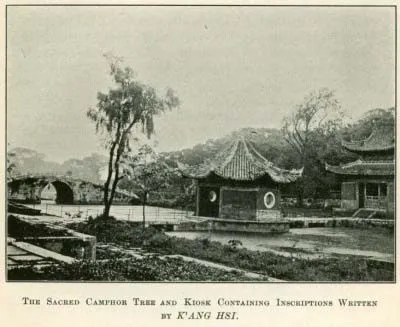
THE SACRED CAMPHOR TREE AND KIOSK CONTAINING INSCRIPTIONS WRITTEN BY K’ANG HSI.
In the Southern Sung Dynasty the Emperor Hsien Shun, during the year 1265, had a high official named Fan, who had diseased eyes. He sent his son to Poot’oo to pray. The prince brought some water from a spring below Chao ying tung, with which the statesman washed himself and was cured. Again the Emperor sent his son to offer thanks to the goddess. Having discharged his obligations, he was sitting by the cave when the goddess revealed herself in a cloud of smoke in which she was veiled. When the young prince came to another cave he saw the servants of the goddess standing face to face by his side. They were dressed in white garments with crowns upon their heads, both looking towards him as if they wished to speak.
The following two legends are assigned to the Yuan Dynasty. In the thirteenth year of the emperor Chih Yüan, A.D. 1264, a high official was sent with a Lama priest to the Southern isles to restore order. Upon his arrival he expected to see the goddess as others had seen her, and when no vision appeared he was angry and shot an arrow into the cave and took his departure. On his homeward way he was surrounded by water lilies so dense that all progress was impossible. Fear fell upon the warrior, and he repen...
Table of contents
- ACKNOWLEDGMENT.
- EARLY BUDDHISM IN HWANG MEI
- NGN REN TSZ—THE MONASTERY OF BENEVOLENCE
- KIU HUA SHAN—OR THE NINE-LOTUSFLOWER MOUNTAIN
- POOT’OO: CHINA'S SACRED ISLAND
- THE WHITE DEER GROTTO UNIVERSITY
- THE MANDARIN'S GRAVE
- LUNG-HU SHAN—THE DRAGON-TIGER MOUNTAIN
- CONCLUSIONS
Frequently asked questions
Yes, you can cancel anytime from the Subscription tab in your account settings on the Perlego website. Your subscription will stay active until the end of your current billing period. Learn how to cancel your subscription
No, books cannot be downloaded as external files, such as PDFs, for use outside of Perlego. However, you can download books within the Perlego app for offline reading on mobile or tablet. Learn how to download books offline
We are an online textbook subscription service, where you can get access to an entire online library for less than the price of a single book per month. With over 1.5 million books across 990+ topics, we’ve got you covered! Learn about our mission
Look out for the read-aloud symbol on your next book to see if you can listen to it. The read-aloud tool reads text aloud for you, highlighting the text as it is being read. You can pause it, speed it up and slow it down. Learn more about Read Aloud
Yes! You can use the Perlego app on both iOS and Android devices to read anytime, anywhere — even offline. Perfect for commutes or when you’re on the go.
Please note we cannot support devices running on iOS 13 and Android 7 or earlier. Learn more about using the app
Please note we cannot support devices running on iOS 13 and Android 7 or earlier. Learn more about using the app
Yes, you can access Sacred Places In China by Carl F. Kupfer in PDF and/or ePUB format, as well as other popular books in Architecture & Religious Architecture. We have over 1.5 million books available in our catalogue for you to explore.