- English
- ePUB (mobile friendly)
- Available on iOS & Android
eBook - ePub
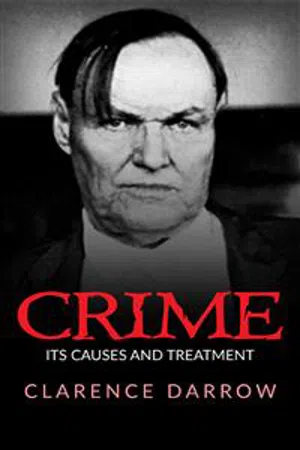
Crime, Its Cause And Treatment
About this book
TABLE OF CONTENTS
PREFACE
1. WHAT IS CRIME?
2. PURPOSE OF PUNISHMENT
3. RESPONSIBILITY FOR CRIME
4. ENVIRONMENT
5. ADJUSTING HEREDITY AND ENVIRONMENT
6. PSYCHOLOGY OF CRIMINAL CONDUCT
7. THE CRIMINAL
8. THE FEMALE CRIMINAL
9. JUVENILE CRIMINALS
10. HOMICIDE
11. SEX CRIMES
12. ROBBERY AND BURGLARY
13. MAN AS A PREDATORY ANIMAL
14. CRIMES AGAINST PROPERTY
15. ATTITUDE OF THE CRIMINAL
16. THE LAW AND THE CRIMINAL
17. REPEALING LAWS 18. IS CRIME INCREASING?
19. MEDICAL EXPERTS
20. PUNISHMENT
21. THE EFFECT OF PUNISHMENT ON OTHERS
22. EVOLUTION OF PUNISHMENT
23. CAPITAL PUNISHMENT
24. STIGMATA OF THE CRIMINAL
25. THE GOOD IN CRIMINALS
26. THE DEFECTIVE AND INSANE
27. SOCIAL CONTROL
28. INDUSTRIALISM AND CRIME
29. WAR AND CRIME
30. CIVILIZATION AND CRIME
31. THE CONVICT
32. ISOLATION AND STERILIZATION
33. CRIME, DISEASE AND ACCIDENT
34. LUCK AND CHANCE
35. PARDONS AND PAROLES
36. REMEDIES
Information
Topic
Ciencias socialesSubtopic
Criminología1. WHAT IS CRIME?
There can be no sane discussion of "crime" and "criminals" without an investigation of the meaning of the words. A large majority of men, even among the educated, speak of a "criminal" as if the word had a clearly defined meaning and as if men were divided by a plain and distinct line into the criminal and the virtuous. As a matter of fact, there is no such division, and from the nature of things, there never can be such a line.
Strictly speaking, a crime is an act forbidden by the law of the land, and one which is considered sufficiently serious to warrant providing penalties for its commission. It does not necessarily follow that this act is either good or bad; the punishment follows for the violation of the law and not necessarily for any moral transgression. No doubt most of the things forbidden by the penal code are such as are injurious to the organized society of the time and place, and are usually of such a character as for a long period of time, and in most countries, have been classed as criminal. But even then it does not always follow that the violator of the law is not a person of higher type than the majority who are directly and indirectly responsible for the law.
It is apparent that a thing is not necessarily bad because it is forbidden by the law. Legislators are forever repealing and abolishing criminal statutes, and organized society is constantly ignoring laws, until they fall into disuse and die. The laws against witchcraft, the long line of "blue laws," the laws affecting religious beliefs and many social customs, are well-known examples of legal and innocent acts which legislatures and courts have once made criminal. Not only are criminal statutes always dying by repeal or repeated violation, but every time a legislature meets, it changes penalties for existing crimes and makes criminal certain acts that were not forbidden before.
Judging from the kind of men sent to the State legislatures and to Congress, the fact that certain things are forbidden does not mean that these things are necessarily evil; but rather, that politicians believe there is a demand for such legislation from the class of society that is most powerful in political action. No one who examines the question can be satisfied that a thing is intrinsically wrong because it is forbidden by a legislative body.
Other more or less popular opinions of the way to determine right or wrong are found to be no more satisfactory. Many believe that the question of whether an act is right or wrong is to be settled by a religious doctrine; but the difficulties are still greater in this direction. First of all, this involves a thorough and judicial inquiry into the merits of many, if not all, forms of religion, an investigation which has never been made, and from the nature of things cannot be made. The fact is, that one's religious opinions are settled long before he begins to investigate and quite by other processes than reason. Then, too, all religious precepts rest on interpretation, and even the things that seem the plainest have ever been subject to manifold and sometimes conflicting construction. Few if any religious commands can be, or ever were, implicitly relied on without interpretation. The command, "Thou shalt not kill," seems plain, but does even this furnish an infallible rule of conduct?
Of course this commandment could not be meant to forbid killing animals. Yet there are many people who believe that it does, or at least should. No Christian state makes it apply to men convicted of crime, or against killing in war, and yet a considerable minority has always held that both forms of killing violate the commandment. Neither can it be held to apply to accidental killings, or killings in self-defense, or in defense of property or family. Laws, too, provide all grades of punishment for different kinds of killing, from very light penalties up to death. Manifestly, then, the commandment must be interpreted, "Thou shalt not kill when it is wrong to kill," and therefore it furnishes no guide to conduct. As well say: "Thou shalt do nothing that is wrong." Religious doctrines do not and clearly cannot be adopted as the criminal code of a state.
In this uncertainty as to the basis of good and bad conduct, many appeal to "conscience" as the infallible guide. What is conscience? It manifestly is not a distinct faculty of the mind, and if it were, would it be more reliable than the other faculties? It has been often said that some divine power implanted conscience in every human being. Apart from the question of whether human beings are different in kind from other organisms, which will be discussed later, if conscience has been placed in man by a divine power, why have not all peoples been furnished with the same guide? There is no doubt that all men of any mentality have what is called a conscience; that is, a feeling that certain things are right, and certain other things are wrong. This conscience does not affect all the actions of life, but probably the ones which to them are the most important. It varies, however, with the individual. What reason has the world to believe that conscience is a correct guide to right and wrong?
The origin of conscience is easily understood. One's conscience is formed as his habits are formed—by the time and place in which he lives; it grows with his teachings, his habits and beliefs. With most people it takes on the color of the community where they live. With some people the eating of pork would hurt their conscience; with others the eating of any meat; with some the eating of meat on Friday, and with others the playing of any game of chance for money, or the playing of any game on Sunday, or the drinking of intoxicating liquors. Conscience is purely a matter of environment, education and temperament, and is no more infallible than any habit or belief. Whether one should always follow his own conscience is another question, and cannot be confounded with the question as to whether conscience is an infallible guide to conduct.
Some seek to avoid the manifold difficulties of the problem by saying that a "criminal" is one who is "anti-social." But does this bring us nearer to the light? An anti-social person is one whose life is hostile to the organization or the society in which he lives; one who injures the peace, contentment, prosperity or well-being of his neighbors, or the political or social organization in which his life is cast.
In this sense many of the most venerated men of history have been criminals; their lives and teachings have been in greater or lesser conflict with the doctrines, habits and beliefs of the communities where they lived. From the nature of things the wise man and the idealist can never be contented with existing things, and their lives are a constant battle for change. If the anti-social individual should be punished, what of many of the profiteers and captains of industry who manipulate business and property for purely selfish ends? What of many of our great financiers who use every possible reform and conventional catch word as a means of affecting public opinion, so that they may control the resources of the earth and exploit their fellows for their own gain?
No two men have the same power of adaptation to the group, and it is quite plain that the ones who are the most servile and obedient to the opinions and life of the crowd are the greatest enemies to change and individuality. The fact is, none of the generally accepted theories of the basis of right and wrong has ever been the foundation of law or morals. The basis that the world has always followed, and perhaps always will accept, is not hard to find.
The criminal is the one who violates habits and customs of life, the "folk-ways" of the community where he lives. These customs and folkways must be so important in the opinion of the community as to make their violation a serious affair. Such violation is considered evil regardless of whether the motives are selfish or unselfish, good or bad. The folk-ways have a certain validity and a certain right to respect, but no one who believes in change can deny that they are a hindrance as well as a good. Men did not arrive at moral ideas by a scientific or a religious investigation of good and bad, of right and wrong, of social or anti-social life.
Man lived before he wrote laws, and before he philosophized. He began living simply and automatically; he adopted various "taboos" which to him were omens of bad luck, and certain charms, incantations and the like, which made him immune from ill-fortune.
All sorts of objects, acts and phenomena have been the subjects of taboo, and just as numerous and weird have been the charms and amulets and ceremonies that saved him from the dangers that everywhere beset his way. The life of the primitive human being was a journey down a narrow path; outside were infinite dangers from which magic alone could make him safe.
All animal life automatically groups itself more or less closely into herds. Buffaloes, horses and wolves run in packs. Some of these groups are knit closely together like ants and bees, while the units of others move much more widely apart. But whatever the group may be, its units must conform. If the wolf gets too far from the pack it suffers or dies; it matters not whether it be to the right or the left, behind or ahead, it must stay with the pack or be lost.
Men from the earliest time arranged themselves into groups; they traveled in a certain way; they established habits and customs and ways of life. These "folk-ways" were born long before human laws and were enforced more rigidly than the statutes of a later age. Slowly men embodied their "taboos," their incantations, their habits and customs into religions and statutes. A law was only a codification of a habit or custom that long ago was a part of the life of a people. The legislator never really makes the law; he simply writes in the books what has already become the rule of action by force of custom or opinion, or at least what he thinks has become a law.
One class of men has always been anxious to keep step with the crowd. The way is easier and the rewards more certain. Another class has been skeptical and resentful of the crowd. These men have refused to follow down the beaten path; they strayed into the wilderness seeking new and better ways. Sometimes others have followed and a shorter path was made. Often they have perished because they left the herd. In the sight of the organized unit and the society of the time and place, the man who kept the path did right. The man who tried to make a new path and left the herd did wrong. In its last analysis, the criminal is the one who leaves the pack. He may lag behind or go in front, he may travel to the right or to the left, he may be better or worse, but his fate is the same.
The beaten path, however formed or however unscientific, has some right to exist. On the whole it has tended to preserve life, and it is the way of least resistance for the human race. On the other hand it is not the best, and the way has ever been made easier by those who have violated precepts and defied some of the concepts of the time. Both ways are right and both ways are wrong. The conflict between the two ways is as old as the human race.
Paths and customs and institutions are forever changing. So are ideas of right and wrong, and so, too, are statutes. The law, no doubt, makes it harder for customs and habits to be changed, for it adds to the inertia of the existing thing.
Is there, then, nothing in the basis of right and wrong that answers to the common conception of these words? There are some customs that have been forbidden longer and which, it seems, must necessarily be longer prohibited; but the origin of all is the same. A changing world has shown how the most shocking crimes punished by the severest penalties have been taken from the calendar and no longer even bear the suspicion of wrong. Religious differences, witchcraft and sorcery have probably brought more severe punishments than any other acts; yet a change of habit and custom and belief has long since abolished all such crimes. So, too, crimes come and go with new ideals, new movements and conditions. The largest portion of our criminal code deals with the rights of property; yet nearly all of this is of comparatively modern growth. A new emotion may take possession of man which will result in the repeal of many if not all of these statutes, and place some other consideration above property, which seems to be the controlling emotion of today.
Crime, strictly speaking, is only such conduct or acts as are forbidden by the law and for which penalties are prescribed. The classification of the act does not necessarily have relation to moral conduct. This cannot be fixed by any exact standard. There is no straight clear line between the good and bad, the right and wrong. The general ways of determining good and bad conduct are of little value. The line between the two is always uncertain and shifting. And, in the last analysis, good or bad conduct rests upon the "folk-ways," the habits, beliefs and customs of a community. While this is the real basis of judging conduct, it is always changing, and from the nature of things, if it could be made stable, it would mean that society was stratified and all hope of improvement dead.
2. PURPOSE OF PUNISHMENT
Neither the purpose nor the effect of punishment has ever been definitely agreed upon, even by its most strenuous advocates. So long as punishment persists it will be a subject of discussion and dispute. No doubt the idea of punishment originated in the feeling of resentment and hatred and vengeance that, to some extent at least, is incident to life. The dog is hit with a stick and turns and bites the stick. Animals repel attack and fight their enemies to death. The primitive man vented his hatred and vengeance on things animate and inanimate. In the tribes no injury was satisfied until some member of the offending tribe was killed. In more recent times family feuds have followed down the generations and were not forgotten until the last member of a family was destroyed. Biologically, anger and hatred follow fear and injury, and punishment follows these in turn. Individuals, communities and whole peoples hate and swear vengeance for an injury, real or fancied. Punishments, even to the extent of death, are inflicted where there can be no possible object except revenge. Whether the victim is weak or strong, old or young, sane or insane, makes no difference; men and societies react to injury exactly as animals react.
That vengeance is the moving purpose of punishment is abundantly shown by the religious teachings that shape the ethical ideas of the Western world. The Old Testament abounds in the justification of vengeance. A few quotations amply show the Biblical approval of this doctrine:
Whoso sheddeth man's blood, by man shall his blood be shed. Genesis 9;6.
No expiation can be made for the land for the blood that is shed therein, but by the blood of him that shed it. Numbers 35;33.
Wherefore should the nations [Gentiles] say, Where is their [the Jews'] God? Let the avenging of the blood of thy servants which is shed, be known among the nations in our sight. Psalms 79;10.
The righteous shall rejoice when he seeth the vengeance; he shall wash his feet in the blood of the wicked; so that men shall say, Verily there is a reward for the righteous, verily there is a God that judgeth in the earth. Psalms 58;10.
And I [God] will execute vengeance in anger and wrath upon the nations which hearkened not. Micah 5;15.
All things are cleansed with blood, and apart from the shedding of blood there is no remission. Hebrews 9;22.
For we know him that said, Vengeance belongeth unto me. ... It is a fearful thing to fall into the hands of the living God. Hebrews 10;30.
True it is often claimed that Jesus repudiated the doctrine of vengeance. The passage of 5th Matthew, 38-30 is often quoted in proof of this assertion—"Ye have heard that it hath been said, an eye for an eye and a tooth for a tooth. But I say unto you, that ye resist not evil, but whosoever shall smite thee on thy right cheek, turn to him the other also." But the gospels and the other books of the New Testament show plainly that non-resistance was not laid down as a rule for the guidance of mankind, but only as a policy by one sect of the Jews and Christians to save themselves from the Romans. The reason for the doctrine was the belief that resistance was hopeless, and that God who had the power would in his own time visit on the oppressors the vengeance that the Jews and Christians were too weak to inflict. Jesus and the early Christians knew of no people beyond their immediate territory, and they did not appeal to mankind as a whole, or to future generations.
The early Christians believed in judging and in punishment as vengeance, the same as the Jews and other peoples believed in it. (See 13 Matthew 41-43, 23 Matthew 33, 25 Matthew 46.) They believed that the end of the world was at hand; that the coming of the Lord was imminent; that some of that generation would not taste death, and that God would punish sinners in his own time. The New Testament is replete with this doctrine, which was stated and elaborated in the socalled "Revelations of St. Peter."
Probably this document was composed about the year 150 A.D. and by the year 200 it was read as "Scripture" in some Christian communities. Subsequently it disappeared and was known only by name until a substantial fragment of the document was discovered at Akhmim in Egypt, in the year 1887. A portion of it represents a scene in which the disciples of Jesus ask him to show them the state of the righteous dead, in order that this knowledge may be used to encourage people to accept Christianity. The request is granted and the disciples are shown not only a vision of the delightful abodes of the righteous, but also a vivid picture of the punishments that are being meted out to the wicked. It is interesting to note how the punishments are devised to balance in truly retributive fashion the crimes mentioned. It is this type of tradition that furnished Dante and Milton the basis for their pictures of hell.
The following is the more interesting portion of this document:
And the Lord showed me [Peter] a very great country outside of this world, exceeding bright with light, and the air there lighted with rays of the sun, and the earth itself blooming with unfading flowers and full of spices and plants, fair-flowering and incorruptible and bearing blessed fruit. And so great was the perfume that it was borne thence even unto us. And the dwellers in that place were clad in the raiment of shining angels and their raiment was like unto their country; and angels hovered about them there. And the glory of the dwellers there was equal, and with one voice they sang praises alternately to the Lord God, rejoicing in that place. The Lord said to us, This is the place of your brethren the righteous.
And over against that place I saw another, exceedingly parched, and it was the place of punishment. And those who were being punished there and the angels who punished them wore dark raiment like the air of the place.
Certain persons there were hanging by the tongue. These were they who blaspheme the way of righteousness, and under them lay a fire whose flames tortured them.
Also there was a great lake full of flaming mire in which were certain men that pervert righteousness, and tormenting angels afflicted them.
And there were also others, women, hanged by their hair over that mire that flamed up, and these were they who adorned themselves for adultery. And the men who mingled with them in the defilement of adultery, were hanging by the feet with their heads in that mire, and they exclaimed in a loud voice: We did not believe that we should come to this place.
And I saw the murderers and their accomplices cast into a certain narrow place full of evil snakes where these evil beasts smote them while they turned to and fro in that punishment, and worms like great black clouds afflicted them. And the souls of those who had been murdered said, as they stood and looked upon the punishment of their murderers, O God, just is thy judgment.
And other men and women were aflame up to the middle, and were cast into a dark place and were beaten by evil spirits, and their inwards were eaten by restless worms. These were they who persecuted the righteous and delivered them up to the authorities.
And over against these were other men and women gnawing their tongues and having flaming fire in their mouths. These were false witnesses.
And in a certain other place there were pebbles sharper than swords or any needle, red hot, and women and men in tattered and filthy raiment, rolled about on them in pu...
Table of contents
- PREFACE
- 1. WHAT IS CRIME?
- 2. PURPOSE OF PUNISHMENT
- 3. RESPONSIBILITY FOR CRIME
- 4. ENVIRONMENT
- 5. ADJUSTING HEREDITY AND ENVIRONMENT
- 6. PSYCHOLOGY OF CRIMINAL CONDUCT
- 7. THE CRIMINAL
- 8. THE FEMALE CRIMINAL
- 9. JUVENILE CRIMINALS
- 10. HOMICIDE
- 11. SEX CRIMES
- 12. ROBBERY AND BURGLARY
- 13. MAN AS A PREDATORY ANIMAL
- 14. CRIMES AGAINST PROPERTY
- 15. ATTITUDE OF THE CRIMINAL
- 16. THE LAW AND THE CRIMINAL
- 17. REPEALING LAWS
- 18. IS CRIME INCREASING?
- 19. MEDICAL EXPERTS
- 20. PUNISHMENT
- 21. THE EFFECT OF PUNISHMENT ON OTHERS
- 22. EVOLUTION OF PUNISHMENT
- 23. CAPITAL PUNISHMENT
- 24. STIGMATA OF THE CRIMINAL
- 25. THE GOOD IN CRIMINALS
- 26. THE DEFECTIVE AND INSANE
- 27. SOCIAL CONTROL
- 28. INDUSTRIALISM AND CRIME
- 29. WAR AND CRIME
- 30. CIVILIZATION AND CRIME
- 31. THE CONVICT
- 32. ISOLATION AND STERILIZATION
- 33. CRIME, DISEASE AND ACCIDENT
- 34. LUCK AND CHANCE
- 35. PARDONS AND PAROLES
- 36. REMEDIES
Trusted by 375,005 students
Access to over 1.5 million titles for a fair monthly price.
Study more efficiently using our study tools.
Frequently asked questions
Yes, you can cancel anytime from the Subscription tab in your account settings on the Perlego website. Your subscription will stay active until the end of your current billing period. Learn how to cancel your subscription
No, books cannot be downloaded as external files, such as PDFs, for use outside of Perlego. However, you can download books within the Perlego app for offline reading on mobile or tablet. Learn how to download books offline
Perlego offers two plans: Essential and Complete
- Essential is ideal for learners and professionals who enjoy exploring a wide range of subjects. Access the Essential Library with 800,000+ trusted titles and best-sellers across business, personal growth, and the humanities. Includes unlimited reading time and Standard Read Aloud voice.
- Complete: Perfect for advanced learners and researchers needing full, unrestricted access. Unlock 1.5M+ books across hundreds of subjects, including academic and specialized titles. The Complete Plan also includes advanced features like Premium Read Aloud and Research Assistant.
We are an online textbook subscription service, where you can get access to an entire online library for less than the price of a single book per month. With over 1.5 million books across 990+ topics, we’ve got you covered! Learn about our mission
Look out for the read-aloud symbol on your next book to see if you can listen to it. The read-aloud tool reads text aloud for you, highlighting the text as it is being read. You can pause it, speed it up and slow it down. Learn more about Read Aloud
Yes! You can use the Perlego app on both iOS and Android devices to read anytime, anywhere — even offline. Perfect for commutes or when you’re on the go.
Please note we cannot support devices running on iOS 13 and Android 7 or earlier. Learn more about using the app
Please note we cannot support devices running on iOS 13 and Android 7 or earlier. Learn more about using the app
Yes, you can access Crime, Its Cause And Treatment by Clarence Darrow in PDF and/or ePUB format, as well as other popular books in Ciencias sociales & Criminología. We have over 1.5 million books available in our catalogue for you to explore.