- English
- ePUB (mobile friendly)
- Available on iOS & Android
eBook - ePub
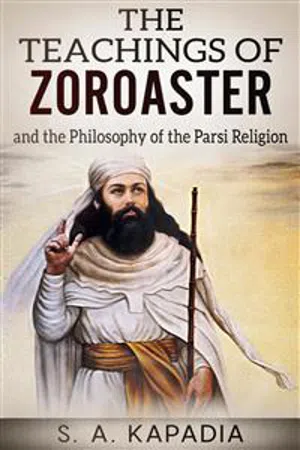
The Teachings Of Zoroaster
About this book
The Iranian prophet and reformer Zarathustra (Greek: Zoroaster) founded his religion in the 6th Century BC. In a series of visions he was taken up to Heaven and Ahura Mazda - creator of all that is good - charged him with enlisting Humanity in the fight against Aura Mainyu - the principle of chaos and destruction - offering Mankind a free choice between Good and Evil. It is hard to overstate the importance of Zoroastrianism. According to Professor of Iranian Studies Dr Mary Boyce: "It was the first to teach the doctrines of an individual judgment, Heaven and Hell, the future resurrection of the body, the general Last Judgment, and life everlasting for the reunited soul and body." 'The Teachings of Zoroaster' is an excellent introduction to this little-known and often misunderstood religion, giving Zoroastrianism its rightful place as the precursor of many Christian, Judaic and Islamic beliefs.
Information
Topic
Theology & ReligionSubtopic
ReligionEXTRACTS
PURITY 23
"Purity is for man, next to life, the greatest good that purity is procured by the law of Mazda to him who cleanses his own self with Good Thoughts, Words, and Deeds.
"Make thyself pure, O righteous man! Any one in the world here below can win purity for himself, namely, when he cleanses himself with Good Thoughts, Good Words, and Good Deeds."
PRAYER OF ASHEM-VOHU 24
FROM KHORDAH-AVESTA
- "Purity is the best good.
- "Happiness, happiness is to him:
- "Namely, to the most pure in purity."
THE LAW OF AHURA-MAZDA 25
". . . The law of Mazda cleanses the faithful from every evil thought, word, and deed, as a swift-rushing, mighty wind cleanses the plain.
. . . . .
"So let all deeds thou doest be henceforth good. . . . A full atonement for thy sin is effected by means of the law of Mazda."
COMMANDMENTS FOR THE BODY AND THE SOUL 26
The sage asked the Spirit of Wisdom thus: "How is it possible to seek maintenance and prosperity of the body without injury of the soul, and the preservation of the soul without injury of the body?"
The Spirit of Wisdom answered thus: "Him who is less than thee consider as an equal, and an equal as a superior, and a greater than him as a chieftain, and a chieftain as a ruler. And among rulers one is to be acquiescent, obedient, and true-speaking; and among accusers be submissive, mild, and kindly regardful.
"Commit no slander; so that infamy and wickedness may not happen unto thee. For it is said that slander is more grievous than witchcraft.
. . . . .
"Form no covetous desire, so that the demon of greediness may not deceive thee, and the treasure of the world may not be tasteless to thee.
"Indulge in no wrathfulness, for a man when he indulges in wrath becomes then forgetful of his duty and good works . . . and sin and crime of every kind occur unto his mind, and until the subsiding of the wrath he is said to be just like Ahareman. 27
"Suffer no anxiety, for he who is a sufferer of anxiety becomes regardless of enjoyment of the world and the spirit, and contraction happens to his body and soul.
"Commit no lustfulness, so that harm and regret may not reach thee from thine own actions.
"Bear no improper envy, so that thy life may not become tasteless.
. . . . .
"Practice no sloth, so that the duty and good work, which it is necessary for thee to do, may not remain undone.
"Choose a wife who is of character, because that one is good who in the end is more respected.
. . . . .
"Thou shouldst be DILIGENT and MODERATE, and EAT OF THINE OWN REGULAR INDUSTRY, and provide the share of the sacred beings and the good; and thus the practice of this in thy occupation is the greatest good work.
. . . . .
"With enemies fight with equity. With a friend proceed with the approval of friends.
With a malicious man carry on no conflict, and do not molest him in any way whatever. With a greedy man thou shouldst not be a partner, and do not trust him with the leadership. With an ill-famed man form no connection. With an ignorant man thou shouldst not become a confederate and associate. With a foolish man make no dispute. With a drunken man do not walk on the road. From an ill-natured man take no loan.
. . . . .
"In forming a store of good works thou shouldst be diligent, so that it may come to thy assistance among the spirits.
"Thou shouldst not become presumptuous through any happiness of the world; for the happiness of the world is such-like as a (aloud that comes on a rainy day, which one does not ward off by any hill,
"Thou shouldst not become presumptuous through much treasure and wealth; for in the end it is necessary for thee to leave all.
. . . . .
"Thou shouldst not become presumptuous through great connections and race; for in the end thy trust is on thine own deeds.
"Thou shouldst not become presumptuous through life; for death comes upon thee at last, and the perishable part falls to the ground."
THE SOUL'S DESTINATION 28
- Zarathustra asked Ahura-Mazda: "Ahura-Mazda, Heavenly, Holiest, Creator of the corporeal world, Pure! when a pure man dies, where does his soul dwell during this night?"
- Then answered Ahura-Mazda: "Near his head it sits itself down, reciting the Gâthâ Ustavaiti, praying happiness for itself: 'Happiness be to the man who conduces to the happiness of each. May Ahura-Mazda create, ruling after His wish.' On this night the soul sees as much joyfulness as the whole living world possesses."
- "Where does the soul dwell throughout the second night?"
- Then answered Ahura-Mazda: "Near his head it sits itself," etc. (as in verse 2).
- "Where does his soul stay throughout the third night?"
- Then answered Ahura-Mazda: "Near his head it sits itself," etc. (as in verse 2).
- "When the lapse of the third night turns itself to light, then the soul of the pure man goes forward, recollecting itself at the perfume of plants. A wind blows to meet it from the mid-day region, a sweet-scented one, more sweet-scented than the other winds. . . . . .
- "In that wind there comes to meet him his own law in the figure of a maiden, one beautiful, shining, with shining arms; one powerful, well-grown, slender, with large breasts, praiseworthy body; one noble, with brilliant face, one of fifteen years, as fair in her growth as the fairest creatures.
- "Then to her (the maiden) speaks the soul of the pure man, asking: 'What maiden art thou whom I have seen here as the fairest of maidens in body?'
- "Then replies to him his own law: 'I am, O youth, thy good thoughts, words, and works, thy good law, thine own law of thine own body—which would be in reference to thee like in greatness, goodness, and beauty, sweet-smelling, victorious, harmless, as thou appearest to me.
- "Thou art like me, O well-speaking, well-thinking, well-acting youth, devoted to the good law, so in greatness, goodness, and beauty as I appear to thee. . . . . .
- "'Thou hast made the pleasant yet more pleasant to me, the fair yet fairer, the desirable yet more desirable, that sitting in a high place, sitting in a yet higher place, in these Paradises Humata, Hûkhta, Hvarsta (Paradises) . . . .
- "'The soul of the pure man goes the first step and arrives in (the Paradise) Humata; the soul of the pure man takes the second step and arrives at (the Paradise) Hûkhta; it goes the third step and arrives at (the Paradise) Hvarsta; the soul of the pure man takes the fourth step and arrives at the Eternal Lights.'"
- Zarathustra asked Ahura-Mazda: "Ahura-Mazda, Heavenly, Holiest, Creator of the corporeal world, Pure! when a wicked one dies, where does the soul dwell throughout this night?"
- Then answered Ahura-Mazda, "There, O pure Zarathustra, near the head it runs about whilst it utters the prayer Ké mánm, etc., 'Which land shall I praise, whither shall I go praying, O Ahura-Mazda?' In this night the soul sees as much displeasing as the whole living world.
- "When the lapse of the third night approaches towards light, O pure Zarathustra, then goes the soul of the wicked man to the impure place, recollecting itself continually by the stench. To it comes a wind blowing from the North Region, an evil-smelling one, more evil-smelling than other winds.
- "When the soul of the wicked man receives this wind into the nose, it goes (saying), 'Whence comes this wind which I smell with the nose as the most evil-smelling wind?'
. . . . .
33. "The fourth step takes the soul of the wicked man and it arrives at the darknesses without beginning."
THE SOUL'S RENDERING OF ACCOUNT 29
"The thirteenth question is that which you ask thus: Who should prepare the account of the soul as to sin and good works, and in what place should they make it up? And when punishment is inflicted by them, where is their place then?
"The reply is this, that the account about the doers of actions, as to good works and sin, three times every day whilst the doer of the actions is living, Vohûmano the archangel should prepare; because taking account of the thoughts, words, and deeds of all material existences is among his duties.
"And about the sin which affects accusers, which is committed by breakers of promises, even in the world Mitrô is said to be over the bodies, words, and fortunes of the promise-breakers; and as to the amount, and also as to being more than the stipulation...
Table of contents
- EDITORIAL NOTE
- AUTHOR'S PREFACE
- INTRODUCTION
- EXTRACTS
- NOTES
Trusted by 375,005 students
Access to over 1.5 million titles for a fair monthly price.
Study more efficiently using our study tools.
Frequently asked questions
Yes, you can cancel anytime from the Subscription tab in your account settings on the Perlego website. Your subscription will stay active until the end of your current billing period. Learn how to cancel your subscription
No, books cannot be downloaded as external files, such as PDFs, for use outside of Perlego. However, you can download books within the Perlego app for offline reading on mobile or tablet. Learn how to download books offline
Perlego offers two plans: Essential and Complete
- Essential is ideal for learners and professionals who enjoy exploring a wide range of subjects. Access the Essential Library with 800,000+ trusted titles and best-sellers across business, personal growth, and the humanities. Includes unlimited reading time and Standard Read Aloud voice.
- Complete: Perfect for advanced learners and researchers needing full, unrestricted access. Unlock 1.5M+ books across hundreds of subjects, including academic and specialized titles. The Complete Plan also includes advanced features like Premium Read Aloud and Research Assistant.
We are an online textbook subscription service, where you can get access to an entire online library for less than the price of a single book per month. With over 1.5 million books across 990+ topics, we’ve got you covered! Learn about our mission
Look out for the read-aloud symbol on your next book to see if you can listen to it. The read-aloud tool reads text aloud for you, highlighting the text as it is being read. You can pause it, speed it up and slow it down. Learn more about Read Aloud
Yes! You can use the Perlego app on both iOS and Android devices to read anytime, anywhere — even offline. Perfect for commutes or when you’re on the go.
Please note we cannot support devices running on iOS 13 and Android 7 or earlier. Learn more about using the app
Please note we cannot support devices running on iOS 13 and Android 7 or earlier. Learn more about using the app
Yes, you can access The Teachings Of Zoroaster by S. A. Kapadia in PDF and/or ePUB format, as well as other popular books in Theology & Religion & Religion. We have over 1.5 million books available in our catalogue for you to explore.