- English
- ePUB (mobile friendly)
- Available on iOS & Android
eBook - ePub
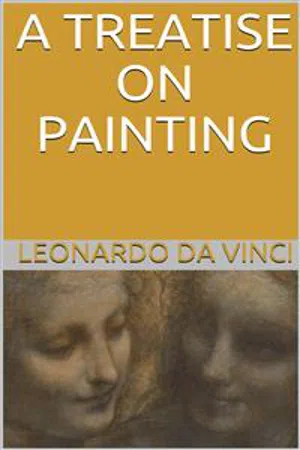
A Treatise on Painting (Illustrated)
About this book
The excellence of the following Treatise is so well known to all in any tolerable degree conversant with the Art of Painting, that it would be almost superfluous to say any thing respecting it, were it not that it here appears under the form of a new translation, of which some account may be expected.
Of the original Work, which is in reality a selection from the voluminous manuscript collections of the Author, both in folio and quarto, of all such passages as related to Painting, no edition appeared in print till 1651, though its Author died so long before as the year 1519; and it is owing to the circumstance of a manuscript copy of these extracts in the original Italian, having fallen into the hands of Raphael du Fresne; that in the former of these years it was published at Paris in a thin folio volume in that language, accompanied with a set of cuts from the drawings of Nicolo Poussin, and Alberti; the former having designed the human figures, the latter the geometrical and other representations.
Information
Topic
ArtSubtopic
Art TechniquesTable of Contents
DRAWING.
Chap. I.—What the young Student in Painting ought in the first Place to learn.
Chap. II.—Rule for a young Student in Painting.
Chap. III.—How to discover a young Man’s Dispositionfor Painting.
Chap. IV.—Of Painting, and its Divisions.
Chap. V.—Division of the Figure.
Chap. VI.—Proportion of Members.
Chap. VII.—Of Dimensions in general.
Chap. VIII.—Motion, Changes, and Proportion of Members.
Chap. IX.—The Difference of Proportion between Children and grown Men.
Chap. X.—The Alterations in the Proportion of the human Body from Infancy to full Age.
Chap. XI.—Of the Proportion of Members.
Chap. XII.—That every Partbe proportioned to its Whole.
Chap. XIII.—Of the Proportion of the Members.
Chap. XIV.—The Danger of forming an erroneous Judgment in regard to the Proportion and Beauty of the Parts.
Chap. XV.—Another Precept.
Chap. XVI.—The Manner of drawing from Relievos, and rendering Paper fit for it.
Chap. XVII.—Of drawing from Casts or Nature.
Chap. XVIII.—To draw Figures from Nature.
Chap. XIX.—Of drawing from Nature.
Chap. XX.—Of drawing Academy Figures.
Chap. XXI.—Of studying in the Dark, on first waking in the Morning, and before going to sleep.
Chap. XXII.—Observations on drawing Portraits.
Chap.XXIII.—The Method of retaining in the Memory the Likeness of a Man, so as to draw his Profile, after having seen him only once.
Chap. XXIV.—How to remember the Form of a Face.
Chap. XXV.—That a Painter should take Pleasure in the Opinion of every body.
ANATOMY.
Chap. XXVI.—What is principally to be observed in Figures.
Chap. XXVII.—Mode of Studying.
Chap. XXVIII.—Of being universal.
Chap. XXIX.—A Precept for the Painter.
Chap. XXX.—Of the Measures of the human Body, and the bending of Members.
Chap. XXXI.—Of the small Bones in several Joints of the human Body.
Chap. XXXII.—Memorandum to be observed by the Painter.
Chap. XXXIII.—The Shoulders.
Chap. XXXIV.—The Difference of Joints between Children and grown Men.
Chap. XXXV.—Of the Joints of the Fingers.
Chap. XXXVI.—Of the Joint of the Wrist.
Chap. XXXVII.—Of the Joint of the Foot.
Chap. XXXIX.—Of the Joints.
Chap. XL.—Of the Naked.
Chap. XLI.—Of the Thickness of the Muscles.
Chap. XLII.—Fat Subjects have small Muscles.
Chap. XLIII.—Which of the Muscles disappear in the different Motions of the Body.
Chap. XLIV.—Of the Muscles.
Chap. XLV.—Of the Muscles.
Chap. XLVI.—The Extension and Contraction of the Muscles.
Chap. XLVII.—Of the Muscle between the Chest and the lower Belly.
Chap. XLVIII.—Of a Man’s complex Strength, but first of the Arm.
Chap. XLIX.—In which of the twoActions, Pulling or Pushing, a ...
Table of contents
- DRAWING.
- INVENTION,or COMPOSITION.
- LIGHT and SHADOW.
- COLOURS and COLOURING.
- MISCELLANEOUS OBSERVATIONS.
Trusted by 375,005 students
Access to over 1.5 million titles for a fair monthly price.
Study more efficiently using our study tools.
Frequently asked questions
Yes, you can cancel anytime from the Subscription tab in your account settings on the Perlego website. Your subscription will stay active until the end of your current billing period. Learn how to cancel your subscription
No, books cannot be downloaded as external files, such as PDFs, for use outside of Perlego. However, you can download books within the Perlego app for offline reading on mobile or tablet. Learn how to download books offline
Perlego offers two plans: Essential and Complete
- Essential is ideal for learners and professionals who enjoy exploring a wide range of subjects. Access the Essential Library with 800,000+ trusted titles and best-sellers across business, personal growth, and the humanities. Includes unlimited reading time and Standard Read Aloud voice.
- Complete: Perfect for advanced learners and researchers needing full, unrestricted access. Unlock 1.5M+ books across hundreds of subjects, including academic and specialized titles. The Complete Plan also includes advanced features like Premium Read Aloud and Research Assistant.
We are an online textbook subscription service, where you can get access to an entire online library for less than the price of a single book per month. With over 1.5 million books across 990+ topics, we’ve got you covered! Learn about our mission
Look out for the read-aloud symbol on your next book to see if you can listen to it. The read-aloud tool reads text aloud for you, highlighting the text as it is being read. You can pause it, speed it up and slow it down. Learn more about Read Aloud
Yes! You can use the Perlego app on both iOS and Android devices to read anytime, anywhere — even offline. Perfect for commutes or when you’re on the go.
Please note we cannot support devices running on iOS 13 and Android 7 or earlier. Learn more about using the app
Please note we cannot support devices running on iOS 13 and Android 7 or earlier. Learn more about using the app
Yes, you can access A Treatise on Painting (Illustrated) by Leonardo da Vinci in PDF and/or ePUB format, as well as other popular books in Art & Art Techniques. We have over 1.5 million books available in our catalogue for you to explore.