The main purpose of this essay is to show that natural language, when contextualised, by its nature avoids the paradoxes and the shortcomings ascribed to it.
Preliminarily, I would like to put forward some hypotheses on the origin of language based on hypotheses inferred, in my opinion, in the writings of the American linguist, Noam Chomsky, and the American philosopher, Jerry Fodor. I also propose a simple, naturalist hypothesis on the origin of natural numbers and therefore of arithmetic.
- English
- ePUB (mobile friendly)
- Available on iOS & Android
eBook - ePub
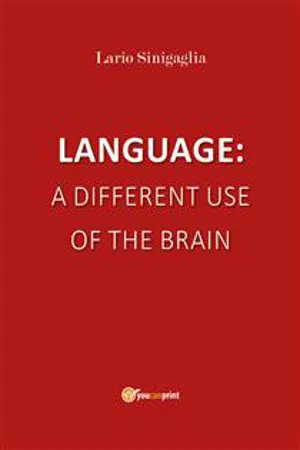
Language: a different use of the brain
About this book
Trusted by 375,005 students
Access to over 1.5 million titles for a fair monthly price.
Study more efficiently using our study tools.
Information
Topic
PhilosophySubtopic
Logic in Philosophy1) EDUCATION
A small child of a few years speaks, at ten they write correctly, and at 14 they can be held criminally liable and therefore are expected to know the rules of civilised life. These are the results of a thorough education provided in a civil context. But how did this all begin?
Darwinian evolution follows Homo sapiens back to about 200,000 years ago and, since we are also Homo sapiens, he could have been our grandfather who, even though he did not speak, did not write, nor use utensils and was therefore certainly much smarter than our actual grandfather in managing with his bare hands in an unimaginably hostile environment.
According to Noam Chomsky (1928), the great scholar of language, Homo sapiens began to speak quite suddenly around 60,000 years ago and he bases this hypothesis on the emergence at that time of archaeological finds that demonstrate the ability to symbolise the circumstances of human life, relatively complex societies, as well as the population’s greater dynamism for growth and migration (Noam Chomsky and James McGilvray, The Science of Language. Interviews with James McGilvray, 2012, Italian translation published by Il Saggiatore, Milan 2015).
We therefore follow Chomsky as much for the depth of his studies on language as for the implicit assumption that the linguistic path is the most important one for understanding humans: after all, it is the only characteristic that separates them from the universe of other living beings.
Chomsky admits, however, that the conquest of language was preceded by brain activity which he characterised as Merge (to merge: to add, incorporate, blend together), which is preliminary to the typical compositionality of language.
All these are of course the famous professor’s hypotheses and we should abound in the use of the conditional to put them forward (as Chomsky himself does: it would have been preceded... etc.). But I like the professor’s hypotheses and I will therefore use the indicative, reserving the conditional for my own hypotheses.
But what does the brain merge and incorporate? Certainly not words, which do not exist, nor simply images, as every higher animal has certainly done for a long time.
Perhaps it merges “experiences”.
Let us return briefly to the present since it remains the best way to explain a past that basically never dies.
Experiences are generally considered a value, but, as we shall see, they have an ambiguous value because you pay for them with the painful currency of mistakes.
It is impossible to gain experiences without making mistakes and we gain experiences only by surviving mistakes.
Training and contraptions of experience simulators can be used but, ultimately, reality is different.
Different from what? From what we thought it was according to information at our disposal.
Let’s go back to 200,000 years ago: Homo sapiens actually knew next to nothing of what we learn in school today. But, if they managed to survive until then, it is because there was a valid and innate instinctual heritage that was all that they had.
Therefore, to gain experience (since today we gain experience, in the beginning they did the same), to gain experience, one must, at least in part, falsify one’s own instinctual heritage. That is, behave differently from how instinct tells us to, for example handling fire.
2) EXIT FROM THE GARDEN OF EDEN
Chomsky argued fiercely that the sudden appearance of language is not the result of a gradual, Darwinian genetic evolution. He instead believes that organs (not just the brain) used before, and in a certain way for a very long time, were suddenly converted to other uses.
Just like an instinctual brain that converts itself at least in part – i.e. it splits – and starts to work against itself by diverting and even blocking ancient impulses.
Let us pause for a moment and come back to today. Is this not what we feel happening in us even now?
Is it not true that education has an informative content but more fundamentally a compulsory content to be internalised in order to act even when it is not the educator's responsibility? In fact, the biblical Decalogue is largely constituted by prohibitions.
Let’s go back to Homo sapiens: what happened with him?
The Bible is very clear: the Devil misled Eve, who then persuaded Adam. There are reasons to believe that it was Adam who was particularly misled because he was more expendable since he had fewer genetic obligations, while Eve kept most of her instinctual heritage.
In addition to the Devil’s persuasion, we can take into consideration:
a) Exceptional circumstances: for example, in imminent life or death danger, Homo sapiens holds a firebrand and discovers the advantages of this non-inst...
Table of contents
- PREFACE
- 1) EDUCATION
- 2) EXIT FROM THE GARDEN OF EDEN
- 3) THE INVENTION OF LANGUAGE
- 4) CHARACTERISTICS OF LANGUAGE
- 5) THE FUNCTION OF NATURAL LANGUAGE
- 6) THE FUNCTION OF FORMALISED LANGUAGE
- 7) LINGUISTIC PARADOXES
- 8) SET THEORY
- 9) ARITHMETIC
- 10) CONCLUSION
Frequently asked questions
Yes, you can cancel anytime from the Subscription tab in your account settings on the Perlego website. Your subscription will stay active until the end of your current billing period. Learn how to cancel your subscription
No, books cannot be downloaded as external files, such as PDFs, for use outside of Perlego. However, you can download books within the Perlego app for offline reading on mobile or tablet. Learn how to download books offline
Perlego offers two plans: Essential and Complete
- Essential is ideal for learners and professionals who enjoy exploring a wide range of subjects. Access the Essential Library with 800,000+ trusted titles and best-sellers across business, personal growth, and the humanities. Includes unlimited reading time and Standard Read Aloud voice.
- Complete: Perfect for advanced learners and researchers needing full, unrestricted access. Unlock 1.5M+ books across hundreds of subjects, including academic and specialized titles. The Complete Plan also includes advanced features like Premium Read Aloud and Research Assistant.
We are an online textbook subscription service, where you can get access to an entire online library for less than the price of a single book per month. With over 1.5 million books across 990+ topics, we’ve got you covered! Learn about our mission
Look out for the read-aloud symbol on your next book to see if you can listen to it. The read-aloud tool reads text aloud for you, highlighting the text as it is being read. You can pause it, speed it up and slow it down. Learn more about Read Aloud
Yes! You can use the Perlego app on both iOS and Android devices to read anytime, anywhere — even offline. Perfect for commutes or when you’re on the go.
Please note we cannot support devices running on iOS 13 and Android 7 or earlier. Learn more about using the app
Please note we cannot support devices running on iOS 13 and Android 7 or earlier. Learn more about using the app
Yes, you can access Language: a different use of the brain by Ilario Sinigaglia in PDF and/or ePUB format, as well as other popular books in Philosophy & Logic in Philosophy. We have over 1.5 million books available in our catalogue for you to explore.