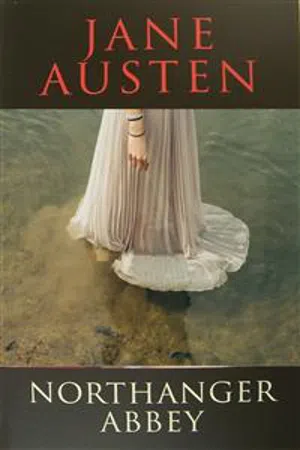
Northanger Abbey Seventeen-year-old Catherine Morland is one of ten children of a country clergyman. Although a tomboy in her childhood, by the age of 17 she is "in training for a heroine" and is excessively fond of reading Gothic novels, among which Ann Radcliffe's Mysteries of Udolpho is a favourite. Catherine is invited by the Allens, her wealthier neighbours in Fullerton, to accompany them to visit the town of Bath and partake in the winter season of balls, theatre and other social delights. Although initially the excitement of Bath is dampened by her lack of acquaintances, she is soon introduced to a clever young gentleman, Henry Tilney, with whom she dances and converses. Much to Catherine's disappointment, Henry does not reappear in the subsequent week and, not knowing whether or not he has left Bath for good, she wonders if she will ever see him again. Through Mrs Allen's old school-friend Mrs Thorpe, she meets her daughter Isabella, a vivacious and flirtatious young woman, and the two quickly become friends. Mrs Thorpe's son John is also a friend of Catherine's older brother, James, at Oxford where they are both students. James and John arrive unexpectedly in Bath. While Isabella and James spend time together, Catherine becomes acquainted with John, a vain and crude young gentleman who incessantly tells fantastical stories about himself. Henry Tilney then returns to Bath, accompanied by his younger sister Eleanor, who is a sweet, elegant, and respectable young lady. Catherine also meets their father, the imposing General Tilney... Northanger Abbey was the first of Jane Austen's novels to be completed for publication, though she had previously made a start on Sense and Sensibility and Pride and Prejudice. According to Cassandra Austen's Memorandum, Susan (as it was first called) was written circa 1798–99. It was revised by Austen for the press in 1803, and sold in the same year for £10 to a London bookseller, Crosby & Co., who decided against publishing. In the spring of 1816, the bookseller was content to sell it back to the novelist's brother, Henry Austen, for the exact sum—£10—that he had paid for it at the beginning, not knowing that the writer was by then the author of four popular novels. The novel was further revised by Austen in 1816/17, with the intention of having it published. Among other changes, the lead character's name was changed from Susan to Catherine, and Austen retitled the book Catherine as a result. Austen died in July 1817. Northanger Abbey (as the novel was now called) was brought out posthumously in late December 1817 (1818 given on the title page), as the first two volumes of a four-volume set that also featured another previously unpublished Austen novel, Persuasion. Neither novel was published under the title Jane Austen had given it; the title Northanger Abbey is presumed to have been the invention of Henry Austen, who had arranged for the book's publication.
- English
- ePUB (mobile friendly)
- Available on iOS & Android
eBook - ePub
Northanger Abbey (English edition)
About this book
Information
Subtopic
ClassicsIndex
LiteratureTable of contents
- Table of Contents
- Northanger Abbey
- Advertisement by the Authoress, to Northanger Abbey
- Chapter 1
- Chapter 2
- Chapter 3
- Chapter 4
- Chapter 5
- Chapter 6
- Chapter 7
- Chapter 8
- Chapter 9
- Chapter 10
- Chapter 11
- Chapter 12
- Chapter 13
- Chapter 14
- Chapter 15
- Chapter 16
- Chapter 17
- Chapter 18
- Chapter 19
- Chapter 20
- Chapter 21
- Chapter 22
- Chapter 23
- Chapter 24
- Chapter 25
- Chapter 26
- Chapter 27
- Chapter 28
- Chapter 29
- Chapter 30
- Chapter 31
Trusted by 375,005 students
Access to over 1.5 million titles for a fair monthly price.
Study more efficiently using our study tools.
Frequently asked questions
Yes, you can cancel anytime from the Subscription tab in your account settings on the Perlego website. Your subscription will stay active until the end of your current billing period. Learn how to cancel your subscription
No, books cannot be downloaded as external files, such as PDFs, for use outside of Perlego. However, you can download books within the Perlego app for offline reading on mobile or tablet. Learn how to download books offline
Perlego offers two plans: Essential and Complete
- Essential is ideal for learners and professionals who enjoy exploring a wide range of subjects. Access the Essential Library with 800,000+ trusted titles and best-sellers across business, personal growth, and the humanities. Includes unlimited reading time and Standard Read Aloud voice.
- Complete: Perfect for advanced learners and researchers needing full, unrestricted access. Unlock 1.5M+ books across hundreds of subjects, including academic and specialized titles. The Complete Plan also includes advanced features like Premium Read Aloud and Research Assistant.
We are an online textbook subscription service, where you can get access to an entire online library for less than the price of a single book per month. With over 1.5 million books across 990+ topics, we’ve got you covered! Learn about our mission
Look out for the read-aloud symbol on your next book to see if you can listen to it. The read-aloud tool reads text aloud for you, highlighting the text as it is being read. You can pause it, speed it up and slow it down. Learn more about Read Aloud
Yes! You can use the Perlego app on both iOS and Android devices to read anytime, anywhere — even offline. Perfect for commutes or when you’re on the go.
Please note we cannot support devices running on iOS 13 and Android 7 or earlier. Learn more about using the app
Please note we cannot support devices running on iOS 13 and Android 7 or earlier. Learn more about using the app
Yes, you can access Northanger Abbey (English edition) by Jane Austen in PDF and/or ePUB format, as well as other popular books in Literature & Classics. We have over 1.5 million books available in our catalogue for you to explore.