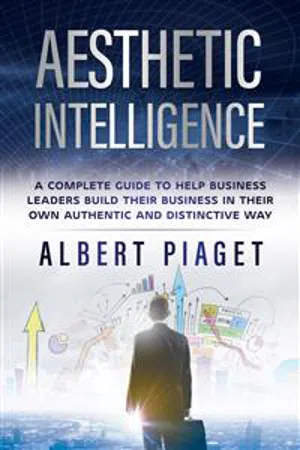
Truly delight costumers and differentiate his own business......very business leader has to deal with it. If you're a business leader, you probably know exactly how these target can become difficult to reach. But there's a way to that: Aesthetic Intelligence (AI) In additional to traditional and emotional intelligence, great leaders also need to develop Aesthetic Intelligence or AI. It is not easy to give a definition of Aesthetic Intelligence. This means knowing what good taste is and thinking about how your services and products stimulate all five senses to create delight. However it is not about design, although design is important. It is not about beauty, because sometimes aesthetics can be less than beautiful, at least in the conventional definition of beauty, but still utterly compelling, exciting, and pleasurable. This particular type of topic has to be explained by a good and simple guide. That's why "Aesthetic Intelligence: a Complete Guide to Help Business Leaders Build Their Business in Their Own Authentic and Distinctive Way" was created by Albert Piaget. Here's what you'll find inside the guide: the Aesthetic advantage the use of senses interpreting and reinterpreting personal style the art of curating the future of Aesthetics...and much more! Scroll up and add to cart "Aesthetic Intelligence" by Albert Piaget!
eBook - ePub
Aesthetic Intelligence
A complete guide to help business leaders build their business in their own authentic and distinctive way
- English
- ePUB (mobile friendly)
- Available on iOS & Android
eBook - ePub
Aesthetic Intelligence
A complete guide to help business leaders build their business in their own authentic and distinctive way
About this book
Trusted by 375,005 students
Access to over 1.5 million titles for a fair monthly price.
Study more efficiently using our study tools.
Information
Topic
CommerceSubtopic
Commerce GénéralChapter 1
The Aesthetic Advantage
The term aesthetic is usually used to describe how things look. In business, this means product and packaging design, brand image, and corporate identity. However, this word is much more useful if one wants the full meaning far beyond visual elegance. Aesthetics is the pleasure of us all perceiving objects and experiences through our senses. Aesthetic intelligence Another term we come back to is the ability to understand, interpret, and articulate emotions caused by a particular object or experience.
Aesthetic companies typically use all five senses and provide products or services that are comfortable to buy and consume. In return, consumers do not like to pay a premium for the benefit of these products and services. However, they can see, flavour, taste, smell, hear (sound), and somatosensory (tactile) Preference for the pleasure of sensations including. Aesthetic statements change consumer motivation from functional and transactional to experience-oriented, ambitious, and memorable. For companies, this means higher demand for their products, stronger customer loyalty, and higher value for their shareholders.
In a world where people desire less, crave for more affluent and more meaningful experiences, and have an unprecedented market force to get what they want, the aesthetic value of a company's product or service is essential for its long-term success. Managers, entrepreneurs, and other professionals can harness the power of aesthetics by learning to identify and apply them to their business interests. This critical ability is called aesthetic intelligence. They win when companies involve consumers at an artistic level. In the past, non-luxury sectors that have focused on size, efficiency, and innovation are eroding the value of finance and consumers by rejecting, misunderstanding, or underestimating aesthetics.
Unlike design thinking, which focuses on the problem-solving process and solution-based strategies, the value of business aesthetics is to enhance the human spirit through sensory experiences and delight the opportunity to evoke imagination. When done right, it benefits both businesses and customers. Recently, and for the foreseeable future with money. Computers can solve increasingly functional problems. You cannot and will not find new meaningful ways to reconnect with our humanity. Automating society means that machines perform today and more and more tasks like analysis, data acquisition, and interpretation, as well as everyday physical tasks and tasks. However, people need to apply their talents and skills to activities where technology cannot be quickly and economically overtaken. This includes the ability to create art, create beauty, and establish deep connections with humans. These are the places where we can go beyond computers.
The retired CEO of Google, remarks, we hope to succeed in the future, and we observe this separation of power and, when necessary, make it possible to operate computers while specializing in doing our best. You have to learn. When striving to mitigate the adverse effects of overproduction and industrial development, the quality, importance, beauty, and durability of goods must be more important than price, accessibility, and availability. The development of aesthetic standards and strategies is essential for the economic and social sustainability of all people and businesses.
It is possible to learn Aesthetics
To run an artistic company, managers need to adapt not only to their aesthetics and values but also to their customers' senses and values. Studies show that sentiment and non-analytic thinking affect an estimated 85% of purchase decisions. However, marketers usually focus their efforts on the remaining 15% of the purchase decision, which is a reasonable assessment of functionality.
The value of business aesthetics starts at the top of the leader's own AI, but also depends on the leader's ability to build, support, and maintain the right organization and culture around this aesthetic position. Everyone is born with more artistic skills than he or she uses. Of course, musicians Bob Dylan listens extraordinarily to sound and rhythm, or chefs Wolfgang Puck have the legendary ability to harmonize flavours, textures and tastes, and those who are naturally favoured. Some are talented. But people like Dylan and Puck also need to improve their skills further and develop styles to stay active and relevant in their field, so that their aesthetic advantage is not lost. They also need to adapt to changing preferences on the broader market and modify or optimize individual expressions over time.
After all, classics also need to be modernized to stay relevant. For example, the Louis Vuitton brand, the steamship era that grew up in the first wave of global travel, may have died on a steamship after World War II. Still, the brand is more valuable, influential, and relevant than before. How did you do it? Obtaining the appropriate antithesis among legacy and resurrection, in these rapidly changing times, tradition and heritage values are even more critical. However, brands should not be preserved and presented to museums like works of art. They must still be useful and useful. Marketers need to take the time to understand which aspects of brand heritage are still relevant and which are simply of historical interest. Vuitton, a French luggage maker, introduced a flat-bottomed (stackable) trunk made of canvas (relatively light) and airtight (protected from flood damage) in the mid-19th century. This was a useful and essential innovation for travellers in the steamship era.
The idea of carrying large, stiff luggage in the 21st century is not well suited for modern travel. But the appeal of world travel has never been this exciting. Louis Vuitton has a robust, current, and consistent reference to travel around the world, including advertising campaign photos, store motifs, ornate pop show exhibitions, and curated Voguez and Voyagez, making it a big brand Maintaining relevance. It follows the [brand] adventure from 1854 to the present. However, all of these products are lightweight and compact, making them ideally sized for overhead aircraft containers. Other key companies, such as Apple, Walt Disney Company, Adidas, and Starbucks, are all further enhancing their exceptional aesthetic quality and increasing their desirability while paying attention to legacy and brand codes. None are stagnant.
These companies have similar products to their competitors. Apple smartphones have the same computing power as Samsung. Airbnb, Marriott, and Craigslist offer travelers a competitive accommodation service. Aesthetics is discrimination. That's why some customers are willing to queue up to pay more than $ 1,000 for iPhone X or make a $ 1,000 deposit to be on the Tesla purchase waiting list. Aesthetics explains why Airbnb is by far the largest market for vacation rentals, with both the world's largest hotel group and the established Internet company that has been a market leader for 20 years. The aesthetics of the booking experience are intuitive and attractive. The appearance of the website is clean, elegant, and inherent in terms of functionality. No more than three clicks from the booking. More critical than usability is a website that helps people and encourages them to dream.
The last point about the process of developing and using aesthetic intelligence is what we call artistic empathy: as AI begins to establish its aesthetic sensitivity, it requires as much deep understanding and respect for the sensitivity of others as possible. And unlike ours, it better reflects the market. The fact that there are various types of good taste does not mean that there is no bad taste. "Knowing the difference between good and bad tastes and being sensitive to the good feelings (i.e., aesthetic empathy) of others, imagines, and predicts who will (or will not) respond to your product or service A valuable tool for how.
Understanding how aesthetics can help your business and how to use them effectively and reliably can dramatically increase your chances of survival and longevity. As a prime example, consider Veuve Clicquot, one of the world's most famous champagne brands. A French businessman in the early 19th century, became known as the Great Hall of Champagne due to innovations in the aesthetic expression of champagne. In 1798 she married François Clicquot, the son of the founder of Maison Clicquot. François shared the passion and knowledge of champagne with his wife. When she became a widow at the age of 27 in 1805, she was able to run a business. The business continued to prosper under her leadership.
Madam Clicquot not only saved the family business but improved it by developing a new production technique called puzzles that dramatically improved the taste and visual appeal of champagne. She has developed a method to combat the unpleasant appearance of sediment deposited on the bottom of the bottle. This technique is still used by winegrowers today. Madame Clicquot has also innovated the first blend of rose champagne. Rose champagne is a fascinating pink that is popular for weddings and special occasions around the world. The yellow-yellow label, a signature of Clicquot since 1772, is a powerful visual marker of brand tradition and personality. Madame Clicquot used her aesthetic intelligence to improve existing products, create special ones, and make it timeless. The power of a robust artistic strategy has built her company one of the world's leading champagne brands. However, Mrs. Clicquot was not born with the knowledge of the wine industry and did not go to college to study design. Instead, she saw with her husband and learned to trust her instinct on what was right about the product and what would be better. Here, the book starts with the idea that you can learn AI.
Art historian Maxwell L. Anderson states that, as Madame Clicquot showed, developing AI does not require formal training or growth in a sophisticated environment, but it certainly does provide the foundation. Claim to be useful. According to Dr. Anderson is a skill that anyone can develop. If you are passionate about cooking, you may have a sophisticated instinct for quality food. The cyclist brings the same rigor to his judgment on bicycles—oil and acrylic painters of certain brands. According to Anderson, they should be able to transfer these skills and develop their art and design judgment. Chef's favorite Le Creuset kitchenware follows the same principles of excellent craftsmanship as other luxury goods. Learn how to recognize and use this ability to distinguish between making objects and experiences fun in other areas. This is the first step to foster AI. Practice leads to polishing. Once you recognize the quality, resist the urge to copy others. Authenticity and originality are essential to long-term aesthetic results, especially in business. Fast fashion brands can create patterns, styles, and silhouettes similar to the coveted high-end designer goods, but the value of these replicas diminishes with each wear. Like new cars, discounts have little resale value. Helms Birkin bags, on the other hand, are often auctioned at prices much higher than the original retail price.
Take creative and visionary people to the executive suite, give them the same place at the table, and empower them to do their best. Do not justify all decisions in financial calculations. For businessmen like David Rubenstein, being surrounded by aesthetically intelligent people is especially important. Given his position, he may not need to have a strong sense of aesthetic himself. Aesthetic value is not limited to design-oriented companies in areas such as beauty and fashion. Making connections between people is a complex task and has far-reaching implications. It can be done through aesthetics. Hopefully, it will lead to a more luxurious brand experience. It is the responsibility of the creator to harmonize his thoughts with motifs that are worth personally experiencing deeply. Modern consumers who are no longer interested in the accumulation of material possessions are looking for depth and meaning. That's why a tolerable brand makes sense, is emotional, and inspires imagination. Your drivers are far beyond commercial motivation. They strive to unite and delight generations who are impressed with their products and services. Aesthetically productive companies must be built on a bright and stable foundation. Ultimately, it challenges, empowers, and appeals to customers. You don't need to see or treat your customers merely wanting to consume them, but eventually, you want to feel alive.
Chapter 2
Senses
As mentioned in this book, about 85% of consumers' purchasing decisions depend on how they feel about the product or service (aesthetic pleasure). Only 15% is based on a conscious and rational assessment of product features and functions. Ironically, marketers are up to 100% focused on developing, building and promoting product features. As eternal as the commodity or co-operation is functioning, companies that stimulate the senses and find ways to create associative or emotional connections have long-term value.
Creativity and psychology of sensation
Sensations are accessed through a series of biological and neurological activities that are perceived and identified by the brain and then respond to relevant memories that remind people, places, or events. Our aesthetics are highly dependent on how we interpret sensory experiences. It's not commonplace, especially when creating lessons and moments that involve people.
Sound first reaches the brain by vibrating the eardrum toward the ear canal. Vibration is transmitted to the co cow through the ossicles. Due to the wave of the sound, the liquid in the cow moves and the hair cells bend. Hair cells generate nerve signals that the auditory nerve picks up. The hair cells at one end of the co cow transmit bass sound information, and the hair cells at the other end communicate treble sound details. The auditory nerve sends signals to the brain. In mind, signals are interpreted as loud or soft, calming or abrasive. Humans respond to certain sounds. The sound of the jackhammer is annoying and annoying, forcing you to close windows and throb across the street. However, the sound of a crying baby is intolerable, ideally crying with the sound source. Find a comfortable child. Barring dogs is seen as a note, and laughing tells us to relax and take part in the fun.
The smell is a chemical process, and our nasal receptors and nerves identify chemicals in the environment, which can be benign, comfortable, or repellent. Our sense of smell also relates to the olfactory bulb, one of the structures of the limbic system, the old part of the human brain. Our understanding of smell is rooted in the natural part of the brain, part of the survival mechanism. The olfaction is not connected by the thalamus, which integrates all other sensory information. The odour is sent directly to the amygdala and the hypothalamus. None of our other senses has such a direct connection to the area of the brain responsible for processing emotions, associative learning, and memory. The scent of freshly cut grass is reminiscent of early summer. Citrus fruits, especially lemons, represent cleanliness. The pine reminds us of a festive winter vacation. As the findings show, all three fragrances make us happy. Coffee-like aromas can help solve analytical problems better.
Touch is part of the somatosensory system and an extensive and diverse network of receptors and processing centres that help to perceive the pleasant sensations, temperatures and pain that are processed in the parietal lobe of the cerebral cortex. These sensory receptors cover the skin and epithelium, skeletal muscle, bones and joints, internal organs and even the cardiovascular system. Cashmere conveys a feeling of luxurious comfort. The refreshing taste of the tightly woven percale leaf conveys a sense of elegance and order. Rough oak tables convey a feeling of strength and durability.
The view is the predominant sense of the post-industrial age, in which visual perception consists of perceiving light, colour, shape, movement and everything else in our environment. Of course, what we see is interpreted in the brain, but specific colours and configurations can manipulate it. In the west, red often means standstill, blood or gender. Yellow means happy and sunshine. White means purity and cleanliness. And green means freshness and nature.
Taste or taste is the ability to recognize the feeling of a substance. In humans (and other vertebrates) the taste often has a less perceived smell than the perception of the flavour in the brain. It is a function of the central nervous system. Our taste receptors are located on the surface of the tongue, soft palate, pharynx and epiglottis epithelium. Traditionally we have defined four primary taste sensations: sweet, salty, sour and bitter. The fifth sensation, called Umami, is a new sensation that has been added to the traditional four. The sweet taste is related to fun and enjoyment (ice cream, chocolate), flavour with warmth and comfort (homemade pasta, roast chicken, vegetable soup), strength and Umami (parmesan, tomatoes, mushrooms, beef).
The Influence of Halo
Aesthetic pleasure is the deep satisfaction or pleasure felt when a sensation (at least three of the five are victorious) is awake, concerning a particular product, a specific brand, a particular service, or a specific experience is. Interestingly, this form of pleasure consumes not only a product or service but also the same memory that evokes a sense when we handle it, due to the combination of expectation and memory of experience using the product or service. Treat the sensory elements of the product that you can enjoy. Studies show that about 50% of consumer pleasure is related to expectations and memories (the rest of past sensory experiences). The other fifty per cent is associated with direct experience (five senses work together and keep people busy at this time).
Although it does not explain how a company can spread a company's financial success, the experience is a continuum that includes the memory of the lead, the background, and what repeatedly informs the point. The original example is birth. The stimulating expectations of the baby and the memory of how wonderful the newborn felt and smelled often contrasted with the intolerable pain of contraction during actual childbirth. This pain can be fo...
Table of contents
- Chapter 1 The Aesthetic Advantage
- Chapter 2 Senses
- Chapter 3 Cracking the Code
- Chapter 4 Designed to Last
- Chapter 5 Tuning In to Taste
- Chapter 6 Interpreting (and Reinterpreting) Personal Style
- Chapter 7 The Art of Curation
- Chapter 8 Articulating Artistry
- Chapter 9 The Future of Aesthetics
Frequently asked questions
Yes, you can cancel anytime from the Subscription tab in your account settings on the Perlego website. Your subscription will stay active until the end of your current billing period. Learn how to cancel your subscription
No, books cannot be downloaded as external files, such as PDFs, for use outside of Perlego. However, you can download books within the Perlego app for offline reading on mobile or tablet. Learn how to download books offline
Perlego offers two plans: Essential and Complete
- Essential is ideal for learners and professionals who enjoy exploring a wide range of subjects. Access the Essential Library with 800,000+ trusted titles and best-sellers across business, personal growth, and the humanities. Includes unlimited reading time and Standard Read Aloud voice.
- Complete: Perfect for advanced learners and researchers needing full, unrestricted access. Unlock 1.5M+ books across hundreds of subjects, including academic and specialized titles. The Complete Plan also includes advanced features like Premium Read Aloud and Research Assistant.
We are an online textbook subscription service, where you can get access to an entire online library for less than the price of a single book per month. With over 1.5 million books across 990+ topics, we’ve got you covered! Learn about our mission
Look out for the read-aloud symbol on your next book to see if you can listen to it. The read-aloud tool reads text aloud for you, highlighting the text as it is being read. You can pause it, speed it up and slow it down. Learn more about Read Aloud
Yes! You can use the Perlego app on both iOS and Android devices to read anytime, anywhere — even offline. Perfect for commutes or when you’re on the go.
Please note we cannot support devices running on iOS 13 and Android 7 or earlier. Learn more about using the app
Please note we cannot support devices running on iOS 13 and Android 7 or earlier. Learn more about using the app
Yes, you can access Aesthetic Intelligence by Albert Piaget in PDF and/or ePUB format, as well as other popular books in Commerce & Commerce Général. We have over 1.5 million books available in our catalogue for you to explore.