Winner of the 2022 Nautilus Book Award in Religion / Spirituality of Western Thought (#24B)
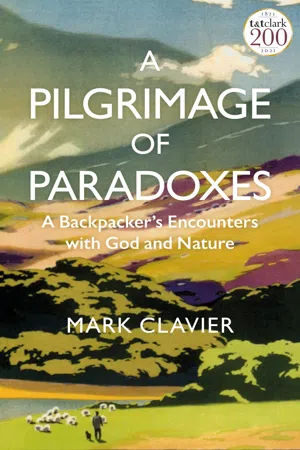
Mark Clavier examines a series of paradoxes that lie at the heart of Christian faith: eternity and time, silence and words, and wonder and the commonplace. In an intellectual reflection on an overnight trek on Cadair Idris in Wales and other wilderness walks, he explores the oft-hidden connections between faith, society, and nature.
Each reflection ranges widely through history, folklore, poetry, philosophy, and theology to consider what these paradoxes can teach us about God, ourselves, and our world. Drawing on the recent upsurge in interest in the personal experience of landscapes and memory, this book invites readers to walk with Clavier in the Appalachians, Norway, Iceland, the Alps, and around Britain as he discovers the ways in which Christianity is profoundly earthed.
By weaving together nature-writing, memoir, social commentary, and theological reflection A Pilgrimage of Paradoxes uses a memorable mountain journey in the ancient landscape of Wales to draw readers into reflecting about what it means to belong.
Please find the study guide for this book here: https://convivium-brecon.com/a-pilgrimage-of-paradoxes/
- 208 pages
- English
- ePUB (mobile friendly)
- Available on iOS & Android
eBook - ePub
About this book
Trusted by 375,005 students
Access to over 1.5 million titles for a fair monthly price.
Study more efficiently using our study tools.
Information
1
Cadair Idris
Encountering God and nature on a Welsh mountain
I know many people are Catholic1 because of the otherworldliness they encounter in ornate liturgies and plainsong chant, the rich array of symbols and the secure embrace of the company of holy saints. They admire richly ordered churches where eyes are irresistibly drawn up towards the ceiling, and hence metaphorically towards heaven. Catholic worship and devotion seem unlike anything ever devised by humankind and, therefore, evoke for them a transcendent God. Stand in Salisbury Cathedral, Notre Dame or the Duomo and try not to think about God. It’s impossible. Catholic array and actions communicate the numinous to our senses and this moves many people deeply.
That’s not why I’m Catholic. It’s the church’s earthiness that attracts me – she may look towards heaven, but her feet are planted firmly on the earth. Certainly, her rituals and adornments evoke and express the eternal, that the veil between heaven and earth is thin, even diaphanous. Witness sunlight filter through ancient glass and plumes of incense here in Brecon Cathedral, and you’ll easily believe heaven is nearby. But Catholicism wraps her worship in the very tangible, often unremarkable, materials of the earth: bread, wine, water, gold and silver, wood, beeswax, silk, fire, incense, flowers and greenery. These seem to say that the path to God isn’t away from the everyday stuff of creation, but through it.
In the northern hemisphere, Catholicism even marks time in conformity with nature’s annual diary – Advent heralds the coming of winter and Lent its farewell; Easter celebrates the Resurrection with the early buds of spring; the season of Trinity (or Pentecost) arrays altars, pulpits and priests in green vesture while nature carpets the landscape with leaf and grass. We commemorate the dead on All Saints and All Souls as nature paints the countryside in the rich colours of dying foliage. Traditionally, too, Christians have celebrated the agricultural year by blessing ploughs, praying for fruitfulness, beating the bounds and celebrating the bounty of the harvest. In all of this, the church keeps one eye on the earth even while she adores God. By our worship, we seem to declare that Christians shouldn’t worship God unless we’re joined by nature.
So, I’m Catholic not because Catholicism gives me a taste of heaven but because she only allows me to do so in the company of the earth. Take, for example, our dependence on the sacraments. If I want to be included among God’s family, I must first be bathed in water; if I want to be united with Christ, I must regularly partake of bread and wine; if I want to be filled with the sevenfold gifts of the Holy Spirit, I must have oil smeared on my forehead. It’s as though God says that we can’t approach him apart from his creation, that he wants nothing to do with us if we come with only our souls and bodies. What else do the sacraments teach us but that we dare not approach heaven by leaving creation behind? Indeed, Catholicism insists that to be with God we must be willing to subject ourselves to the simplest objects of creation: water, grapes, grain and oil. Strange to think that the same ingredients used for baking a pie can also be used for filling the faithful with God’s grace. Alongside the wood of the cross, those four ingredients are the earthy elements of our salvation. Without them we’re lost.
Part of the wonder of the sacraments is that they also require us to trust creation. The Catholic tradition insists on the absurd idea that we must trust that water, grapes, grain and oil can convey us to heaven. How easy to believe that God wants to save us; how hard for some to accept that he does so by washing us in the ordinary water of baptism. I believe that when I swallow consecrated bread and wine, I receive the Body and Blood of Christ. But that belief rests on my accepting the strange notion that the One through whom ‘all things in heaven and on earth were created, things visible and invisible’ (Col. 1.15) can be conveyed to me by ordinary baked wheat and fermented grapes. Can the same oil that I use to cook a meal be saturated with the Holy Spirit when used to anoint a priest or the sick?
According to the Anglican Book of Common Prayer, we can trust the simple elements of the sacraments utterly. There, the English Reformer Thomas Cranmer describes a sacrament as ‘an outward and visible sign of an inward and spiritual grace given unto us, ordained by Christ himself, as a means whereby we receive the same, and a pledge to assure us thereof’.2 The sacramental elements not only convey ‘spiritual grace’ but also guarantee visibly that we’ve received that grace no matter how distracted or unworthy we may be. Catholic salvation therefore rests on the conviction that the earth can be trusted: that water, bread, wine and oil can and do dependably communicate our God to us. They are, if you will, divine tokens of love – God’s gift of his presence tenderly wrapped in simple objects.
The Exsultet, sung in many churches at the Easter Vigil, captures something of creation’s mysterious proximity to God. It is a long, ancient chant that rejoices in the victory of Easter and involves the blessing of the Paschal Candle, itself symbolic of the light of Christ. It’s replete with majestic language about Christ’s resurrection and the conquering of darkness by light. Amid this high theology, however, the cantor sings:
But now we know the praises of this pillar,
which glowing fire ignites for God’s honour,
a fire into many flames divided,
yet never dimmed by sharing of its light,
for it is fed by melting wax,
drawn out by mother bees
to build a torch so precious.3
The image of mother bees building the precious Paschal Candle with their wax immediately grounds the exalted language about God and redemption in the everyday activity of insects. That’s what I lo ve about Catholicism – we can’t even celebrate Easter without including the bees.
I know many find this sort of thing too mystical, even a little superstitious. And I can see why: the belief that actual water washes away immaterial sins or that wheat and fermented grapes can be drenched through with Christ is absurd! On the other hand, I’ve never really understood why this is any stranger than believing that God can fill human beings with his Spirit. If I can be a vehicle of God’s grace, why not bread and wine? Paul preached to the Athenians that God is he in whom we ‘live and move and have our being’ (Acts 17.28) and wrote to the Romans that ‘from him and through him and to him are all things’ (Rom. 11.36). God who’s beyond everything is also within everything. What’s then to prevent him from being within water, grapes, grain and oil to our spiritual benefit? The acacia wood of the Ark of the Covenant contained God’s presence as did the richly adorned walls of the Holy of Holies in the Temple in Jerusalem. Eden was so vibrant with the glory of God that he seemed to stroll there in the cool of the evening. How else did Balaam’s ass scold his master except by receiving the power of God to do so? No, it seems to me that restricting God’s grace to human beings requires one to accept the notion that we somehow stand apart from creation – worse, it suggests that God himself isn’t free to do with his own creation as he pleases. Who are we to say what he can’t do with the simplest elements of the earth?
So, the commitment to hold both heaven and earth together is why I’m Catholic. If you want to find an otherworldly religion, turn to those forms of Christianity that insist that the Christian armed only with a Bible can approach God without sparing a thought for creation. Megachurches awash with artificial light and amplified sounds created by miked-up preachers, electrified musical instruments and multimedia presentations are to me places far more detached from the world than any monastery. How can we be mindful of the earth in these artificial environments? Indeed, how much harm is done to creation just to provide their hi-tech worship? Where is there room for the humble bee in such places? For me, these churches are the logical consequence of a Christianity that discards the sacraments – reject them and you run the danger of also rejecting the earth as we see in many conservative versions of Evangelicalism in America. And that’s why I’m a Catholic.
-o0o-
I probably never would’ve discovered the reason for my Catholicism were I not also deeply in love with nature. I spend a great deal of my free time outdoors. I regularly go for short walks through fields and along riverbanks and longer ones in mountains and along coastal paths. I’ve backpacked in the Appalachians, the Brecon Beacons and Snowdonia in Wales, the Sunnmøre Alps in Norway, among the hot springs and glaciers of Iceland, the high passes of the Alps, from Grenoble to Avignon among vineyards and fields of lavender and along the dry, rocky paths of the high Pyrenees with their crystalline lakes. I’m out in all conditions with my wife Sarah and our two spaniels Cuthbert and Humphrey exploring new landscapes or becoming deeply conversant with familiar ones. As a result, during the past eight years, I’ve rambled more than 20,000 miles, equal to 80 per cent of the earth’s circumference.
There are two kinds of walks: those in the company of others and those that are solitary. The former affords time for long conversations with friends and companions – the countryside seems to lend itself to deep discussions. There’s something about being out in nature that drops our social defences and draws out our intimate thoughts and feelings. One of the most famous examples of this are the walks that J. R. R. Tolkien and C. S. Lewis took along Addison’s Walk by the Cherwell in Oxford – those strolls not only cemented their fateful friendship but also drew from Lewis the kind of questions that led him to become a Christian. If only we had an account of the conversations Paul and Luke must have shared while on their missionary journeys or that St Francis and his companions enjoyed during their holy wanderings. At least we’re told about a memorable walk along a road to Emmaus that ended with a meal that opened eyes and inflamed hearts.
The other kind of walk is the solitary one when we can be absorbed into the landscape. While I treasure days out with friends and especially my wife, I find nothing else quite like losing myself in the beauty and wonder that nature conjures. I’m immersed in the surrounding splendour, noticing tiny details like wildflowers, the shape of a leaf, the song of thrush and nuthatch or the way light filters through the canopy of a forest. Starved of conversation, my senses extend to fill the void and by doing so bring the scenery around me closer. I feel younger through the experience, too, as though the boy who delighted in his natural surroundings is lurking just behind the next tree, ready to greet me. This is, I suppose, what’s now called mindfulness, but it might be better described as sensuality, for the mind is enlivened through the awakening of the five senses. It’s then that I start to perceive, experiencing everything around me in a more complete way rather than through just my eyes and at a distance.
When I walk alone, I also start to become acquainted with the sense of places that comes only by closely observing how natural features relate to each other within a landscape: the way a solitary oak tree stands in a meadow or a craggy knoll divides a river from the steep slopes of a mountain. This requires an artist’s eye, observing in a way that takes in the particulars without losing sight of the whole, as though my mind were saying, ‘an outcropping of rock is just the thing for that steep slope’ or ‘this rich, green grass is perfect for these bleach-bark birches’. Only, the work of the Artist has already been completed; we simply observe and enjoy. Such sensory companionship with nature is the main reason why I walk – I’m drawn out my front door by the deep contentment that comes from regularly rejoining the company of the good earth rather than for the health benefits gained. I don’t understand how people stay sane without doing the same.
You don’t really begin to know the sense of a place until you’ve experienced it through a full cycle of seasons and, even then, only when you do so consciously. Such knowledge bears some resemblance to human friendship: the way you know someone only after you’ve shared their company through the highs and lows and different seasons of their life. Perhaps there’s also something about being present in familiar places during the variable seasons of your own life. Often when I walk in deeply familiar places, thoughts and moods from previous walks suddenly pounce on me as though they continued to haunt the paths after my earlier visits.
On most early mornings I take the dogs for a two-mile walk through the ancient woodland that stretches northward from the walled, medieval close of Brecon Cathedral where I now live in Wales. Morning walks first became a habit when I lived in a small village in rural Oxfordshire. My route would take me by the primary school, up a pa...
Table of contents
- Cover
- Half-Title
- Title
- Epigraph
- Contents
- List of figures
- Welsh names
- Preface
- Acknowledgements
- 1 Cadair Idris: Encountering God and nature on a Welsh mountain
- PART I The paradox of eternity and time
- PART II The paradox of silence and words
- PART III The paradox of wonder and the commonplace
- Bibliography
- Index
- Copyright
Frequently asked questions
Yes, you can cancel anytime from the Subscription tab in your account settings on the Perlego website. Your subscription will stay active until the end of your current billing period. Learn how to cancel your subscription
No, books cannot be downloaded as external files, such as PDFs, for use outside of Perlego. However, you can download books within the Perlego app for offline reading on mobile or tablet. Learn how to download books offline
Perlego offers two plans: Essential and Complete
- Essential is ideal for learners and professionals who enjoy exploring a wide range of subjects. Access the Essential Library with 800,000+ trusted titles and best-sellers across business, personal growth, and the humanities. Includes unlimited reading time and Standard Read Aloud voice.
- Complete: Perfect for advanced learners and researchers needing full, unrestricted access. Unlock 1.5M+ books across hundreds of subjects, including academic and specialized titles. The Complete Plan also includes advanced features like Premium Read Aloud and Research Assistant.
We are an online textbook subscription service, where you can get access to an entire online library for less than the price of a single book per month. With over 1.5 million books across 990+ topics, we’ve got you covered! Learn about our mission
Look out for the read-aloud symbol on your next book to see if you can listen to it. The read-aloud tool reads text aloud for you, highlighting the text as it is being read. You can pause it, speed it up and slow it down. Learn more about Read Aloud
Yes! You can use the Perlego app on both iOS and Android devices to read anytime, anywhere — even offline. Perfect for commutes or when you’re on the go.
Please note we cannot support devices running on iOS 13 and Android 7 or earlier. Learn more about using the app
Please note we cannot support devices running on iOS 13 and Android 7 or earlier. Learn more about using the app
Yes, you can access A Pilgrimage of Paradoxes by Mark Clavier in PDF and/or ePUB format, as well as other popular books in Theology & Religion & Christian Theology. We have over 1.5 million books available in our catalogue for you to explore.