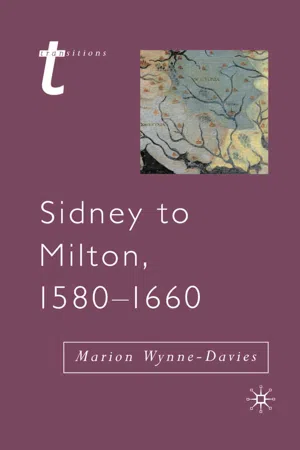
- 211 pages
- English
- ePUB (mobile friendly)
- Available on iOS & Android
eBook - ePub
Sidney to Milton, 1580-1660
About this book
This invaluable guide offers readers an accessible and imaginative approach to the literature of early modern Britain. Exploring the poetry, drama and prose of the period, Marion Wynne-Davies combines theory and practice, providing a helpful introduction to key theoretical concepts and close readings of individual texts by both canonical and less well-known authors. Amongst other things, Wynne-Davies discusses sixteenth- and seventeenth-century poetry in its political and cultural contexts, considers Renaissance drama in terms of performance space, and uses the early modern map to explain the prose works of writers such as Bunyan and Cavendish.
Information
1 Contexts
Elizabeth I
‘The daughter of debate’
(Elizabeth I)
(Elizabeth I)
In many ways Queen Elizabeth I (1533–1603) could have been referring to herself when she spoke of the ‘daughter of debate’ in her short poem, ‘The Doubt of Future Foes’ (Wynne-Davies 1998, 12). Indeed, of all the political, religious and cultural debates to shake the country during the sixteenth century it was surely the convoluted events that surrounded Elizabeth’s parentage that had the most resounding impact and far-reaching repercussions. When Henry VIII finally affirmed his determination to divorce his first wife, the Catholic Queen Catherine, in order to marry Anne Boleyn with a view to producing a male heir to the throne, the result was to be more schismatic than he could possibly have predicted. For Henry’s marriage to his new Protestant queen was to produce more than the swaddled form of the young Princess Elizabeth. The English Protestant reformation, the successive violent purges affecting both faiths, internal political schism, and subsequent international allegiances were to a certain extent catalysed by and facilitated through Henry’s divorce. Elizabeth was, therefore, in very real terms the ‘daughter’ of a king and queen whose wedlock shifted the course of European politics and the English church. And as the unexpected, and unwanted, female heir to the English throne, Elizabeth was to overturn further expectations of gendered rulership and religious authority.
Indeed, it is still possible to perceive the debates, which had been brought struggling into the sixteenth-century world, in our own age; they seem to remain with us, through a process of ideological as well as monarchic inheritance. In this sense, the Protestant queen of the Early Modern period may be seen as a far-distant ancestor of our second Elizabethan age. And as we proceed into the new millennium the present British queen, who carries in her train all the attendant value-systems of the previous century, sometimes appears as antiquated as the aged monarch of that first Elizabethan court. This panoply of genealogical continuity is attractive, lending a sense of stability and oneness to what might appear the random shifts of power and authority. Yet such patterning is as decked in rhetorical artifice as the idealised portraits of the successive Elizabeths, for a necessary piece of information has been omitted from the argument – when Elizabeth I spoke of the ‘daughter of debate’ she was not referring to herself at all.
Let’s go back to the poem, which begins with Elizabeth’s concern that ‘future foes’ will threaten her ‘present joy’ through a series of falsehoods, deceits and political subterfuge. The poem then shifts at its centre to two well-tried Early Modern political metaphors: the state as garden, and the ambitious courtier as a falcon. The first trope depicts the dissidents as encouraged by the ‘changed course of [political] winds’ into believing that ‘the root upreared shall be’, in other words, the rebels hope that Elizabeth’s rule and her rightful inheritance of the ‘family tree’ will be overturned. But the Queen immediately denies the success of any rebellion since, ‘fruitless all their grafted guile [shall be], as shortly ye shall see’. That is, the rebels cannot lay claim to the true descent of the Tudor tree, but are ‘grafted’ and therefore in this instance, ‘fruitless’. The poem subsequently concentrates on an astringent attack against the forces of revolt, which shifts skilfully between metaphoric allusion and political veracity. The last eight lines of the poem need therefore to be quoted in full:
The dazzled eyes with pride, which great ambition blinds,
Shall be unsealed by worthy wights whose foresight falsehood finds.
The daughter of debate that discord aye doth sow
Shall reap no gain where former rule still peace hath taught to know.
No foreign banished wight shall anchor in this port;
Our realm brooks not seditious sects, let them elsewhere resort.
My rusty sword through rest shall first his edge employ
To poll their tops that seek such change or gape for future joy.
(Wynne-Davies 1998, 12)
Shall be unsealed by worthy wights whose foresight falsehood finds.
The daughter of debate that discord aye doth sow
Shall reap no gain where former rule still peace hath taught to know.
No foreign banished wight shall anchor in this port;
Our realm brooks not seditious sects, let them elsewhere resort.
My rusty sword through rest shall first his edge employ
To poll their tops that seek such change or gape for future joy.
(Wynne-Davies 1998, 12)
The shift in metaphor from horticulture to the noble sport of falconry seems at first inappropriate, suggesting perhaps a poet who lacks maturity and skill. The allusive gaze, however, remains directed upwards, the top of the tree being succeeded by the dazzling vision of the sun. But in addition to this visual tie, the movement in trope is necessary, for these rebels are not common-garden folk but the peers of the realm. Thus, right at the heart of her 16-line poem Elizabeth uncovers the political meaning central to her text, which in turn discloses the rebellion at the heart of her realm.
The Queen’s text proves to extend beyond the rhetorical bounds of poetic form and metaphoric tradition, projecting out from its innermost lines into the actuality of Elizabethan politics. For those eyes dazzled by ‘great ambition’ belonged to real people, to the Earl of Arundel, the Earl of Norfolk and other Catholic lords. And it is perfectly probable that they had been plotting or preparing to plot against Elizabeth in an attempt to ‘uprear’ her since she had ascended the throne in 1558. At first their machinations had been unfocused, but in 1568 a specific impetus was provided in the figure of Mary Queen of Scotland. Here was a Catholic queen to supplant the Protestant Elizabeth and, moreover, a queen whose descent neatly evaded the taint of bastardy (as they would see it, ‘grafting’) that Henry VIII’s divorce signalled to the Catholic world. Mary’s claim to the English throne came from her father, James V of Scotland, whose mother, Mary Tudor, was the daughter of Henry VII (and therefore Henry VIII’s sister). Until Mary was deposed from the Scottish throne in 1567 she had not appeared as a threat to Elizabeth, but once she had crossed the Northern border into England seeking refuge, she was transformed into a throneless queen, on the look out perhaps for another crown. At this point, in the view of the English court, there was no alternative but to lock her up. Hence Mary was imprisoned in a series of castles while Elizabeth grew increasingly uneasy about her cousin’s political intrigues. Eventually, of course, Elizabeth’s advisers, those ‘whose foresight falsehood finds’ uncovered the Ridolfi plot and Mary was finally and categorically identified as the ‘daughter of debate’, the woman who constantly threatened political ‘discord’.
There can be little doubt about Elizabeth’s unease with the subsequent decision to execute Mary. Apart from the consanguinity of the two queens, the political advisability of condoning the death of an anointed monarch and one moreover whose faith could claim substantial sympathy at home and abroad was always uncertain. And the poem participates in this sense of unease, for as if evading the stark fact of Mary’s inevitable execution, Elizabeth slips back into the gardening metaphor, depicting the two women as maids, sowing and reaping the alternate crops of peace and war. It is only when the poem swings back once again to external circumstance – to a possible invasion by the forces of a ‘foreign banished wight’ and to the covert actions of the ‘seditious sects’ – that the sharp focus of political reality returns. The harsh necessities are sustained in the conclusion with the threat of further executions, even though they are simultaneously combined with the horticultural trope. Thus, while Elizabeth’s ‘sword’ of justice might have grown ‘rusty’ with lack of use in times of peace, she is ready to decree further beheadings as she prepares to ‘poll’ the rebels’ ‘tops’. The image of the decapitations is partially softened with the gardening metaphor, the vision of the bloody neck being veiled with the alternative picture of a gardener pruning the unwieldy branches of the tree. Yet there is a more politically astute reasoning behind the combination, for the whole discourse of horticulture serves to naturalise an act of political expediency, allowing Elizabeth to present an uncompromising punishment as a caring, necessary and inevitable act. As in Shakespeare’s Richard II, the garden becomes a metaphor for the state and rebel lords are compared to plants that have grown too high:
Go . . . and like an executioner
Cut off the heads of too fast growing sprays,
That look too lofty in our commonwealth.
(III.iv.33–5)1
Cut off the heads of too fast growing sprays,
That look too lofty in our commonwealth.
(III.iv.33–5)1
Shakespeare’s play is dated to around 1595 and as such is unlikely to refer to the Catholic unrest of the 1560s that engendered Elizabeth’s poem, although the text was in its turn to be used in one of the challenges to Elizabeth’s power.2 Nevertheless Elizabeth, like Shakespeare, was able to draw upon a host of classical antecedents, including Livy’s account of Tarquin’s order to destroy the leading men of the Gabii, and Herodotus’ account of Thrasyblus’ warning to his enemy Periander. In general terms therefore, the gardening metaphor was an Early Modern commonplace. But Elizabeth transforms the metaphor in one significant respect, for while in all other examples the gardener/avenging ruler is male, as are those executed, in her poem both monarch and rebel are female. The Queen had certainly overturned expectations of gendered rule when she succeeded to the throne, but Elizabeth also reinforced the realities of her political power with a feminised reworking of those metaphors most closely identified with the monarchy.
Elizabeth’s poem, when read in the context of the political realities of her time and the poetic discourses that were commonly employed in describing them, thus pivots, in more ways than one, about the phrase ‘daughter of debate’. From a reading that drew upon the broad historical expanse of the English Reformation and its far-reaching impact, the poem may now be recognised as a text immersed in its own cultural and political immediacy. Moreover, such periodisation and the recognition of ideological positionings are essential to the understanding of such shifting interpretations. Thus, while in terms of historical awareness it is important to survey the overarching discourses that link our own age with the past, it is also essential to retain an openness to the detailed particulars of a unique time and place. And although for Elizabeth the ‘daughter of debate’ might clearly represent Mary Queen of Scots as she approached the block, the term immediately pushes past this well-worn image to the unease with which Early Modern Europe viewed all female monarchs, especially those who claimed a spiritual as well as a secular authority.
There are several moments in Elizabeth I’s poem that allow us to perceive such shifting interpretations. Apart from ‘the daughter of debate’, the different views of ‘grafting’ and the awkward merging of the two queens as garden maids have been mentioned, but there is one further point at which meaning stirs incessantly. At the very end of the poem Elizabeth threatens to execute those who ‘seek such change’ (that is to overthrow her) or those who ‘gape for future joy’. I would like to look more closely at the word ‘gape’, for its meaning slides in relation to its grammatical and contextual position. Coming immediately after the image of beheading ‘gape’ cannot help but evoke the graphic picture of the neck like a wide and bloody mouth yawning for its decapitated head. Moreover, while that truncated form could hardly be said to have any expectation of ‘joy’ on earth, its ‘future joy’ in heaven remains a possibility. Yet ‘to gape for’ is not quite the same as ‘to gape’. The use of the word ‘for’ thus offers an alternative interpretation, one that suggests yearning for something, as indeed the Catholic nobles must have yearned for the overthrow of their Protestant queen. But ‘for’ is also an unstable signifier, since linked with the following phrase, ‘future joy’, it can change to mean ‘because of’. This in turn precipitates a reappraisal of ‘gape’ into the act of staring in bewilderment, with wonder or with anticipation. Indeed, in the definition of ‘to gape’ as ‘an open-mouthed stare’ the OED cites Elizabeth I’s use of the term in her 1593 translation of Boethius: ‘Paulin the consul from the gapers Jawes I drew’ (my emphasis).3 The rebels are thus belittled into mere ‘gapers’ staring on foolishly as Elizabeth efficiently polices her realm in the same manner as she deploys rhetoric in order to defuse the image of bloody throats with the comic picture of open mouths. But the round mouthed ‘O’ of the gaper itself demands a circular interpretation.
The first line of Elizabeth’s poem presents her own fears: ‘The doubt of future foes exiles my present joy’, which are then expurgated from realm and text through the merciless function of state and rhetoric. Yet the last words, ‘or gape for future joy’ demand a return to the beginning, a cyclical process which is reinforced through the image of the ‘O’ as well as through the repetition of vocabulary. On one level, of course, there is a certain neat satisfaction in the movement from Elizabeth’s assurance of her own ‘present joy’ through the precise act of negating the ‘future joy’ of her foes. In other words, she secures her throne by eliminating all opposition, a policy condoned by Early Modern court advisers and political dramatists alike. However, while such narrative neatnesses might have been desirable for the temporal realities of the European state, such a policing of boundaries was unsustainable within the poetic conventions of the day. The use of such cyclical devices was a commonplace in Early Modern court poetry and Elizabeth would have been immersed in a discourse that called upon the structural ‘O’ to denote a multiplicity of significations, from a simple narrative change, through an awareness of incessant mutability, to a glimpse of the gaping nothingness of negation. As such, if the gapers in Elizabeth’s poem are the beheaded nobles, then the gaping mouth of the text also portends the constant shifting of power within the Elizabethan world. And thus the poem finally proffers a nightmare vision of a gaping hole in which bloodied neck mutates into the yawning chasm of death, nothingness and the destabilisation of meaning. Like the Queen herself, Elizabeth’s poem becomes a ‘daughter of debate’.
The analysis of Elizabeth I’s short political poem has served to foreground the importance of understanding historical contexts and the shifting possibilities of such discourses. Political trends, the immediate material circumstances of the text’s production, the dominant cultural mores of the period and a self-aware recognition of ideological positioning are all key elements in the interpretation of texts. In the remainder of this chapter I want to explore several of the contexts that have been introduced during the initial analysis: the influence of the court and the question of regionalisation, the religious schism between Catholic and Protestant, as well as the issues surrounding authority. Each of these particular Early Modern contexts will be explored through the writings of Philip Sidney, in particular his sonnet sequence, Astrophil and Stella (1581–82). However, the contexts discussed here re-emerge into later chapters, combining ideological analyses with an overall focus upon genre. Thus, the uncompromising divide between Protestant and Catholic is clearly perceived in the poetry of John Donne. The discussion of political and spiritual authority is reworked through a reading of the plays of Christopher Marlowe, William Shakespeare and Thomas Middleton in the chapter upon drama. And, finally with a return to the notion of circularity, the way in which women negotiated a changing identity is described with reference to the prose works of Mary Wroth and Margaret Cavendish. Inheritance and radical change thus formed an uneasy contextual alliance in Early Modern England and at this point I wish to turn to the specific textual debates engendered by these moments of ideological transitions.
Philip Sidney
‘Phoenix thou wert’
(Mary Sidney)
(Mary Sidney)
On 22 September 1586 during a cavalry attack against an overwhelming number of Spanish troops, Philip Sidney (1554–86) was wounded by a musket ball. Blood poisoning developed and within four weeks he was dead, one of the many victims i...
Table of contents
- Cover
- Title Page
- Copyright
- Contents
- General Editor’s Preface
- Acknowledgements
- Introduction
- 1. Contexts
- 2. Poetry
- 3. Drama
- 4. Prose
- Conclusion
- Chronology 1476–1685
- Annotated Bibliography
- Bibliography
- Index
Trusted by 375,005 students
Access to over 1.5 million titles for a fair monthly price.
Study more efficiently using our study tools.
Frequently asked questions
Yes, you can cancel anytime from the Subscription tab in your account settings on the Perlego website. Your subscription will stay active until the end of your current billing period. Learn how to cancel your subscription
No, books cannot be downloaded as external files, such as PDFs, for use outside of Perlego. However, you can download books within the Perlego app for offline reading on mobile or tablet. Learn how to download books offline
Perlego offers two plans: Essential and Complete
- Essential is ideal for learners and professionals who enjoy exploring a wide range of subjects. Access the Essential Library with 800,000+ trusted titles and best-sellers across business, personal growth, and the humanities. Includes unlimited reading time and Standard Read Aloud voice.
- Complete: Perfect for advanced learners and researchers needing full, unrestricted access. Unlock 1.5M+ books across hundreds of subjects, including academic and specialized titles. The Complete Plan also includes advanced features like Premium Read Aloud and Research Assistant.
We are an online textbook subscription service, where you can get access to an entire online library for less than the price of a single book per month. With over 1.5 million books across 990+ topics, we’ve got you covered! Learn about our mission
Look out for the read-aloud symbol on your next book to see if you can listen to it. The read-aloud tool reads text aloud for you, highlighting the text as it is being read. You can pause it, speed it up and slow it down. Learn more about Read Aloud
Yes! You can use the Perlego app on both iOS and Android devices to read anytime, anywhere — even offline. Perfect for commutes or when you’re on the go.
Please note we cannot support devices running on iOS 13 and Android 7 or earlier. Learn more about using the app
Please note we cannot support devices running on iOS 13 and Android 7 or earlier. Learn more about using the app
Yes, you can access Sidney to Milton, 1580-1660 by Marion Wynne-Davies,Julian Wolfreys in PDF and/or ePUB format, as well as other popular books in Literature & Modern Literary Criticism. We have over 1.5 million books available in our catalogue for you to explore.