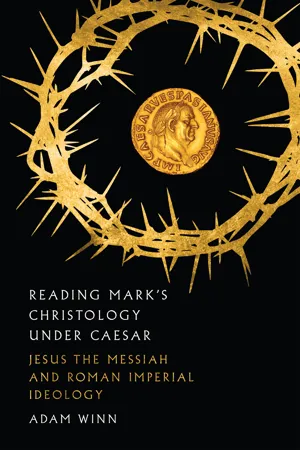
The Gospel of Mark has been studied from multiple angles using many methods. But often there remains a sense that something is wanting, that the full picture of Mark's Gospel lacks some background circuitry that would light up the whole. Adam Winn finds a clue in the cataclysmic destruction of Jerusalem by the Romans in AD 70. For Jews and Christians it was an apocalyptic moment. The gods of Rome seemed to have conquered the God of the Jews.Could it be that Mark wrote his Gospel in response to Roman imperial propaganda surrounding this event? Could a messiah crucified by Rome really be God's Son appointed to rule the world?Winn considers how Mark might have been read by Christians in Rome in the aftermath of the fall of Jerusalem. He introduces us to the propaganda of the Flavian emperors and excavates the Markan text for themes that address the Roman imperial setting. We discover an intriguing first-century response to the question "Christ or Caesar?"
eBook - ePub
Reading Mark's Christology Under Caesar
Jesus the Messiah and Roman Imperial Ideology
- 204 pages
- English
- ePUB (mobile friendly)
- Available on iOS & Android
eBook - ePub
About this book
Trusted by 375,005 students
Access to over 1 million titles for a fair monthly price.
Study more efficiently using our study tools.
Information
Topic
Theology & ReligionSubtopic
Roman Ancient History
THE POWERFUL JESUS
OF MARK 1–8

HERE MY ASSESSMENT OF Mark’s narrative Christology begins. As noted in the introduction, the method of this project is both historical and narratival. By historical and narratival, I mean that I will offer a reading of the Markan narrative from a particular historical vantage point—the vantage point of post–70 CE Roman Christians living under the shadow of Flavian propaganda. Thus my approach to the Markan text will be twofold. I will first address the Markan narrative itself, noting its major features as well as its narrative progression and development. Due to the scope of this project, this treatment of Mark’s narrative will be cursory in nature, often summarizing the narrative rather than offering the detailed analysis that one might find in a commentary or monograph that is focused on a single literary unit of Mark.1 After this basic narrative analysis, I will consider the way in which this narrative and its various christological pieces might be read by Roman Christians living in the shadow of Flavian propaganda, with particular attention given to the way in which the narrative might address propagandistic challenges. This chapter will consider the first half of Mark’s narrative, Mark 1–8.
THE MARKAN INCIPIT
It is widely recognized that Mark 1:1 functions as a title or incipit for the entire Gospel of Mark. Such titles were significant in ancient literature, as they often functioned as a programmatic statement for the reader, providing a lens through which the entire text should be read.2 Thus paying close attention to Mark’s incipit should offer the reader clues as to the function and purpose of the entire Gospel.
A number of brief preliminary exegetical comments can be made about Mark’s incipit: “The beginning of the good news [gospel] of Jesus Christ, the Son of God.” The reference to “beginning” (άρχή) could be a reference to the beginning of Jesus’ earthly ministry, which will be described in Mark, or it could be a reference to the entirety of Jesus’ ministry as outlined in Mark, that is, what is described in this text is only the beginning of God’s work, not the entirety of it. “Gospel” (εὐαγγελίον) generally refers to good news or glad tidings and is not here used in a technical sense to refer to genre, that is to say, Mark is not identifying this work as “a Gospel.” Presumably this good news is about Jesus, who is identified as the Christ or God’s Messiah.3 Jesus’ identity as the Christ is then further qualified by the title “Son of God,” that is, Jesus is understood as Messiah in terms of divine sonship.
However, the title “Son of God” is textually uncertain, with the phrase being absent in one significant early manuscript (Codex Sinaiticus, א*). Despite this omission, the reading “Son of God” is found in good and reliable early manuscripts (Codex Vaticanus, B; Codex Alexandrinus, A; Codex Bezae, D). Yet many scholars find it more likely that a scribe added the title than omitted it. It is possible, however, that the omission was accidental, as a scribe would have been looking at a list of six genitive words, with the sacred names abbreviated and listed without spaces between them—ΙΥΧΥΥΥΘΥ.4 This textual issue is impossible to resolve with any certainty, but there is adequate reason to accept “Son of God” as original to Mark’s incipit, and I will cautiously move forward accepting the longer reading.
Thus Mark’s incipit establishes Jesus’ identity as God’s Messiah (and plausibly Son of God) and clearly indicates that Mark has a strong christological interest. But such a conclusion is rather generic and gives the reader little insight into how Mark might understand these titles or to what ends these titles are used in Mark. To glean more from Mark’s incipit, attention must be given to the possible backgrounds against which the language of the incipit could be read. Many interpreters have argued that the language of Mark’s incipit finds meaning against the background of Isaiah’s Servant Song, in which “the one who proclaims good news” (εὐαγγελιζόμενος, a participle from the same root as the noun εὐαγγελίον, “good news”) is prominent (e.g., Is 40:9 [2x]; 41:27 [Masoretic Text]; 52:7 [2x]; 60:6; 61:1). The “one who proclaims good news” announces God’s victory over the enemies of Israel (Is 41:27) and the reestablishment of God’s righteous reign over Israel (Is 40:9-10; 52:7). That the incipit is followed by a citation from Isaiah’s Servant Song (Is 40:3) serves to strengthen the connection between Mark’s incipit and “the one who proclaims good news” in Isaiah. Such a conclusion is also supported by the first words spoken by the Markan Jesus, who enters Galilee saying, “The time is fulfilled, and the kingdom of God has come near; repent, and believe in the good news” (Mk 1:15). Thus through the incipit Mark is intentionally identifying Jesus as the one who both proclaims and establishes the Isaianic good news.
But other interpreters have noted that the language of the Markan incipit strongly echoes the language of the Roman imperial world. Εὐαγγέλιον was a word regularly associated with Roman emperors. It was often used to describe their birth, political ascension, and military victories. Josephus writes that on receiving the news of Vespasian’s rise to power, “every city kept festivals for the good news [εὐαγγέλια] and offered sacrifices on his behalf.”5 He also writes, “On reaching Alexandria, Vespasian was greeted by the good news [εὐαγγέλια] from Rome and by embassies of congratulation from every quarter of the world, now his own.”6 But perhaps most significant is the Priene Calendar Inscription, written in honor of the emperor Augustus:
Since Providence, which has ordered all things and is deeply interested in our life, has set in most perfect order by giving us Augustus, whom she filled with virtue that he might benefit humankind, sending him as a savior, both for us and for our descendants, that he might end war and arrange all things, and since he, Caesar, by his appearance (excelled even our anticipations), surpassing all previous benefactors, and not even leaving to posterity any hope of surpassing what he has done, and since the birthday of the god [θεοῦ] Augustus was the beginning [ἦρξεν] of the good tidings [εὐαγγελίων] for the world that came by reason of him.7
Here we see a striking similarity with the Markan incipit, as both refer to the “beginning of the good tidings [gospel].” And while in this inscription Augustus is identified as a god, he and his successors were often given the title “son of God” (see discussion above in chapter two), a title present in the Markan incipit. If one were to remove “Jesus Christ” from the Markan incipit and replace it with “Caesar Augustus,” the resulting text would be quite similar to Roman imperial inscriptions found throughout the empire. Undeniably the first century Greco-Roman reader would have recognized the presence of Roman imperial language in Mark’s incipit. To such a reader it would have appeared that Mark intentionally replaced Caesar with Jesus and thus attributed to Jesus the honor that was regularly reserved for the emperor alone.
The similarities that Mark’s incipit shares with both the language of Isaiah and the language of the Roman imperial world have led many interpreters to argue for one background over against the other.8 While such a choice might seem the only way forward, both Craig Evans and I have argued for a third possibility—namely, that the Evangelist has intentionally brought together the language of both the Jewish and the Roman world.9 The intentional merging of such language would be perfectly suited to address a crisis created by Flavian propaganda, propaganda in which Vespasian had already merged Jewish messianic hope with Roman imperial realities. Mark’s merging of Isaianic language (clearly understood messianically) and the language of the Roman imperial world could easily and naturally have been understood as an intentionally mirroring of and response to Vespasian’s merging of these same two realities. Thus, from the outset of Mark’s Gospel, he proclaims the “good news” of Jesus contra Vespasian, that Jesus is the true Messiah and fulfillment of Jewish Scriptures contra Vespasian, and that Jesus is true “Son of God” contra Vespasian. Thus I propose that through an incipit tailor made to address the crisis facing the Markan community, the Evangelist sets the agenda for the entire Gospel and provides the reader with the proper lens for reading the entire narrative.
JOHN THE BAPTIST AND JESUS
After the Markan incipit, the reader is introduced to John the Baptist, a figure established as a powerful prophet of God and one who plays a preparatory role for God’s salvific work. Mark styles John after the powerful prophet Elijah, as he is dressed in a similar fashion (2 Kings 1:8). John’s role is relatively minor in Mark’s Gospel. Though he does not use Jesus’ name, he declares that Jesus will be even greater than himself and that Jesus will baptize people with the Holy Spirit. At the baptism of Jesus the wilderness prophet fades into the background (though he reappears in Mk 6) while God declares Jesus to be his beloved son, and Jesus is anointed with the Spirit of God. Jesus is then driven into the wilderness for forty days, where he is presumably victorious over the testing of Satan and the threat of wild beasts, and is subsequently attended to by angels.
In these opening verses of Mark’s narrative Jesus is presented as an impressive and powerful figure. He is greater than the powerful prophet John and will have the ability to wield the very Spirit of God. Jesus’ baptism reaffirms the claim of Mark’s incipit that Jesus is the “Son of God.” Mark’s echo of Psalm 2:7, a royal coronation psalm, presents Jesus’ baptism as just such a coronation. The latter half of the divine saying, “the Beloved; with you I am well pleased,” echoes Isaiah 42:1, which describes God’s servant assigned to an eschatological task.10 Thus at his baptism Jesus begins his reign as God’s appointed eschatological ruler. As God’s ruler, Jesus is victorious over both spiritual and physical opposition, and he regains his strength from the aid of divine agents. It is this powerful figure who will enter Galilee and dominate the first half of Mark’s Gospel.
THE GALILEAN MINISTRY
In Mark 1:15 Jesus enters Galilee proclaiming the “good news” of the coming kingdom of God. With Jesus’ recent appointment as God’s ruler, the reader might rightfully conclude that Jesus should be understood as the ruler of this kingdom, though he is ruling on behalf of God himself. The narrative that follows this proclamation of the kingdom of God is dominated by the powerful actions of Jesus, including healings, exorcisms, power over nature, and the power to multiply food. Interspersed with these powerful actions are accounts of people’s reactions to Jesus, both positive and negative, and Jesus’ teaching on the nature of the kingdom of God. Throughout this portion of the narrative there are persistent questions about Jesus’ identity, with some perceiving it clearly and others failing to do so.
As I noted in the introductory chapter, most narrative assessments of Mark have tended to give narrative priority to the various responses to Jesus throughout the Galilean ministry, with the powerful deeds of Jesus often treated as mere vehicles for addressing discipleship and proper responses to Jesus. As such the miracles of Jesus often play a minor role in narrative assessments of Mark’s Christology. Such an approach to understanding the Jesus of Mark’s Galilean ministry seems tragically misguided, as Jesus’ deeds of power seem to dominate the narrative space of the first eight chapters of Mark’s Gospel. That Mark devotes such space to Jesus’ great deeds of power suggests that those deeds of power are intended to communicate important aspects of Jesus’ identity. To be sure, people’s responses to Jesus’ deeds of power are important for the Markan narrative, but are they truly primary over the powerful deeds of Jesus? I propose that the powerful deeds of Jesus are primary for Mark’s presentation of Jesus and that the reactions to these deeds often function both to illustrate the significance of the deeds themselves and to identify the proper response to such deeds. Often the reader is pushed to make an assessment about what the deeds mean for Jesus’ identity, as questions about his identity often accompany his deeds of power.
To illustrate, I offer a narrative overview of a section of Mark’s Galilean ministry, Mark 1:21–3:35. This section of Markan text begins with Jesus exorcising a demon through a verbal command. This episode illustrates for the reader an important part of Jesus’ identity as God’s Messiah and Son—that he possesses extreme power, including power over the supernatural realm that opposes God. The response of those present for the exorcism, “What is this? A new teaching—with authority! He co...
Table of contents
- Cover
- Title Page
- Dedication Page
- Contents
- Acknowledgments
- Abbreviations
- Introduction
- ONE | Reconstructing Mark’s Historical Setting
- TWO | Mark’s Christological Titles
- THREE | The Powerful Jesus of Mark 1–8
- FOUR | The Suffering Jesus of Mark 8:22–10:52
- FIVE | A Roman Reading of Mark’s So-Called Secrecy Motif
- SIX | Jesus and the Temple
- SEVEN | Jesus in Mark’s Passion Narrative
- Conclusion
- Appendix: Yahweh Christology in Mark’s Gospel
- Bibliography
- Author Index
- Subject Index
- Scripture Index
- Notes
- Praise for Reading Mark's Christology Under Caesar
- About the Author
- More Titles from InterVarsity Press
- Copyright
Frequently asked questions
Yes, you can cancel anytime from the Subscription tab in your account settings on the Perlego website. Your subscription will stay active until the end of your current billing period. Learn how to cancel your subscription
No, books cannot be downloaded as external files, such as PDFs, for use outside of Perlego. However, you can download books within the Perlego app for offline reading on mobile or tablet. Learn how to download books offline
Perlego offers two plans: Essential and Complete
- Essential is ideal for learners and professionals who enjoy exploring a wide range of subjects. Access the Essential Library with 800,000+ trusted titles and best-sellers across business, personal growth, and the humanities. Includes unlimited reading time and Standard Read Aloud voice.
- Complete: Perfect for advanced learners and researchers needing full, unrestricted access. Unlock 1.4M+ books across hundreds of subjects, including academic and specialized titles. The Complete Plan also includes advanced features like Premium Read Aloud and Research Assistant.
We are an online textbook subscription service, where you can get access to an entire online library for less than the price of a single book per month. With over 1 million books across 990+ topics, we’ve got you covered! Learn about our mission
Look out for the read-aloud symbol on your next book to see if you can listen to it. The read-aloud tool reads text aloud for you, highlighting the text as it is being read. You can pause it, speed it up and slow it down. Learn more about Read Aloud
Yes! You can use the Perlego app on both iOS and Android devices to read anytime, anywhere — even offline. Perfect for commutes or when you’re on the go.
Please note we cannot support devices running on iOS 13 and Android 7 or earlier. Learn more about using the app
Please note we cannot support devices running on iOS 13 and Android 7 or earlier. Learn more about using the app
Yes, you can access Reading Mark's Christology Under Caesar by Adam Winn in PDF and/or ePUB format, as well as other popular books in Theology & Religion & Roman Ancient History. We have over one million books available in our catalogue for you to explore.