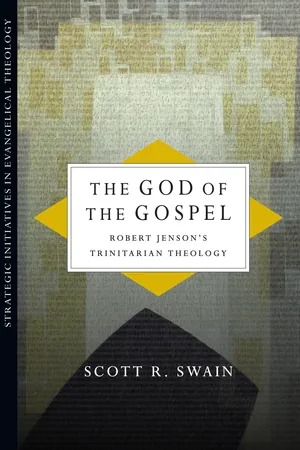
Who is the God of the gospel?Robert W. Jenson's way of answering this question, according to Scott Swain, hinges on the nature of the relationship between God in himself and the redemptive events through which God becomes
our God.Swain first locates Jenson's pursuit of a relentlessly "evangelical" understanding of God in the broader history of trinitarian theology after Karl Barth, before carefully and sympathetically unpacking Jenson's doctrine of the Trinity. For Jenson, one of today's most prominent theologians, the answer to the question, "Who is the God of the gospel?" may be summarized as, "The one who raised Jesus from the dead." Swain then offers a constructive evaluation of Jenson's account of the mutually constitutive character of God's intrinsic identity and saving acts.Although critical of many of Jenson's trinitarian reinterpretations, Swain remains attentive to Jenson's concerns and insights. In the process, Swain sheds new light on what it means for the ecumenical trinitarian tradition to advocate a truly evangelical doctrine of the Trinity in the wake of the twentieth-century recasting of the identity of the God of the gospel.
God according to the gospel. The phrase epitomizes what must be the perennial quest of Christian theology: to know the only true God through Jesus Christ whom he has sent (Jn 17:3; 1:18). The foundation of this quest lies in the reality that God has indeed revealed himself supremely and reliably through the embassy of the Son’s incarnation, atonement, resurrection and enthronement. As Luther proclaims: “The seals are broken, the stone rolled away from the door of the tomb, and that greatest of all mysteries brought to light—that Christ, God’s Son became man, that God is Three in One, that Christ suffered for us, and will reign forever.”[1] From the reality that founds this quest follows a corresponding rule for theological reflection, eloquently summarized by John of Damascus: Since the divine benevolence “has revealed to us what it was expedient for us to know” through his only-begotten Son, “with these things let us be content and in them let us abide and let us not step over the ancient bounds or pass beyond the divine tradition” handed down to us “by the Law and the Prophets and the Apostles and the Evangelists.”[2] The present study is concerned with one particular dimension of the broad yet bounded place that is the knowledge of the gospel’s God, specifically the relationship between God and the evangelical events whereby God becomes our God. Our quaestio,[3] to borrow the scholastic idiom, concerns the relationship between God’s being and God’s self-determination, between the Trinity and election, between God’s unfailing character and God’s unfolding covenant that reaches its climax in the gospel of Jesus Christ. As this and the next chapter will demonstrate, this question is highly debated in contemporary theology. It is moreover a question that a truly “evangelical”[4] theology cannot ignore.
Theological questions have historical contexts, and this is certainly true of the topic at hand. Though our topic makes indirect appearances here and there in the history of theology, it finds perhaps its clearest and most direct expression in recent debates provoked by the theology of Karl Barth, on many accounts the most significant Protestant theologian of the twentieth century. The historical context for our study is trinitarian theology “after Barth.”[5] When it comes to the doctrine of the Trinity, the Basel theologian continues to stimulate diverse, creative and often contradictory proposals about what trinitarian theology should be, about where it is going, and especially about the relationship between God’s being Trinity and his being “the electing God”—the God who ordains and constitutes himself the “Friend and Benefactor” of sinners in Jesus Christ.[6] On this latter score especially, Barth’s theology poses a question that continues to “give rise to thought” (Heidegger).[7]
While the reception history of Barth’s trinitarian theology provides the broad context for the present study, its more immediate focus is Robert W. Jenson’s doctrine of God. An American Lutheran theologian of international ecumenical stature, Jenson has devoted nearly fifty years as a professional theologian to delineating a consistently evangelical doctrine of God.[8] In doing so, his theological program provides one of contemporary theology’s most sophisticated, comprehensive, and creative responses to many of the questions that Barth poses for a trinitarian dogmatics. Unfortunately, Jenson’s theology is only beginning to receive the critical attention it deserves.[9] As David Bentley Hart observes, Jenson’s “thought is too little taught and too little studied; too few dissertations engage his ideas; not nearly enough attention is paid to his contributions to modern dogmatics; and too little pride is taken in the dignity his work lends to American theology.”[10] This is a lamentable situation, not only because a theologian of Jenson’s stature remains so largely neglected, but also because of the nature of his proposal. The present study hopes to remedy this situation, at least in part, by rendering a critical exposition of his account of “God according to the gospel.”[11] The intention is not merely descriptive, however. Engaging Jenson’s doctrine of God provides both stimulus and occasion for outlining my own constructive response to the topic under consideration, the relationship between God’s triune being and his triune self-determination to be our God through the gospel.
In order to set the stage for addressing the question before us in this book, the present chapter will seek to accomplish two things: first, to provide the necessary backdrop to the story of trinitarian theology after Barth, and to Jenson’s place within that story, by describing the modern roots of the contemporary resurgence of trinitarian theology; second, to introduce the structure and argument of the present study by providing an overview of the chapters that follow.
The Modern Roots of the Contemporary Trinitarian Resurgence
The latter half of the twentieth century and the first decade of the twenty-first have witnessed a resurging interest in the doctrine of the Trinity, a fact now universally recognized and widely documented.[12] Rather than rehearsing matters that have been treated competently elsewhere, I wish to focus instead on elements of the modern trinitarian resurgence directly related to the question at hand, and to the specific context in which it arises. As we will see more fully in chapter two, although the renewal of trinitarian theology in the work of Karl Barth, and among those doing theology in his wake, represents a novel development in relation to much of modern theology, from another vantage point this renewal also represents the culmination of a consistent trajectory in modern Protestant theology devoted to developing a distinctly evangelical doctrine of God.
Since the time of the Reformation, the doctrine of the Trinity has been a problematic topic, especially for Protestants. The problem did not initially concern the doctrine per se (the virulent anti-trinitarianism of the sixteenth century notwithstanding). Though the early Reformers at times displayed ambiguous postures in relation to traditional trinitarian terminology (e.g., hypostasis, persona, ousia) and in relation to the doctrine’s place within the broader system of theology (e.g., Melanchthon’s 1521 Loci communes theologici), these ambiguities never amounted to questioning the substance of the doctrine. Luther located the doctrine of the Trinity among those “sublime articles of majesty” that were “not matters of dispute or contention” between Catholics and Protestants.[13] With Luther, all of the major theologians of the early Reformation era, along with the major confessions and divines of Protestant orthodoxy, roundly affirmed the doctrine of the Trinity as received and confessed by the ancient church. The problem for Protestants, at least initially, did not concern the content of the doctrine. The problem initially concerned what we might call the hermeneutical shape of trinitarian theology: the relationship between Holy Scripture, the ecumenically received form of the doctrine and the constructive task of dogmatics.[14] Whereas medieval theologians had the luxury of pursuing dogmatic reflection on the Trinity on the basis of established ecumenical symbols and the “sentences” of trustworthy ecclesial doctors, the Reformers’ commitment to grounding all dogmas in Scripture alone demanded that reflection on the Trinity exhibit a more directly exegetical mode. The point of course is not that the Reformers or their Protestant orthodox heirs sought to engage trinitarian doctrine apart from the church’s authoritative pronouncements and teachers, but that their engagement of the tradition had to take place within a transparently exegetical context. The reliability of secondary authorities could not be assumed but rather had to be established. This new hermeneutical setting for trinitarian theology resulted in a complex and often fruitful phase in the development of the doctrine that spanned a period of more than two centuries.[15]
With the rise of Enlightenment thought, the aforementioned hermeneutical problematic became more acute and, as it did, trinitarian theology underwent (oftentimes radical) material transformation.[16] Among many relevant factors contributing to this transformation, three deserve mention here: the rise of new interpretive methods, new attitudes toward classical metaphysics and new agendas for the Protestant university. First, as new approaches to biblical interpretation developed, not only were the biblical bases of the Trinity increasingly brought into question. The very enterprise of what we might call “trinitarian biblical exegesis” was undermined as the locus on the Trinity was segregated to the discipline of dogmatic theology, freeing the discipline of biblical exegesis to devote itself to its “proper” subject matter, that is, the historical development of biblical religion(s).[17] Uprooted from its native scriptural soil, trinitarian doctrine now needed to be rooted in other sources such as history and/or experience, if it was to be rooted at all.[18] Second, the rejection of traditional Christian metaphysics transposed the discourse of both critics and defenders of the Trinity into a new (and increasingly univocal) key, which in turn served to heighten the perceived irrationality of the doctrine.[19] Providing a constructive account of the “essence” of traditional trinitarian teaching under the new metaphysical, epistemological and linguistic conditions of the Enlightenment thus became one of the central tasks of modern trinitarian theology. Third, the restructuring of Protestant universities simultaneously inaugurated a new era of learning and relegated many of the pedagogical sources and religious practices associated with traditional orthodoxy to the status of terra incognita.[20] The effects of this relegation were perhaps subtler than other factors contributing to the modern transformation of trinitarian theology. Nevertheless, the significance of these changes cannot be overestimated. New institutional contexts and aims produced new and sometimes unreliable readers of the classical tradition of trinitarian thought, a fact particularly evident in nineteenth-century histories of dogma and in the constructive trinitarian theologies that emerged under their tutelage.[21]
Protestant responses to this ever deepening problematic were variegated. In his Conflict of the Faculties, Immanuel Kant famously concluded that the dogma of the Trinity was inconceivable as a concept and irrelevant to practical religion. He drew similar conclusions regarding the dogmas of Christ’s incarnation, resurrection and ascension.[22] Other modern thinkers were not generally so bold. Even when they accepted Kant’s critique of classical metaphysics and his basic epistemological framework, many continued to pursue the prize of a consistently evangelical trinitarianism.[23] Friedrich Schleiermacher argued that the traditional dogma could not be established on the basis of biblical exegesis, suggesting that “the Sabellian view” might represent as plausible an exegetical conclusion as “the Athanasian hypothesis.”[24] He also regarded the doctrine as saddled with internal contradictions.[25] These criticisms notwithstanding, Schleiermacher did not dispense with the dogma completely because he believed it articulated an essential element of God’s saving action as impressed on the Christian self-consciousness, namely, God’s active presence with humanity in Jesus Christ and in the church’s common Spirit.[26] Far from being merely an appendix to his theology, Schleiermacher’s discussion of the Trinity therefore functions simultaneously as the capstone of his system and as an attempt to lay the groundwork for an a posteriori approach to the doctrine that would flow out of the Christian experience of God’s twofold redeeming presence in Christ and the Spirit.[27] When Albrecht Ritschl later rejected the scholastic approach to God, with its distinction between God’s essential attributes and God’s external operations, and reinterpreted the eternal processions of Son and Spirit in light of their saving missions, he thus brought the approach initiated by Schleiermacher to its natural conclusion: a postmetaphysical doctrine of the Trinity, chastened by critical exegesis and epistemology, and thoroughly evangelical in impulse.[28]
Widely influential though it was, Schleiermacher’s approach to the Trinity did not prove satisfactory to all. Most notably perhaps, Georg W. F. Hegel considered Schleiermacher’s trinitarianism to be both theologically and philosophically inadequate.[29] Hegel sought an objective comprehension of God’s being, not merely a subjective awareness of God’s active presence. Only the former, he believed, would constitute a true knowledge of God. To be sure, for Hegel as much as for Schleiermacher, the doorway to the classical resources of trinitarian thought (i.e., scriptural, dogmatic, metaphysical, etc.) was largely a closed one. His concern to revive a robust trinitarian ontology and epistemology was therefore not an attempt at repristination. Nevertheless, according to Hegel, Christianity contained within itself the path to an objective knowledge of God in its notion of God’s self-revelation in history, with the Trinity standing out as this notion’s most “perspicuous symbol.”[30] Leaving behind a metaphysics of the self-enclosed divine substance for a metaphysics of the self-revealing divine subject (Geist), the doctrine of the Trinity comes to provide in Hegel’s thought both the ontological and the epistemological possibility for a true knowledge of God: As the triune God simultaneously reveals and realizes himself in history, human beings are taken up into God’s own concrete act of self-understanding, thus rendering to them an objective knowledge of God. Hegel’s speculative transgression of Kant’s “epistemological strictures” on trinitarian reflection is extended in the later philosophy of Friedrich Schelling. While Schelling’s trinitarian thought exhibits a greater familiarity with traditional trinitarianism, as well as a greater emphasis on divine freedom than Hegel’s, his modification of Hegel still amounts to a significant “destabilizing” of orthodox trinitarian teaching.[31]
For all the brilliance of these modern theologies of the Trinity, they remain on even the most sympathetic reading distant cousins of the ecumenically received doctrine and, in many cases, rather thin and underdeveloped.[32] A striking exception to this general rule comes in the oft-neglected trinitarian theology of Isaak August Dorner.[33] Working broadly within the Schleiermacherian tradition of inquiry, though drawing also from Hegel and Schelling,[34] Dorner’s doctrine of the Trinity represents a significant critique of and development beyond that of his predecessor in the chair of theology at the University of Berlin. While Dorner sought to provide a dogmatic account of God from within the context of faith, and thereby to continue the modern quest for a distinctly evangelical doctrine of God, he nevertheless argued that faith could only serve as the principium cognoscendi internum of theology not as its ...
Table of contents
Cover
Title
Copyright
Quote
Contents
Acknowledgments
Abbreviations
Introduction
1 The Question Stated
2 The State of the Question
Part One
3 The Way of God’s Identity According to the Old Testament
4 The Way of God’s Identity According to the New Testament
5 The Triune Identity
Part Two
6 “A Father to You”
7 Immanuel
8 “Deluged with Love”
9 Grace and Being
10 Concluding Reflections on the Question
Conclusion
Notes
Bibliography
Author Index
Subject Index
Scripture Index
Strategic Initiatives in Evangelical Theology
About the Author
Trusted by 375,005 students
Access to over 1.5 million titles for a fair monthly price.
Study more efficiently using our study tools.
Frequently asked questions
Yes, you can cancel anytime from the Subscription tab in your account settings on the Perlego website. Your subscription will stay active until the end of your current billing period. Learn how to cancel your subscription
No, books cannot be downloaded as external files, such as PDFs, for use outside of Perlego. However, you can download books within the Perlego app for offline reading on mobile or tablet. Learn how to download books offline
Perlego offers two plans: Essential and Complete
Essential is ideal for learners and professionals who enjoy exploring a wide range of subjects. Access the Essential Library with 800,000+ trusted titles and best-sellers across business, personal growth, and the humanities. Includes unlimited reading time and Standard Read Aloud voice.
Complete: Perfect for advanced learners and researchers needing full, unrestricted access. Unlock 1.5M+ books across hundreds of subjects, including academic and specialized titles. The Complete Plan also includes advanced features like Premium Read Aloud and Research Assistant.
Both plans are available with monthly, semester, or annual billing cycles.
We are an online textbook subscription service, where you can get access to an entire online library for less than the price of a single book per month. With over 1.5 million books across 990+ topics, we’ve got you covered! Learn about our mission
Look out for the read-aloud symbol on your next book to see if you can listen to it. The read-aloud tool reads text aloud for you, highlighting the text as it is being read. You can pause it, speed it up and slow it down. Learn more about Read Aloud
Yes! You can use the Perlego app on both iOS and Android devices to read anytime, anywhere — even offline. Perfect for commutes or when you’re on the go. Please note we cannot support devices running on iOS 13 and Android 7 or earlier. Learn more about using the app
Yes, you can access The God of the Gospel by Scott R. Swain in PDF and/or ePUB format, as well as other popular books in Theology & Religion & Christian Theology. We have over 1.5 million books available in our catalogue for you to explore.