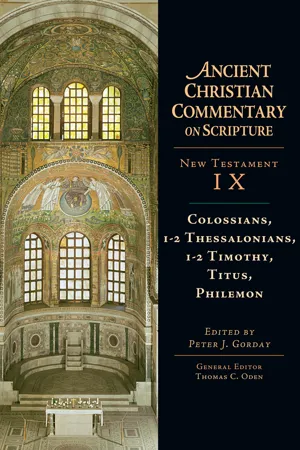
Colossians, 1-2 Thessalonians, 1-2 Timothy, Titus, Philemon
eBook - ePub

Colossians, 1-2 Thessalonians, 1-2 Timothy, Titus, Philemon

Volume 9

  1. 355 pages
  2. English
  3. ePUB (mobile friendly)
  4. Available on iOS & Android
eBook - ePub

Colossians, 1-2 Thessalonians, 1-2 Timothy, Titus, Philemon

Volume 9

About this book

Christianity Today Book of the Year

For the early church fathers, certain passages in the shorter letters of St. Paul proved particularly important in doctrinal disputes and practical church matters. Pivotal in controversies with the Arians and the Gnostics, the most commented-on christological text in these letters was Colossians 1:15-20, where Jesus is declared "the image of the invisible God, the firstborn of all creation."

The fathers found ample support scattered throughout the Pastorals for the divinity of the Son and the Spirit and for the full union of humanity and divinity in the "one mediator between God and men, the man Christ Jesus" (1 Timothy 2:5). These commentators also looked to the Pastorals for important teaching on ethics and church life.

Chief among the Eastern commentators and widely excerpted throughout this volume is John Chrysostom, praised for his pastoral insight. Other Greek commentators cited include Theodoret of Cyr, Theodore of Mopsuestia, Severian of Gabala, Ignatius of Antioch, Justin Martyr, Irenaeus, Clement of Alexandria, Athanasius, Basil the Great, Gregory of Nazianzus, and Gregory of Nyssa. Western commentators include Augustine,Ambrosiaster, Pelagius, Jerome, Hippolytus, Tertullian, Novatian, Cyprian of Carthage, Hilary of Poitiers, and Ambrose. Of particular interest for their ascetical and devotional insight are works from Syrian and Egyptian churches, including Aphrahat,Ephrem the Syrian, Isaac of Nineveh, and Philoxenus of Mabbug.

This Ancient Christian Commentary on Scripture volume opens up a treasure house of ancient wisdom that allows these faithful witnesses, some appearing here in English translation for the first time, to speak with eloquence and intellectual acumen to the church today.

Trusted by 375,005 students

Access to over 1.5 million titles for a fair monthly price.

Study more efficiently using our study tools.

Information

Publisher
IVP Academic
Year
2014
eBook ISBN
9780830897513
Print ISBN
9780830814947

THE FIRST EPISTLE TO THE THESSALONIANS

ARGUMENT: After leaving the Christians of Thessalonica, Paul had sent Timothy back to them from Athens. He now writes to praise them for their firmness of faith, as well as to exhort them to look for the resurrection of the dead (THEODORET). Paul wrote this letter to the Thessalonians in order to praise them for their steadfastness in faith and to give them further instruction (THEODORE). Here Paul encourages the Thessalonian Christians, who have endured a great deal of persecution and who remain vulnerable to pagan Greek influences. Central to Paul’s encouragement is his teaching about the resurrection of the dead, since grief at the death of fellow believers is an especially heavy burden for the Thessalonians (SEVERIAN). They must not be too curious about the exact time of the Lord’s coming (THEODORET). Paul praises the Thessalonians as an example of faith but also presses them to push on toward perfection. He wishes them to have such a measure of the Spirit that in the hope of what is to come they might continue to suffer persecution for the name of Christ (AMBROSIASTER).

GREETINGS AND PRAISE
1 THESSALONIANS 1:1-10

OVERVIEW: Paul’s intention in this opening section is to come before the Thessalonians in all humility, eschewing all titles, magnifying the work of his associates and praising the Thessalonians for their great faith and their hard work during persecution (CHRYSOSTOM). The very nature of true faith is that it arouses believers to good work, for love produces steadfastness in laboring, and hope produces endurance with patience. Paul gives thanks for all of the progress that the Thessalonians have made, holding them up to the other churches and praying for their continued growth (AMBROSIASTER). Paul shows here that the believer who has perfect love, whose faith is whole, is able to bear all things patiently for the sake of the future hope (PELAGIUS).

1:1 Paul, Silvanus and Timothy

WITHOUT TITLE. CHRYSOSTOM: Here Paul gives himself no title. He refers to himself neither as “an apostle” nor as “a servant.” Paul avoids such titles, I suppose, because the Thessalonians were newly instructed and still didn’t know Paul well. His preaching ministry to this church was just beginning. HOMILIES ON 1 THESSALONIANS 1.1
A DIVINE HARMONY. ORIGEN: Two made a symphony, Paul and Sosthenes, when writing the first epistle to the Corinthians. After this Paul and Timothy sang in harmony when they wrote their second letter to the same church. And even three made a symphony when Paul and Silvanus and Timothy gave instruction by letter to the Thessalonians. COMMENTARY ON MATTHEW 14.1.2

1:2 We Give Thanks to God Always for You

OPENING ENCOURAGEMENT. CHRYSOSTOM: For to give thanks to God for them is the act of one testifying to how they have advanced in the faith. Not only are the Thessalonians praised by Paul, but Paul thanks God for them, as though God himself had accomplished everything. Paul also teaches them to be moderate in their self-estimation, all but saying that all their growth is from the power of God. HOMILIES ON 1 THESSALONIANS 1.3

1:5 In Power and in the Holy Spirit

YOUR CONVERSION FROM GOD. THEODORE OF MOPSUESTIA: For you know, he says, how you came to be chosen (that is, how you arrived at faith), for you did not believe solely by means of our words. Indeed, we not only spoke but also showed wonders, great and glorious and worked by the Spirit, by which you were strengthened with regard to the things we had spoken to you. Hold on tightly to what you have learned, and don’t be deflected from your course by the external things that happen to you. COMMENTARY ON 1 THESSALONIANS.4
RECEIVING THE SPIRIT. GREGORY OF NYSSA: Thus, the obedient and responsive soul gives itself over to the virtuous life. This life is freedom itself, on the one hand, from the chains of this life, separating itself from the slavery of base and empty pursuits. On the other hand, this soul devotes itself to faith and the life of God alone, because it sees clearly that where there is faith, reverence and a blameless life, there is present the power of Christ, there is flight from all evil and from death which robs us of life. For shameful things do not have in themselves sufficient power to compete with the power of the Lord. It is their nature to develop from disobedience to his commands. This was experienced in ancient times by the first man, but now it is experienced by all of us when we imitate Adam’s disobedience through stubborn choice. However, those who approach the Spirit with honest intent, unfeigned faith and an undefiled conscience, are cleansed by the Spirit according to the one who says, “for our gospel was not delivered to you in word only, but in power also; and in the Holy Spirit and in much fullness, as you know.” ON THE CHRISTIAN MODE OF LIFE.5
PAUL’S HUMILITY. AMBROSIASTER: In order to indicate that he showed all humility among the Thessalonians and in order to adopt a gentle approach in dealing with them, Paul makes it clear that none of the powerful means by which they have been brought to faith is lacking. His preaching was accompanied by signs and wonders and was empowered by the Holy Spirit. It embodied the fullness of truth rather than fantasy. This could be seen in the teaching of grace, in the quality of discourse among them and in the healing of the sick. By these they could be seen to be the true heirs of the gift of God in the promises to Abraham. COMMENTARY ON THE FIRST LETTER TO THE THESSALONIANS.6
THE NATURE OF SPIRITUAL POWER. PELAGIUS: The reception of the gospel by the Thessalonians “in power” may mean that Paul’s preaching was accompanied by miraculous signs, but it may also mean that it strengthened the Thessalonians for much endurance in suffering. PELAGIUS’S COMMENTARY ON THE FIRST LETTER TO THE THESSALONIANS.7

1:6 In Much Affliction, with Joy

THE JOY OF THE SPIRIT. CHRYSOSTOM: “With joy inspired by the Holy Spirit,” Paul says. So that no one can say, “How can you speak of affliction and of joy in the same breath?” he adds, “inspired by the Holy Spirit.” The affliction pertains to the body, and the joy to things spiritual. But how? The things that happened to them were burdensome, but not so the things that sprang up out of them, for the Spirit does not allow it. So then, it is possible for one who suffers not to rejoice when he is suffering for his sins but nevertheless to experience pleasure when he is being beaten and suffers for Christ’s sake. For such is the joy of the Spirit. In return for the things which seem to be burdensome, the Spirit brings delight. They have afflicted you, he says, and persecuted you, but the Spirit did not forsake you even in those circumstances. HOMILIES ON 1 THESSALONIANS 1.8
TRUE IMITATION. AMBROSIASTER: Those who, eager to believe, suffer insults and injuries from their fellows, are precisely those who may be called imitators of the apostles and of the Lord himself. He suffered the same things from the Jews, as did the apostles who endured persecution as they pursued their faith in God. COMMENTARY ON THE FIRST LETTER TO THE THESSALONIANS.9

1:7 An Example to All the Believers

GRACE REQUIRES COOPERATION. CHRYSOSTOM: Do you see what a great thing zeal is? It does not ask for more time or delay or procrastinate. It is sufficient simply to offer one’s self, and all is fulfilled. . . . Why then do I say this? Because if we are awake we shall not need the help of others. If we sleep, the help of others accomplishes nothing for us, but even with their aid we perish. . . . You say that your prayers accomplish little? They accomplish much when we combine th...

Table of contents

  1. Cover
  2. Title Page
  3. Ancient Christian Commentary Project Research Team
  4. Contents
  5. Publisher’s Note Regarding This Digital Edition
  6. General Introduction
  7. A Guide to Using This Commentary
  8. Abbreviations
  9. Introduction to the Shorter Epistles
  10. Commentary on Colossians
  11. Commentary on 1 Thessalonians
  12. Commentary on 2 Thessalonians
  13. Commentary on 1 Timothy
  14. Commentary on 2 Timothy
  15. Commentary on Titus
  16. Commentary on Philemon
  17. Appendix: Early Christian Writers and the Documents Cited
  18. Chronological List of Persons & Writings
  19. Biographical Sketches
  20. Authors/Writings Index
  21. Subject Index
  22. Scripture Index
  23. Notes
  24. Praise for the Ancient Christian Commentary on Scripture
  25. About the Editor
  26. Ancient Christian Commentary on Scripture
  27. More Titles from InterVarsity Press
  28. Copyright Page

Frequently asked questions

Yes, you can cancel anytime from the Subscription tab in your account settings on the Perlego website. Your subscription will stay active until the end of your current billing period. Learn how to cancel your subscription
No, books cannot be downloaded as external files, such as PDFs, for use outside of Perlego. However, you can download books within the Perlego app for offline reading on mobile or tablet. Learn how to download books offline
Perlego offers two plans: Essential and Complete
  • Essential is ideal for learners and professionals who enjoy exploring a wide range of subjects. Access the Essential Library with 800,000+ trusted titles and best-sellers across business, personal growth, and the humanities. Includes unlimited reading time and Standard Read Aloud voice.
  • Complete: Perfect for advanced learners and researchers needing full, unrestricted access. Unlock 1.5M+ books across hundreds of subjects, including academic and specialized titles. The Complete Plan also includes advanced features like Premium Read Aloud and Research Assistant.
Both plans are available with monthly, semester, or annual billing cycles.
We are an online textbook subscription service, where you can get access to an entire online library for less than the price of a single book per month. With over 1.5 million books across 990+ topics, we’ve got you covered! Learn about our mission
Look out for the read-aloud symbol on your next book to see if you can listen to it. The read-aloud tool reads text aloud for you, highlighting the text as it is being read. You can pause it, speed it up and slow it down. Learn more about Read Aloud
Yes! You can use the Perlego app on both iOS and Android devices to read anytime, anywhere — even offline. Perfect for commutes or when you’re on the go.
Please note we cannot support devices running on iOS 13 and Android 7 or earlier. Learn more about using the app
Yes, you can access Colossians, 1-2 Thessalonians, 1-2 Timothy, Titus, Philemon by Peter J. Gorday, Thomas C. Oden, Peter J. Gorday,Thomas C. Oden in PDF and/or ePUB format. We have over 1.5 million books available in our catalogue for you to explore.