"One of the simplest yet most comprehensive yoga books to be published in recent memory, Miller's work could become a classic . . . appropriate for all levels." —
Publishers Weekly
From the bestselling author of
The Yoga Deck comes
Essential Yoga—the only hatha yoga book to offer this many poses (over 100), this many illustrations (over 180), and this many suggested sequences (over 50).
Focusing on the poses themselves, it provides clear, concise instructions and detailed illustrations for each. It also includes six classic moving meditations (such as Sun Salutation and Camel Vinyasa), ten beginner-to-advanced sessions, and 48 mini-sequences designed to build strength for specific activities or alleviate health problems.
Essential Yoga combines physical poses (asanas), breathing exercises (pranayamas), and meditations (dhyanas) into a simple and complete reference guide for yoga practitioners of all levels. Along the way, author Olivia Miller provides guidance on proper technique and alignment; modifications for beginners or those with knee, neck, or back pain; suggestions for preventing injury; and ways to keep a regular practice interesting and active.
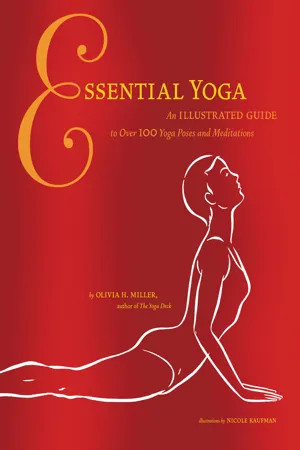
eBook - ePub
Essential Yoga
An Illustrated Guide to Over 100 Yoga Poses and Meditations
- 240 pages
- English
- ePUB (mobile friendly)
- Available on iOS & Android
eBook - ePub
Essential Yoga
An Illustrated Guide to Over 100 Yoga Poses and Meditations
About this book
Information
1

BREATHING EXERCISES
WHEREVER WE ARE WE HAVE THE CAPACITY TO ENJOY THE SUNSHINE, THE PRESENCE OF EACH OTHER, THE WONDER OF OUR BREATHING.
This chapter focuses on breath expansion and control, known as pranayama. The way we breathe has a profound effect on the quality of our lives. Our breath affects the body, mind, and emotions. Shallow breathing deprives the body of oxygen and the life-giving force, prana. When we breathe deeply, our respiratory, circulatory, digestive, and nervous systems function better. Our minds become clearer, and our concentration improves. Stress, anger, and tension dissipate.
Through a variety of breathing techniques, hatha yoga uses pranayama to help us more fully oxygenate and purify our bodies, to slow and calm our minds, to steady our emotions, and to balance our energies. The breath can be divided into four parts: inhalation (puraka), retention or holding the breath in (kumbhaka), exhalation (rechaka), and finally, suspension or holding the breath out (bahya kumbhaka). Inhalation brings nourishment and energy, holding the breath allows prana to fully enter and energize the body, exhalation cleanses the system and quiets the emotions, and suspension extends the benefits of exhalation by further calming your entire being. Full, deep breathing that includes all four stages—inhalation, retention, exhalation, and suspension—properly fuels, energizes, cleanses, balances, and relaxes the entire system.
The 12 exercises included in this chapter encourage conscious yogic breathing, which engages the diaphragm, the large dome-shaped muscle that enables us to breathe. When we inhale, the diaphragm lowers into the abdominal area, drawing air into the lungs; when we exhale, the diaphragm rises up, pushing the air out. Diaphragmatic breathing allows us to fill our lungs completely, bringing in a fresh supply of oxygen, and then expel all the stale air as we exhale, promoting health and well-being.
Many of these breathing exercises include counting to help you slow and lengthen the breath and to encourage you to focus on your breathing. If you are new to pranayama, try to make your exhalation as long as your inhalation; eventually, see if you can slow your exhalation so that it lasts longer than the inhalation, an effective way to thoroughly calm your body and mind. The exhalation should also be longer than or equal to the retention of the breath that follows inhalation.
Most of these breathing exercises may be done from a supine position (lying on your back), in a comfortable seated position on a mat or a cushion on the floor, or seated in a chair. When in a seated position, allow your sitting bones to sink into the chair or cushion. Your pelvis is level, and your shoulders are relaxed and down away from the ears. Your chin is parallel to the floor and retracted slightly. Gently press out through the crown of your head. If you are seated in a chair, your knees may be slightly higher than or even with the hips; if they are not, place your feet on a cushion (see introduction to seated poses, page 89). If you are seated on the floor, you may wish to sit in Easy pose (page 90) or Half Lotus (page 90). Your eyes may be closed or downcast.
If any part of the exercise bothers you—if you’d rather not count, or if the count is too long or too short, for instance—make whatever adjustments you need. Some breathing exercises use sounds as a way to calm the body and mind. Although you may feel self-conscious, this is a great way to focus and concentrate on your breath. If you have trouble breathing or have a cold or bronchitis, wait until you feel better before you do any deep breathing exercises. If you suffer from heart disease or asthma, consult a physician first.
Before you begin, start by focusing on your “normal” breathing pattern. Sit or lie in a comfortable position. Close your eyes. Observe your breath. Try not to change or judge; simply observe. Does the pace of your breath seem rapid or slow? Is it even or uneven? Does your inhalation last longer than your exhalation? Do you hold your breath? What parts of your body move when you breathe? Do you notice any areas of tightness or tension? Do you breathe more from your chest or your belly? Do you breathe through your nose or mouth? Does observing your breath make you uncomfortable? Answers to some of these questions may not come right away; sit with them for a while and see what arises. Focusing on your breathing can also become a form of meditation, another way to focus and alleviate stress.
Once you become more familiar with your breathing pattern, the following exercises will help you explore ways to use your breath to feel stimulated or relaxed. As you breathe deeply, acknowledge the miracle of your breath—this amazing life-giving force that we so often take for granted.
ALTERNATE NOSTRIL BREATH
(Anuloma Viloma)
Although we may not be aware of it, we normally breathe in one- to two-hour cycles; first one nostril, then the other is dominant. (If you’re curious, check which nostril is dominant by closing off one nostril and breathing through the other; reverse, and compare the airflow from each.) Prolonged breathing through one side can drain our energy. Anuloma Viloma, an ancient breathing technique, has a profound stilling effect on the mind and restores the proper balance to our breathing pattern, which equalizes the energies and pathways of the nervous system. Placing your index and middle fingers on your forehead stimulates the “third eye,” our center of intuition and connection to the higher self. Practice Alternate Nostril Breath whenever you seek a calm, clear state of mind.
• Before you begin, you may wish to use a tissue to clear your nostrils. Sit comfortably in a chair or on a mat, keeping your spine straight.
• Place the index and middle fingers of your right hand on your forehead, between the eyebrows. Your thumb rests on the right nostril; the ring and baby fingers rest on your left nostril. If you prefer not to place your fingers on the forehead, curl the index and middle fingers toward the palm instead.
•...
Table of contents
- Cover
- Half title
- Title
- Dedication
- Copyright
- Contents
- Introduction
- Chapter 1: Breathing Exercises
- Chapter 2: Warm-Ups
- Chapter 3: Yoga Poses
- Chapter 4: Meditations
- Chapter 5: Flowing Routines
- Chapter 6: Yoga Sessions
- Chapter 7: Recommended Sequences
- References
- Index
Trusted by 375,005 students
Access to over 1.5 million titles for a fair monthly price.
Study more efficiently using our study tools.
Frequently asked questions
Yes, you can cancel anytime from the Subscription tab in your account settings on the Perlego website. Your subscription will stay active until the end of your current billing period. Learn how to cancel your subscription
No, books cannot be downloaded as external files, such as PDFs, for use outside of Perlego. However, you can download books within the Perlego app for offline reading on mobile or tablet. Learn how to download books offline
Perlego offers two plans: Essential and Complete
- Essential is ideal for learners and professionals who enjoy exploring a wide range of subjects. Access the Essential Library with 800,000+ trusted titles and best-sellers across business, personal growth, and the humanities. Includes unlimited reading time and Standard Read Aloud voice.
- Complete: Perfect for advanced learners and researchers needing full, unrestricted access. Unlock 1.5M+ books across hundreds of subjects, including academic and specialized titles. The Complete Plan also includes advanced features like Premium Read Aloud and Research Assistant.
We are an online textbook subscription service, where you can get access to an entire online library for less than the price of a single book per month. With over 1.5 million books across 990+ topics, we’ve got you covered! Learn about our mission
Look out for the read-aloud symbol on your next book to see if you can listen to it. The read-aloud tool reads text aloud for you, highlighting the text as it is being read. You can pause it, speed it up and slow it down. Learn more about Read Aloud
Yes! You can use the Perlego app on both iOS and Android devices to read anytime, anywhere — even offline. Perfect for commutes or when you’re on the go.
Please note we cannot support devices running on iOS 13 and Android 7 or earlier. Learn more about using the app
Please note we cannot support devices running on iOS 13 and Android 7 or earlier. Learn more about using the app
Yes, you can access Essential Yoga by Olivia H. Miller,Nicole Kaufman in PDF and/or ePUB format, as well as other popular books in Ciencias biológicas & Ciencias del deporte y del ejercicio. We have over 1.5 million books available in our catalogue for you to explore.