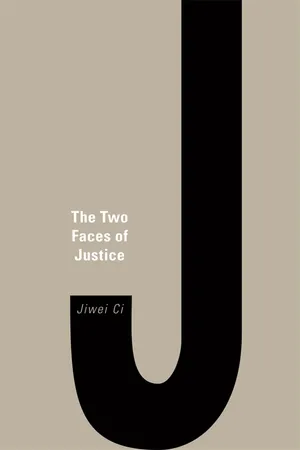
Justice is a human virtue that is at once unconditional and conditional. Under favorable circumstances, we can be motivated to act justly by the belief that we must live up to what justice requires, irrespective of whether we benefit from doing so. But our will to act justly is subject to conditions. We find it difficult to exercise the virtue of justice when others regularly fail to. Even if we appear to have overcome the difficulty, our reluctance often betrays itself in certain moral emotions.
In this book, Jiwei Ci explores the dual nature of justice, in an attempt to make unitary sense of key features of justice reflected in its close relation to resentment, punishment, and forgiveness. Rather than pursue a search for normative principles, he probes the human psychology of justice to understand what motivates moral agents who seek to behave justly, and why their desire to be just is as precarious as it is uplifting.,
A wide-ranging treatment of enduring questions, The Two Faces of Justice can also be read as a remarkably discerning contribution to the Western discourse on justice re-launched in our time by John Rawls.
eBook - PDF
The Two Faces of Justice
About this book
Information
Topic
FilosofíaSubtopic
Ética y filosofía moralTable of contents
- Cover
- Title Page
- Copyright
- Dedication
- Acknowledgments
- Contents
- Introduction
- Chapter 1. Elements of a Just Disposition
- Chapter 2. The Subjective Circumstances of Justice
- Chapter 3. The Objective Circumstances of Justice
- Chapter 4. The Idea of Voluntary Justice
- Chapter 5. The Moral Reach of Rational Egoism
- Chapter 6. Impartiality and Justification
- Chapter 7. A Progress of Reciprocity
- Chapter 8. Two Paths to Unconditional Justice
- Chapter 9. Forgetting and Resentment
- Chapter 10. Individual Forgiveness, Social Resentment
- Chapter 11. Justice and the Moralization of Sympathy
- Chapter 12. Justice as a Conscious Virtue
- Index
Trusted by 375,005 students
Access to over 1.5 million titles for a fair monthly price.
Study more efficiently using our study tools.
Frequently asked questions
Yes, you can cancel anytime from the Subscription tab in your account settings on the Perlego website. Your subscription will stay active until the end of your current billing period. Learn how to cancel your subscription
No, books cannot be downloaded as external files, such as PDFs, for use outside of Perlego. However, you can download books within the Perlego app for offline reading on mobile or tablet. Learn how to download books offline
Perlego offers two plans: Essential and Complete
- Essential is ideal for learners and professionals who enjoy exploring a wide range of subjects. Access the Essential Library with 800,000+ trusted titles and best-sellers across business, personal growth, and the humanities. Includes unlimited reading time and Standard Read Aloud voice.
- Complete: Perfect for advanced learners and researchers needing full, unrestricted access. Unlock 1.5M+ books across hundreds of subjects, including academic and specialized titles. The Complete Plan also includes advanced features like Premium Read Aloud and Research Assistant.
We are an online textbook subscription service, where you can get access to an entire online library for less than the price of a single book per month. With over 1.5 million books across 990+ topics, we’ve got you covered! Learn about our mission
Look out for the read-aloud symbol on your next book to see if you can listen to it. The read-aloud tool reads text aloud for you, highlighting the text as it is being read. You can pause it, speed it up and slow it down. Learn more about Read Aloud
Yes! You can use the Perlego app on both iOS and Android devices to read anytime, anywhere — even offline. Perfect for commutes or when you’re on the go.
Please note we cannot support devices running on iOS 13 and Android 7 or earlier. Learn more about using the app
Please note we cannot support devices running on iOS 13 and Android 7 or earlier. Learn more about using the app
Yes, you can access The Two Faces of Justice by Jiwei Ci in PDF and/or ePUB format, as well as other popular books in Filosofía & Ética y filosofía moral. We have over 1.5 million books available in our catalogue for you to explore.