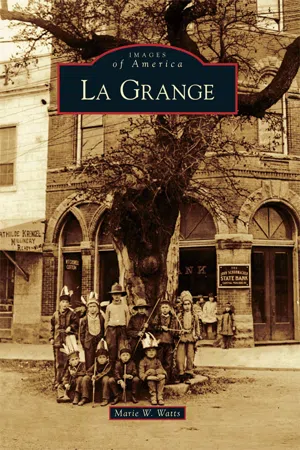
La Grange, voted the capital of the Republic of Texas in 1838, is as colorful and audacious as the state itself. Its citizens were instrumental in winning the republics freedom and have always been willing to fight for their beliefs. Many defend La Grange as the true capital of Texas, unfairly stripped of its title. The town flourished during the 19th century and witnessed the birth of a rough-and-tumble society, where arguments were commonly settled with fists, knives, and guns. In later years, immigrants flocked to the area and built a strong agricultural economy. The 20th century might have passed quietly into history if not for a Houston television reporter who publicized the demise of one of Texass best-known brothels, the Chicken Ranch, located just outside of La Grange. The extensive publicity surrounding the closing of the Best Little Whorehouse in Texas resulted in a musical and movie of the same name, as well as a song by ZZ Top.
eBook - ePub
La Grange
About this book
Trusted by 375,005 students
Access to over 1.5 million titles for a fair monthly price.
Study more efficiently using our study tools.
Information
Four
WORKING HARD AND PLAYING HARD
Between its founding in 1837 and the start of the Civil War, La Grange worked hard as a mercantile center supplying area plantations and as the seat of county government. By 1860, La Grange was supporting nearly 1,000 Fayette County farms, which produced more than 12,000 bales of cotton and 320,000 bushels of corn, along with tobacco and wool.
By the start of the 20th century, when immigration had helped Fayette County reach an all-time high in population (36,542), La Grange was a bustling little city of 2,392. It boasted one wholesale grocery business; seven general merchandise stores; four groceries; five dry goods stores; three hardware stores; three furniture houses; two saddleries; two jewelry stores; three drugstores; 11 barrooms; two beer agents; three blacksmith shops; three shoemakers; two tailors; one millinery; two restaurants; three hotels; one lumberyard; two livery stables; two granaries; one marble yard; one English, one German, and one Czech newspaper; 16 lawyers; two dentists; five physicians; two banks; two meat markets; two photograph galleries; one waterworks and electric light plant; one cotton oil mill; one cotton compress; one soda factory; one ice factory; and two cotton gins. These merchants continued to supply farmers of the area.
During the 20th century, agricultural production turned increasingly to raising cattle. By the 1980s and 1990s, area economic development largely relied on natural resources such as construction gravel, grinding pebbles, clays, timber, oil, and gas.
Besides working hard, La Grange citizens played hard. Parades, local stage productions, baseball games, picnics, beer drinking, singing groups, local bands, high school athletics, and church activities have all been popular. By 1900, La Grange had nine fraternal lodges. Having fun while providing a well-needed service or supporting a favorite charity is a hallmark of La Grange. Even today, area organizations continue to hold dinners, festivals, auctions, or other forms of entertainment to raise money for worthy causes.

Cotton was a big cash crop for Fayette County. During the Civil War, it was shipped to Mexico to raise money for the Confederacy and to provide badly needed supplies to civilians. After the war, freedmen worked cotton fields as sharecroppers, receiving one-third or one-half of the crops for their labors. By 1929, more than half of all farmland in Fayette County was planted in cotton, and production averaged 30,000 bales annually. By 1987, however, cotton was no longer grown. (Courtesy FPLMA.)

After the Civil War, plantation owners sold off their land to German and Czech immigrants, an act resulting in smaller, more numerous farms. The rich soil, abundant surface and groundwater, and intensive cultivation caused these farms to be more productive. The small farms turned to truck farming—raising cabbages, tomatoes, potatoes, beans, peas, and turnips. Here farmers toil in the Colorado River Valley ...
Table of contents
- Title Page
- Copyright Page
- Dedication
- Table of Contents
- ACKNOWLEDGMENTS
- INTRODUCTION
- One - NATIVE AMERICANS AND THE SEVEN FLAGS OVER LA GRANGE
- Two - ALWAYS READY FOR A GOOD FIGHT
- Three - WILLING AND UNWILLING IMMIGRANTS
- Four - WORKING HARD AND PLAYING HARD
- Five - THE MIGHTY ARM OF THE LAW
- Six - THE GOOD, THE BAD, AND THE UNLUCKY
- Seven - THE TRUTH ABOUT THE CHICKEN RANCH
Frequently asked questions
Yes, you can cancel anytime from the Subscription tab in your account settings on the Perlego website. Your subscription will stay active until the end of your current billing period. Learn how to cancel your subscription
No, books cannot be downloaded as external files, such as PDFs, for use outside of Perlego. However, you can download books within the Perlego app for offline reading on mobile or tablet. Learn how to download books offline
Perlego offers two plans: Essential and Complete
- Essential is ideal for learners and professionals who enjoy exploring a wide range of subjects. Access the Essential Library with 800,000+ trusted titles and best-sellers across business, personal growth, and the humanities. Includes unlimited reading time and Standard Read Aloud voice.
- Complete: Perfect for advanced learners and researchers needing full, unrestricted access. Unlock 1.5M+ books across hundreds of subjects, including academic and specialized titles. The Complete Plan also includes advanced features like Premium Read Aloud and Research Assistant.
We are an online textbook subscription service, where you can get access to an entire online library for less than the price of a single book per month. With over 1.5 million books across 990+ topics, we’ve got you covered! Learn about our mission
Look out for the read-aloud symbol on your next book to see if you can listen to it. The read-aloud tool reads text aloud for you, highlighting the text as it is being read. You can pause it, speed it up and slow it down. Learn more about Read Aloud
Yes! You can use the Perlego app on both iOS and Android devices to read anytime, anywhere — even offline. Perfect for commutes or when you’re on the go.
Please note we cannot support devices running on iOS 13 and Android 7 or earlier. Learn more about using the app
Please note we cannot support devices running on iOS 13 and Android 7 or earlier. Learn more about using the app
Yes, you can access La Grange by Marie Watts in PDF and/or ePUB format, as well as other popular books in History & North American History. We have over 1.5 million books available in our catalogue for you to explore.