- 128 pages
- English
- ePUB (mobile friendly)
- Available on iOS & Android
eBook - ePub
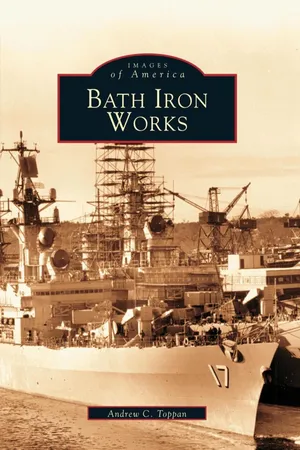
Bath Iron Works
About this book
Bath Iron Works was established by Gen. Thomas Hyde in 1884 and launched its first ship in 1891. This collection of shipbuilding photographs brings to life the proud history of Bath Iron Works.
Since then, the shipyard on the Kennebec River has built dozens of luxurious yachts, hardworking freighters, tugs, trawlers, lightships, and more than two hundred twenty warships for the U.S. Navy. Today, Bath Iron Works continues a shipbuilding tradition that began nearly four hundred years ago when the first ship built in America was constructed just a few miles downriver from Bath. Bath Iron Works showcases a unique collection of photographs that provides a rare view inside one of the nation's great shipyards. The book shows the yard's origins in a few simple buildings, its expansion into a modern shipbuilding facility, and its rapid growth into an industrial powerhouse during World War II. During these years, Bath Iron Works produced famous ships such as the America's Cup defender Ranger, the yachts Aras and Hi-Esmaro, the record-setting destroyer USS Lamson, and fully one fourth of all destroyers built for the U.S. Navy during World War II. Bath Iron Works gives an insider's view of these great vessels and many others, as skilled craftspeople turn raw materials into complex ships, each uniquely suited to its purpose.
Information
Four
RETURN OF THE DESTROYERS: BATH IRON WORKS GOES TO WAR

In 1932, Bath Iron Works returned to the business of building destroyers for the Navy, laying the keel for Dewey (DD 349), which was launched on July 28, 1934. Fourteen years earlier, Bath had launched the Navy’s last flush decker, Pruitt (DD 347). In the interim, the Navy built no destroyers. The drought was broken by Dewey and sistership Farragut, built at another shipyard. With these new ships, the Navy started rebuilding its destroyer fleet for the coming war, while also rebuilding the shipyards that would be needed for wartime construction.

Dewey’s boilers were installed c. 1933. This unique A-frame crane was Bath’s solution to lifting boilers, engines, and other equipment too heavy for conventional cranes, such as the one seen in the background. The A-frame and its supporting structure could be assembled over any of the shipways.

Dewey is on trials. The armament, not yet installed, included five 5-inch guns and eight torpedo tubes, in addition to light weapons. The modern destroyer’s design is radically different from the old flush deckers, including a raised forecastle to keep the decks dry in heavy weather. During the Battle of the Coral Sea, Dewey went alongside the burning carrier Lexington to take off the crew, saving 112 men.

The Kennebec River was vital to the shipyard’s existence, but sometimes caused problems. On March 23, 1936, the river ran high over its banks, putting much of the shipyard underwater. The second Bath destroyer of this era, Drayton, was supposed to be launched this day, but the flooding has forced a delay. Drayton was rated at 1,480 tons standard displacement, compared to 1,190 tons for the old flush deckers.

Just three days later, the river level is down, and although the yard is still littered with flood debris, Drayton will finally launch. The next destroyer, Lamson, is on the ways beside Drayton. This aerial view shows the center of the shipyard. The yard has expanded to the west, with craneways and buildings now extending to the west side of Water Street, which once formed the yard’s western boundary.
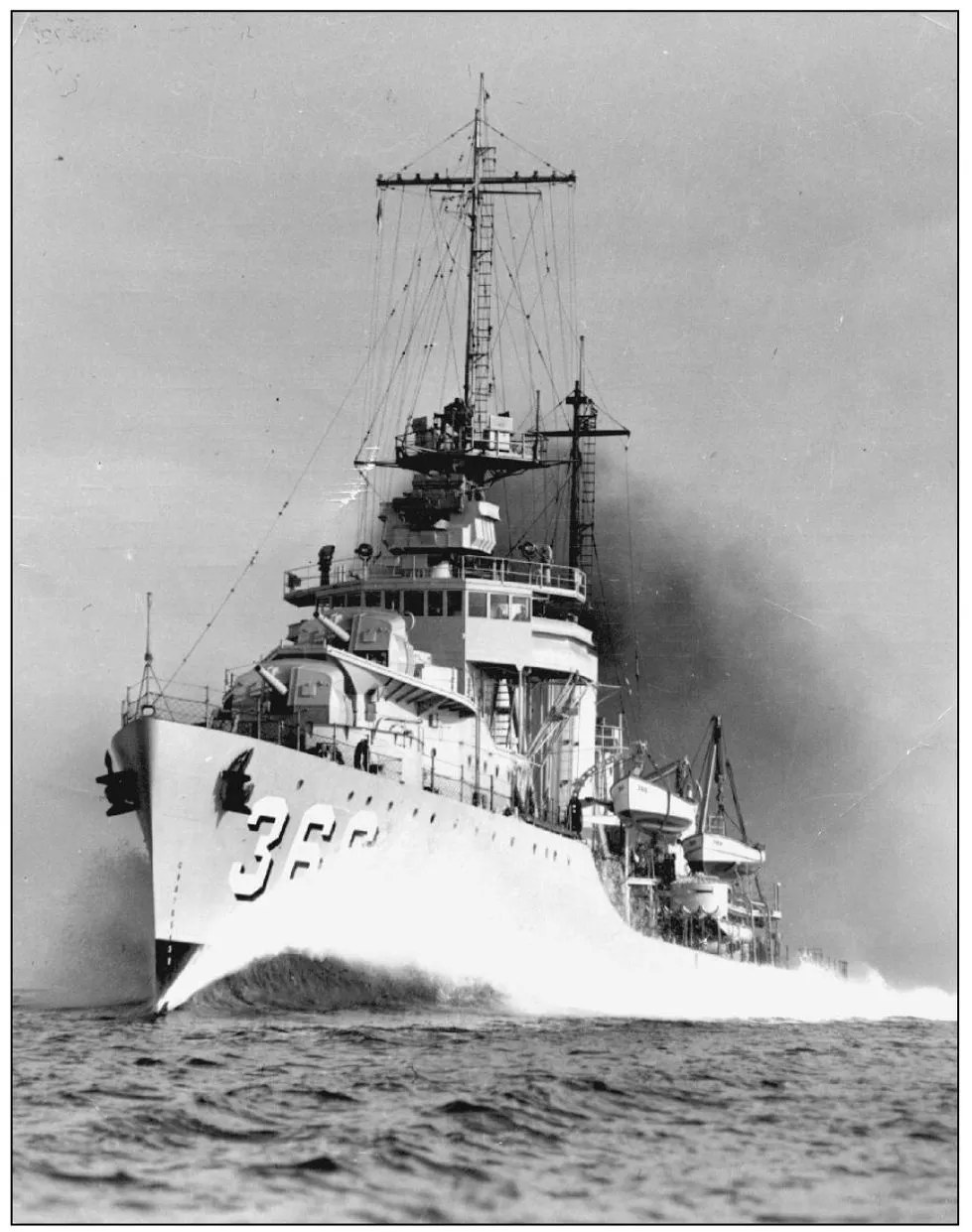
Drayton hits 40 knots on sea trials in 1936. Lamson was faster still, reaching 41.43 knots. They were, and remain, the fastest destroyers ever built for the Navy. The twin destroyers were a slightly larger version of Dewey. Both fought during World War II in the Pacific and survived but were discarded in 1946—only 10 years old, but rendered obsolete by rapid changes in naval warfare.
Lamson’s sponsor, Frances W. Andrews, is ready with her champagne bottle for the ceremonial christening on June 17, 1936. This was the third destroyer named in honor of Roswell Hawkes Lamson, a Civil War hero. The first was a contemporary of Bath’s Flusser, and the second a short-lived flush decker decommissioned in 1930 when the boilers wore out.


Sampson was completed in 1938, representing a group of destroyer leaders. These bigger ships (1,850 tons nominal displacement) were supposed to bridge the gap between the small destroyers and big cruisers. They carried an impressive battery of eight 5-inch guns (two per turret) and 12 torpedo tubes, but the guns could only fire against ships, not aircraft, a major handicap in the coming war.

Sampson’s spartan galley is in sharp contrast to the plush cabins aboard the yachts built earlier in the decade. The destroyers were purely functional a...
Table of contents
- Title Page
- Copyright Page
- Table of Contents
- ACKNOWLEDGMENTS
- INTRODUCTION
- One - THE EARLY YEARS: BIRTH OF A SHIPYARD
- Two - THE DESTROYER YEARS: WORLD WAR I COMES TO BATH
- Three - THE RETURN OF SHIPBUILDING: BATH IRON WORKS REBORN
- Four - RETURN OF THE DESTROYERS: BATH IRON WORKS GOES TO WAR
- Five - POSTWAR TRANSITION: TRAWLERS AND DESTROYERS
- Six - THE GUIDED MISSILE ERA AND COMMERCIAL SHIPBUILDING
- Seven - PORTLAND AND HARDINGS: BATH’S OFF-SITE FACILITIES
- Eight - INTO THE FUTURE: BUILDING ON THE TRADITION
Trusted by 375,005 students
Access to over 1.5 million titles for a fair monthly price.
Study more efficiently using our study tools.
Frequently asked questions
Yes, you can cancel anytime from the Subscription tab in your account settings on the Perlego website. Your subscription will stay active until the end of your current billing period. Learn how to cancel your subscription
No, books cannot be downloaded as external files, such as PDFs, for use outside of Perlego. However, you can download books within the Perlego app for offline reading on mobile or tablet. Learn how to download books offline
Perlego offers two plans: Essential and Complete
- Essential is ideal for learners and professionals who enjoy exploring a wide range of subjects. Access the Essential Library with 800,000+ trusted titles and best-sellers across business, personal growth, and the humanities. Includes unlimited reading time and Standard Read Aloud voice.
- Complete: Perfect for advanced learners and researchers needing full, unrestricted access. Unlock 1.5M+ books across hundreds of subjects, including academic and specialized titles. The Complete Plan also includes advanced features like Premium Read Aloud and Research Assistant.
We are an online textbook subscription service, where you can get access to an entire online library for less than the price of a single book per month. With over 1.5 million books across 990+ topics, we’ve got you covered! Learn about our mission
Look out for the read-aloud symbol on your next book to see if you can listen to it. The read-aloud tool reads text aloud for you, highlighting the text as it is being read. You can pause it, speed it up and slow it down. Learn more about Read Aloud
Yes! You can use the Perlego app on both iOS and Android devices to read anytime, anywhere — even offline. Perfect for commutes or when you’re on the go.
Please note we cannot support devices running on iOS 13 and Android 7 or earlier. Learn more about using the app
Please note we cannot support devices running on iOS 13 and Android 7 or earlier. Learn more about using the app
Yes, you can access Bath Iron Works by Andrew C. Toppan in PDF and/or ePUB format, as well as other popular books in History & North American History. We have over 1.5 million books available in our catalogue for you to explore.