eBook - ePub
Plymouth
About this book
In Plymouth, the reader will find the elm-shaded streets, mill villages, modest shops, and rustic cottages that generations of residents and visitors have loved.
Plymouth is best known as the Pilgrim landing place, but history did not stop when the dishes were cleared away from the first Thanksgiving. Plymouth's intriguing past is not altogether lost. A prosperous fishing village before the War of 1812, Plymouth developed mills and factories to line its modest brooks during the Industrial Revolution, and elegant dwellings were built to replace humble Colonial homes. Steamboats and the railway brought waves of immigrants and summer visitors, transforming the small Yankee village into a bustling town. Later, the mills closed, tourist traffic replaced the clatter of machinery, and massive housing developments transformed the town as the kaleidoscope of history turned yet again. In Plymouth, the reader will find the elm-shaded streets, mill villages, modest shops, and rustic pond-side cottages that generations of residents and visitors have loved. The reader will see vanished landmarks, such as the Samoset House and the Mayflower Inn, the Cornish and Burton schools, and the Leyden Street Casino. From the world's largest rope manufactory (Plymouth Cordage) to Uncle George's famous woolly horse, from Water Street's ancient wharves and chandleries to the storm of 1898, and from Pres. Warren G. Harding's tercentenary visit to Richard Nixon's welcome of the Mayflower II in 1957, the best of the town's visual history is gathered in Plymouth.
Information
Six
PLYMOUTHEANS AT HOME, AT WORK, AND AT PLAY

THE PLYMOUTH TOWN SQUARE, C. 1870. From left to right are the wooden Gothic First Parish Church (1831–1892); the Third Church (Church of the Pilgrimage, 1840); and the Town Tree (with notice board), where official announcements were posted. The Town Tree blew down and killed a woman in 1885. The old Bradford house and the post office were torn down to build the Odd Fellows hall (1877–1904).

LEFT: THE INTERIOR OF THE FIRST PARISH CHURCH BEFORE THE FIRE OF 1892. RIGHT: CLEMENT BATES (1793–1885). Clement Bates, sexton of First Parish Church from 1831 until his death, took care of the Plymouth Town House and rang the town bell at appointed times—7 a.m., 12 p.m., 1 p.m., and 6 p.m. He would ring it at 5 p.m. on Saturdays and at 9 p.m. for curfew. Bates also conducted all funerals before private undertakers became common.

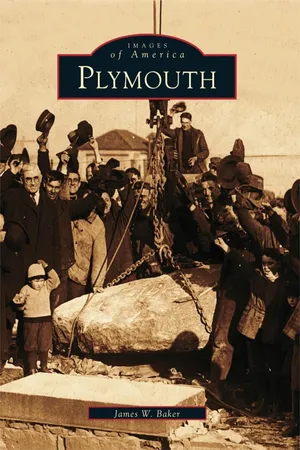
LAYING THE CORNERSTONE OF THE PRESENT FIRST CHURCH (UNITARIAN-UNIVERSALIST), IN THE PLYMOUTH TOWN SQUARE, JUNE 29, 1896. The earlier wooden structure burned down in December 1892. The building on the left is the Old Chapel, which had been moved from just west of the Church of the Pilgrimage. It became part of the First Church Parish Center following the “renewal” of Church and High Streets.

A VIEW OF BURIAL HILL FROM THE STEEPLE OF THE CHURCH OF THE PILGRIMAGE, C. 1870. The wooden Gothic First Parish Church (1831–1892) is on the left. The building in the foreground was the Central School from 1756 to 1840, when the Cornish School was built on Russell Street.

THE ODD FELLOWS BUILDING FIRE ON MAIN STREET IN A VIEW LOOKING NORTHWEST, JANUARY 9, 1904. The Odd Fellows hall was built on the site of Governor Bradford’s house on the Plymouth Town Square. Public events were held upstairs in Adelphian Hall. The Governor Bradford building, which replaced the Odd Fellows building, had a drugstore on the ground floor (Cooper’s Drug, Pilgrim Drug, and CVS) for almost a century untilM&MSporting Goods moved there in 2001.

LEYDEN STREET IN A VIEW LOOKING EAST, C. 1890. This street was Plymouth’s first street, laid out in 1620. The Barnabas Hedge House is on the left. Across the street are Chandler Robbins’s parsonage (with a central door) and General Goodwin’s house (right). The street received the name Leyden Street in 1823.

THE FOOT OF LEYDEN STREET IN A VIEW LOOKING WEST FROM BARNES’ WHARF, ...
Table of contents
- Title Page
- Copyright Page
- Dedication
- Table of Contents
- ACKNOWLEDGMENTS
- INTRODUCTION
- One - PLYMOUTH’S EARLIEST SCENES AND HISTORIC HOUSES
- Two - PLYMOUTH MILLS AND FACTORIES
- Three - PLYMOUTH COMMERCE AND TRANSPORTATION
- Four - THE TOURIST TOWN AND SUMMER VISITATION
- Five - PLYMOUTH PUBLIC BUILDINGS AND EVENTS
- Six - PLYMOUTHEANS AT HOME, AT WORK, AND AT PLAY
Trusted by 375,005 students
Access to over 1.5 million titles for a fair monthly price.
Study more efficiently using our study tools.
Frequently asked questions
Yes, you can cancel anytime from the Subscription tab in your account settings on the Perlego website. Your subscription will stay active until the end of your current billing period. Learn how to cancel your subscription
No, books cannot be downloaded as external files, such as PDFs, for use outside of Perlego. However, you can download books within the Perlego app for offline reading on mobile or tablet. Learn how to download books offline
Perlego offers two plans: Essential and Complete
- Essential is ideal for learners and professionals who enjoy exploring a wide range of subjects. Access the Essential Library with 800,000+ trusted titles and best-sellers across business, personal growth, and the humanities. Includes unlimited reading time and Standard Read Aloud voice.
- Complete: Perfect for advanced learners and researchers needing full, unrestricted access. Unlock 1.5M+ books across hundreds of subjects, including academic and specialized titles. The Complete Plan also includes advanced features like Premium Read Aloud and Research Assistant.
We are an online textbook subscription service, where you can get access to an entire online library for less than the price of a single book per month. With over 1.5 million books across 990+ topics, we’ve got you covered! Learn about our mission
Look out for the read-aloud symbol on your next book to see if you can listen to it. The read-aloud tool reads text aloud for you, highlighting the text as it is being read. You can pause it, speed it up and slow it down. Learn more about Read Aloud
Yes! You can use the Perlego app on both iOS and Android devices to read anytime, anywhere — even offline. Perfect for commutes or when you’re on the go.
Please note we cannot support devices running on iOS 13 and Android 7 or earlier. Learn more about using the app
Please note we cannot support devices running on iOS 13 and Android 7 or earlier. Learn more about using the app
Yes, you can access Plymouth by James W. Baker in PDF and/or ePUB format, as well as other popular books in History & North American History. We have over 1.5 million books available in our catalogue for you to explore.