- 160 pages
- English
- ePUB (mobile friendly)
- Available on iOS & Android
eBook - ePub
About this book
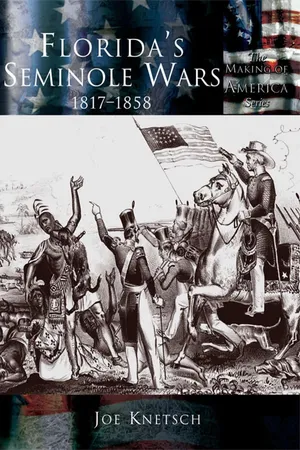
Years before the first shots of the Civil War were fired, Florida witnessed a clash of wills and ways that prompted three wars unlike any others in America's history.
Among the most well-known of Florida's native peoples, the Seminole Indians frustrated troops of militia and volunteer soldiers for decades during the first half of the nineteenth century in the ongoing struggle to keep hold of their ancestral lands. While careers and reputations of American military and political leaders were made and destroyed in the mosquito-infested swamps of Florida's interior, the Seminoles and their allies, including the Miccosukee tribe and many escaped slaves, managed to wage war on their own terms. The study of guerrilla warfare tactics employed by the Seminoles may have aided modern American forces fighting in Viet Nam, Cambodia, and other regions.
Information
1. THE PRELUDE
The waters of the Apalachicola River sluggishly pushed towards the Gulf of Mexico, just like they always have and will. The weather had a nip of autumn in the air as the open flat-boat struggled mightily against the heavy current. Attempting to round the bend below Fort Scott, the weakened force of Lieutenant R.W. Scott looked anxiously forward to the safety of the new fort’s walls and the comradeship of its garrison. With the boat loaded with clothing, 20 sick soldiers, 7 women, and 20 men fit for duty, Lieutenant Scott’s little force was no match for what awaited them. After a very short but bloody skirmish, the tiny command was decimated by the fire from the near shore with only six men and one woman surviving the attack. To this day, it is unclear if any children were aboard that ill-fated craft. Thus began the so-called “First Seminole War” on that fateful autumn day, November 30, 1817.
Was this really the beginning of a new war or simply a continuation of the Creek (“Redstick”) War, which was a continuation of the War of 1812 amid a whole series of conflicts between two different and competing civilizations? At that time, many of the Creek towns had sided with the British during the conflict. Undoubtedly, a significant number of those who survived the Battle of Horseshoe Bend and other skirmishes had fled southward into Florida, there to join their brethren, the Seminoles and Miccosukees. These two tribes had a well known history of raiding across the borders into Georgia and Alabama. Raids and counter-raids had been a feature of these borders with the nominally Spanish colonies of East and West Florida for many years. As the American frontier expanded into the old Southwest, the pressures leading to conflict continued to rise. The push for more land to graze cattle and raise crops put the expanding white population on a direct course for war. In addition to this volatile mixture was the factor of escaped slaves seeking freedom from the plantation system and a better life for their families. Altogether, the complexity and explosiveness of this frontier became more entangled than the infamous ti-ti swamps of the Choctawhatchee River.
Who exactly were the Seminoles and their allies, the Miccosukees? Both have their origins in what the late Dr. Leitch Wright called the Muscogulges people, a broad group of related tribal units that spoke a variety of languages, including Muskogee, Hitchiti, and Choctaw. White society has pigeon-holed these groups into one loose confederation, which they called Creeks. This is not historically accurate and does not reflect the diversity within the groups. However, there are a number of similarities among this array of tribes. One of the more important is their clan structure. Such clans were matrilineal and membership in the clan was determined by the mother’s family. A man was always a member of his mother’s clan, but his children were members of his wife’s clan. Clan membership defined the individual for life, and some of these clans were named after animals such as the bear, deer, or panther, while others took the names of natural forces like the wind or plants. These relationships also defined responsibilities for an individual: whom to joke with, whom to marry, whom to defend or avenge, etc. As clan membership is also a kinship to others of the same clan, no matter what group, members always had uncles, cousins, and other relatives of the mother’s clan that could be relied upon in time of need. It may be because of these vast relationships that white society became so confused about the nature of Native American society and lumped them all together in a Creek Confederation.

RAFTS DESCENDING THE RIVER. This is a good example of the type of craft that may have been used by the R.W. Scott party as it ascended the Apalachicola River in November 1817.
Clan membership also confused Europeans because the local villages (talofa) and larger ceremonial towns (talwa) were governed by councils that represented the various clans living within them. It was these “town councils” that allotted the land for each clan to use based upon their population needs. The lands thus assigned were then divided among clan members by the clan council, presided over by the elders. Each clan had a camp within the village that was designated as its own. This camp was to endure with the Seminoles of Florida well into the twentieth century. The larger towns were also further divided into two moieties, or groups, signified by the colors red (for war) and white (for peace). These towns were headed by a miko (chief) who brought the problems to be discussed in front of the town councils. He had no independent power other than to call the council into session when needed. Yet he was always treated with great respect, having earned it by deeds performed throughout his life. The miko did have power over the surplus food supply established by the villagers and was responsible for rationing it out during times of famine or personal catastrophe. On occasion, he could also use this supply to entertain guests of the town. Finally, he often represented the town in larger tribal councils when serious matters threatened the towns and villages of the tribe. It should be noted that the miko did not have independent power and was expected to always follow the decisions of the town council. Thus, the frequent delays experienced by Indian agents, representatives of European governments (and later the United States), and military negotiators were often the product of this system, and not intentional delaying tactics often attributed to these native representatives. A lack of understanding of the clantown-tribal relationship often caused Europeans to become frustrated while negotiating with these Native Americans.
The so-called Creek Confederation never was designed to have a central government. Part of this comes from a further division among the Creeks into the Upper and Lower groupings. The Upper group was centered in the valleys of the Tallapoosa, Coosa, and Alabama Rivers, while the Lower group inhabited the area of the lower Chattahoochee and Flint Rivers. The Lower Creeks are often referred to as Cowetas by some of the white traders and government officials, just as they frequently called the Upper group Tallapoosas. These divisions, again, ignored the complexity of southeastern American Indian society and totally separated Choctaws, Yuchis, Natchez, and some of the Shawnees from their relatives within the “Creek Confederacy.” These artificial divisions caused confusion for whites that too frequently translated into trouble for the Native Americans. Because of the context of the European experience and from some experiences in the conquest of Central and South America, it was almost inconceivable for whites to understand a government based upon clan relationships and clan, town, and tribal councils. Mikos who led by example and persuasion were too often confused with rulers of the European type. Such cultural bias (or arrogance) would lead to disastrous results for all concerned.
The Creeks and their related neighbors were not simple hunters and gatherers. They were highly sophisticated farmers and adept hunters. They quickly adopted many European methods and technologies. The Creeks rapidly learned the art of ranching and maintaining fairly large herds of cattle, a recent European import, along with the use of the horse. Indian Agent Benjamin Hawkins noted in his famous journal of a trip through the Creek towns the use of a three-crop rotation system, including the penning of cattle and use of manure for fertilizer. Hawkins also reported that nearly every village he visited had from 100 to 150 cattle.
Many of the mikos lived in framed and shingled houses, a sign of their station within the village. Corn, the mainstay of Native American life, was always grown, as were beans, peas, melons, squashes, and potatoes. Hunting, primarily for deer, provided the bulk of the protein in their diet until the introduction of cattle. As trade grew between the two cultures, firearms, metal utensils, finely woven cloth, and other such items became staples in the homes of the Native Americans. The resultant loss of well entrenched skills, such as pottery making and hunting with bow and arrow, among others, became one of the problems faced by some groups as they began to resist removal and migrate to more primitive areas lacking in trade goods.
One of the basic problems with studying the history of any Native American group is that we rely almost totally upon European observers, who often unintentionally misrepresented the true nature of things. Even Indian agents and traders, who often intermarried with their charges or customers, still exhibited their own cultural bias. Relationships, like those described above, are most often misunderstood. Even as late as the Second Seminole War (1835–1842), the army relied more upon former slaves or free blacks for information on Native American motivations and interpretations of Seminole or Miccosukee culture than they did the tribes themselves. Such reliance upon essentially secondhand knowledge from another cultural view (that of the African cultures—of which there were many represented in the escaped slaves or free black population) made understanding Seminole culture even more confusing. To compound matters even more thoroughly, the Seminoles and Miccosukees often used blacks to interpret European culture for them. This cross-cultural viewing of each other added greatly to these misunderstandings.
Slavery, as practiced by the Seminoles, Miccosukees, and others of their relations, was of a rather benign form. The most common source of acquiring slaves was war. Slavery in this form was culturally sanctioned and practiced long before the introduction of Africans into the Southeast. In common with several groups throughout history, most of the slaves taken in war were women and children. In the Seminole culture, as seen by the famed botanist William Bartram, the slaves were fearful of their new rulers and were often silent and respectful. However, they were permitted to intermarry with the Seminoles under certain restrictions, and the resultant children of these matches were considered free and adopted members of the clan and tribe.
Bartram may not have been aware of the relationship of the captured slaves and the clans to which they belonged and how this may have contributed to their treatment. When African slaves were introduced into the cultural mix, the Seminoles adopted many of the European concepts of private property and considered the slaves as articles of barter or trade. As property, they took on a different aspect, something to be defended, like home and family. When seen as having commercial value, the escaped slave became an item of great worth. Escapes frustrated the slave catchers and slave owners of the South, who viewed them as threats to their own power, which was largely dependent upon slave labor, both economically and culturally. Over time, a bond developed between escaped Africans and the Seminoles that only increased with time and white pressure for their return. The former slaves of the white population soon were able to have villages of their own near those of their Seminole “owners” and protectors. A strong co-dependence grew over the years, and each group exchanged and adopted something from each other. Living as they both did in Spanish Florida, they represented a threat to the slave-owning southern states and territories. As archaeologist Brent Weisman has correctly observed, as long as there were Seminoles harboring escaped slaves in Florida, no plantation in the lower Southeast was safe. The relationship and existence of the combined Seminoles, Miccosukees, and escaped slaves would be the most important cause of the Seminole Wars.
INDIANS ATTACKING LIEUTENANT SCOTT’S PARTY. This early nineteenth-century etching dramatizes the event, but note that the Native Americans are not dressed in the Seminole manner.

The word “Seminole,” as is commonly known, comes from the Spanish cimarrones, meaning wild ones or those who broke away. Weisman has found that this was first used relative to those former Creeks who settled in the area of central Florida from around Gainesville southward. He believes that the band later led by the famed “Cowkeeper” was the group to whom this first applied. It is the band visited by William Bartram and described in his famous travels. They had migrated to the area from the Oconee River region of southern Georgia around the middle of the eighteenth century and tended the cattle found in central Florida left by the old Spanish ranch, La Chua. They were at one time part of the Lower Creeks and had migrated southward in search of better and more open lands, away from the pressure of the expanding white population of Georgia. As they ventured toward the South, they became more separated from mainstream Creek society and began to think and act more independently, especially in their relationship to the colonial powers, Great Britain and Spain. When Governor James Grant called for a meeting with all of the Native Americans in the newly acquired colony in 1765, Cowkeeper studiously avoided being present. Grant, like many to follow him, assumed that all of the other “chiefs” present could and would make decisions for all. As noted above, no group of mikos could make a decision for the tribe unless they were given that authority by the local councils. Additionally, Cowkeeper’s absence from the meeting indicated his non-acceptance of the conditions Governor Grant wished to impose or negotiate. Cowkeeper’s town and others aligned with it were definitely ones that had “broken away” from the main groups of the Creek Confederation.
After the Creek War (1813–1815), or Red Stick War, and the signing of the Treaty of Fort Jackson, those who had escaped the wrath of Andrew Jackson’s forces fled southward into Florida. Many were absorbed into the groups already living in the region. Because of their hatred of the white frontiersmen and fear of the U.S. Army under Jackson, they were a constant threat to the Spanish–United States border lands and those moving into the newly acquired lands ceded by the Treaty of Fort Jackson. This treaty had given to the United States almost all of the remaining Creek lands in Georgia and left part of the new boundary unclear to both sides. In actual lands ceded, it gave the United States more land controlled by its Creek allies than it did those of the Red Stick faction. Others, not originally in agreement with the Red Sticks, soon quietly left the Creek lands and headed south also. Hillis Hadjo, or Francis, and his band are good examples of this phenomenon. The augmentation of numbers by these Native Americans added strength and a more war-like outlook to the growing Seminole tribe and its Miccosukee allies. The other meaning of Seminoles, “wild ones,” now assumed a new and more menacing aspect as a result of this buildup of warriors.

RETREAT OF THE BRITISH FROM PENSACOLA ON THE APPROACH OF JACKSON. This sketch shows another dramatized event that indicates the fear or respect Andrew Jackson commanded on the Florida frontier.
The impact of European trade, ambitions, and diseases has been the object of discussion for many years. Generally speaking, the trade and intermarriage of Native Americans with white traders introduced not only new technologies but also the concept of private versus communal ownership of property. As we have seen, land ownership was a communal experience in Creek and Seminole society. No one person could “own” earth. When tribes went to war, it was most often over hunting grounds or social reasons. A male rose in the esteem of his tribe through acts of bravery, cunning in war, or by leading through example in either peace or war. With the concept of ownership came an increase in social and political stratification of a different nature. The individual, who had been exalted in relation to his kinships and clan memberships and rejecting authoritarian leaders, began to lose ground to those recognized by white traders and negotiators as “chiefs” or mikos. Trade with Europeans also meant the depletion of such animals as deer, beaver, muskrat, and otter because the market demanded their fur. This, in turn, sent tribes into other areas searching for these animals, which caused more friction among the now competing tribes. At the same time, Europeans regarded their trading partners as “savages” or “wild people” who were simply a part of the wilderness. To Europeans, the wilderness was something to be tamed and dominated, to make more fruitful and control. The Creeks, Seminoles, Miccosukees, and other tribes, who had benefited from the European desire for furs, slaves, etc., had to be dominated and tamed or, in the extreme, destroyed. The tribes of the lower South, like those throughout what became the United States, were “in the way” and had to be removed. All of this was in the name of progress. Native American removal and separation from white society was just part of this anti-wilderness concept ingrained in the European mind. The ambitious Europeans used horrible epidemics, such as smallpox, in killing vast numbers of Native Americans. By eroding the tribal, town, and clan structure through trade, intermarriage, and the introduction of new diseases and alcohol, the Europ...
Table of contents
- Title Page
- Copyright Page
- Table of Contents
- ACKNOWLEDGMENTS
- INTRODUCTION
- 1. THE PRELUDE
- 2. THE FIRST SEMINOLE WAR 1817–1818
- 3. THE FIRST INTERLUDE 1821–1835
- 4. THE SECOND SEMINOLE WAR 1835–1842
- 5. THE SECOND INTERLUDE 1843–1855
- 6. THE THIRD SEMINOLE WAR 1855–1858
- BIBLIOGRAPHY
- INDEX
Trusted by 375,005 students
Access to over 1.5 million titles for a fair monthly price.
Study more efficiently using our study tools.
Frequently asked questions
Yes, you can cancel anytime from the Subscription tab in your account settings on the Perlego website. Your subscription will stay active until the end of your current billing period. Learn how to cancel your subscription
No, books cannot be downloaded as external files, such as PDFs, for use outside of Perlego. However, you can download books within the Perlego app for offline reading on mobile or tablet. Learn how to download books offline
Perlego offers two plans: Essential and Complete
- Essential is ideal for learners and professionals who enjoy exploring a wide range of subjects. Access the Essential Library with 800,000+ trusted titles and best-sellers across business, personal growth, and the humanities. Includes unlimited reading time and Standard Read Aloud voice.
- Complete: Perfect for advanced learners and researchers needing full, unrestricted access. Unlock 1.5M+ books across hundreds of subjects, including academic and specialized titles. The Complete Plan also includes advanced features like Premium Read Aloud and Research Assistant.
We are an online textbook subscription service, where you can get access to an entire online library for less than the price of a single book per month. With over 1.5 million books across 990+ topics, we’ve got you covered! Learn about our mission
Look out for the read-aloud symbol on your next book to see if you can listen to it. The read-aloud tool reads text aloud for you, highlighting the text as it is being read. You can pause it, speed it up and slow it down. Learn more about Read Aloud
Yes! You can use the Perlego app on both iOS and Android devices to read anytime, anywhere — even offline. Perfect for commutes or when you’re on the go.
Please note we cannot support devices running on iOS 13 and Android 7 or earlier. Learn more about using the app
Please note we cannot support devices running on iOS 13 and Android 7 or earlier. Learn more about using the app
Yes, you can access Florida's Seminole Wars by Joe Knetsch in PDF and/or ePUB format, as well as other popular books in History & North American History. We have over 1.5 million books available in our catalogue for you to explore.