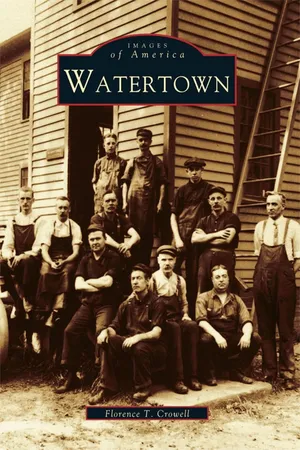
Here, in stunning images and stirring narrative, is the history of Watertown, a community that lies near the center of western Connecticut. The town was once part of Mattatuck, a tract of land purchased from the Paugasett Indians in 1684. The fertile area first attracted Farmington residents, who settled down to farm the land. It was not until 1722, however, that the first sawmill was built. In time, new settlers joined the earlier families and, by 1739, they formed the parish of Westbury, which in turn was incorporated as Watertown in 1780. With more than two hundred unforgettable pictures, Watertown highlights the local men and women, buildings and churches, and neighborhoods and businesses that are the essential element of the town's lively history. It shows some of the nine one-room schoolhouses that children attended. It features the Taft School, a preparatory school for boys opened by Horace Taft in 1893; Mrs. Parke and her strange museum; and tavern keeper and farmer James Bishop. It proudly displays some of the firsts for Watertown: Merrit Heminway winding thread on spools, Wheeler-Wilson developing the lock-stitch sewing machine, and the Watertown Manufacturing Company designing and producing Lifetime Ware.
- 128 pages
- English
- ePUB (mobile friendly)
- Available on iOS & Android
eBook - ePub
Watertown
About this book
Information
Four
SCHOOLS, PUBLIC AND PRIVATE

The Baldwin School fifth graders, shown here in 1909, are, from left to right, as follows: (front row) Hazel Bean, Dick Sperry, Stuart Atwood, Spencer Barlow, Sam Willinger, Joe Humiston, Justine McGowan, Vera McCleary, and Octavia Hickcox; (middle row) Nancy Bronson, Kate Herring, Naomi Davis, Laura Decker, Marilla Atwood, Harry Lockwood, Maude Vercher, and Marjorie Black; (back row) Barbara Bronson, Bertha Cook, Hattie Fields, Helen Matoon, Robert McCleary, Novello Fisher, Zelda Wheeler, Alice Norton, Fred White, and Charles Brouette. The teacher, a Miss Hurlbert, is on the right.

In 1852, Center School, built near the road on North Street, replaced the small school on the triangle. There were two rooms. Huge iron stoves provided heat for this school, and records tell us that in winter the children sitting near the stove “nearly baked” while those on the perimeter of the room “almost froze.” This school was used until 1883.

Because of the increase in population, a new four-room Center School was built just behind the first one in 1883, and an addition was made in 1894. At that time, there were 12 teachers employed in town at an average salary of $30.34 per month. On December 17, 1906, this building burned. Baldwin School, named for one of the early teachers, was erected on this site.

This Nova Scotia School was built at the corner of Thomaston and Fern Hill Roads in 1852. Classes ceased in 1929, and children were transported to Baldwin School. The school was given to the town. It was taken apart in September 1990 by members of UNICO Club, and in 1993, the Lions Club Old Fellows rebuilt it on Munson Park. The school is now open to the public.

In the late 1920s, the students and teacher of Nova Scotia School gathered outside to have this picture taken. At this time, there was no running water in the school and no indoor plumbing. Boys and girls outhouses were provided, and the school was heated with a wood stove.

This Poverty District School was built in 1854 to replace an older building that was about a quarter mile west of here. In 1872, there were 13 students in the school. The name was changed to Winnemaug in 1910, and in 1932, classes ended here and children were transported to Baldwin School. The building was sold to the Winnemaug Social Club in 1935 and was destroyed by vandals in the 1950s.

In 1848, this Guernseytown School was built to replace one that had burned. By the late 1920s, only students in grades one through three attended school here. Classes ended in 1931, and the children were transported to Baldwin School. In 1943, the building was sold for $100. It has been a residence since that time and has had several additions.

Pictured here is a Guernseytown School class in 1907. From left to right are the following: (front row) unidentified, Mike Sabot, Ted Blanner, Mary Wheeler, John Sabot, and Loren Wheeler; (middle row) Ella Little, Frank Judd, Freddie White, Harvey Williams, Dorothy Atwood, Annie Blanner, Maude Verba, Harry Weiss, and Garnsey Verba; (back row) Gladys Atwood, Julia Blanner, Annie Moriarity, Charlie Williams, Charlie Judd, Lillian Judd, Susie Williams, and Logie Blanner. Alice Sperry, the teacher, is s...
Table of contents
- Title Page
- Copyright Page
- Dedication
- Table of Contents
- ACKNOWLEDGMENTS
- INTRODUCTION
- One - WESTBURY BECOMES WATERTOWN
- Two - TRAINS, TROLLEYS, CARS, AND PLANES
- Three - INNS, HOTELS, AND EARLY INDUSTRY
- Four - SCHOOLS, PUBLIC AND PRIVATE
- Five - HOMES OF YESTERYEAR
- Six - FRIENDS AND NEIGHBORS
- Seven - A FARMING COMMUNITY
- Eight - AROUND THE TOWN
Trusted by 375,005 students
Access to over 1.5 million titles for a fair monthly price.
Study more efficiently using our study tools.
Frequently asked questions
Yes, you can cancel anytime from the Subscription tab in your account settings on the Perlego website. Your subscription will stay active until the end of your current billing period. Learn how to cancel your subscription
No, books cannot be downloaded as external files, such as PDFs, for use outside of Perlego. However, you can download books within the Perlego app for offline reading on mobile or tablet. Learn how to download books offline
Perlego offers two plans: Essential and Complete
- Essential is ideal for learners and professionals who enjoy exploring a wide range of subjects. Access the Essential Library with 800,000+ trusted titles and best-sellers across business, personal growth, and the humanities. Includes unlimited reading time and Standard Read Aloud voice.
- Complete: Perfect for advanced learners and researchers needing full, unrestricted access. Unlock 1.5M+ books across hundreds of subjects, including academic and specialized titles. The Complete Plan also includes advanced features like Premium Read Aloud and Research Assistant.
We are an online textbook subscription service, where you can get access to an entire online library for less than the price of a single book per month. With over 1.5 million books across 990+ topics, we’ve got you covered! Learn about our mission
Look out for the read-aloud symbol on your next book to see if you can listen to it. The read-aloud tool reads text aloud for you, highlighting the text as it is being read. You can pause it, speed it up and slow it down. Learn more about Read Aloud
Yes! You can use the Perlego app on both iOS and Android devices to read anytime, anywhere — even offline. Perfect for commutes or when you’re on the go.
Please note we cannot support devices running on iOS 13 and Android 7 or earlier. Learn more about using the app
Please note we cannot support devices running on iOS 13 and Android 7 or earlier. Learn more about using the app
Yes, you can access Watertown by Florence T. Crowell in PDF and/or ePUB format, as well as other popular books in History & North American History. We have over 1.5 million books available in our catalogue for you to explore.