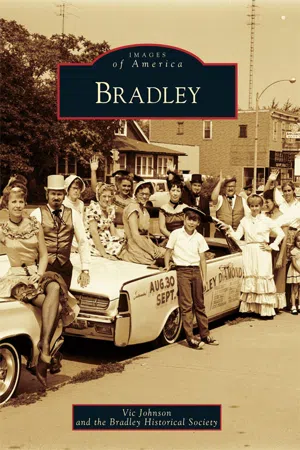
At the age of 49, Ohio-born J. Herman Hardebeck had earned a gilt-edged reputation as a real estate developer in Kankakee. In the spring of 1891, to the north of Kankakee and south of Bourbonnais, lay a flat, mile-wide prairie. The land stretched eastward from a grove of Kankakee river timber, past the Illinois Central Railroad into the watershed of Soldier Creek. In May, Hardebeck signed agreements with Alvah Perry and Hiram Goodwin for the purchase of 340 acres of this property. He had taken options on additional tracts. Here Hardebeck would establish an industrial community first named North Kankakee and later renamed Bradley in honor of farm implement manufacturer David Bradley.
eBook - ePub
Bradley
About this book
Information
Topic
StoriaSubtopic
Storia nordamericanaFive
BROADWAY

On June 4, 1892, Dr. Benjamin F. Uran became president of the newly-formed North Kankakee Electric Light and Railway Company. West Broadway, 100 feet wide and approximately a mile long, became North Kankakee’s main street. On January 12, 1893, wires for the North Kankakee electric lights were being strung. On June 5, 1894, an electric light and water committee was appointed by board president Robert L. Cox. Stores and offices occupied the first floor of these buildings, with living quarters on the second floor and meeting halls for Woodsmen of the World and Independent Order of Odd Fellows. (SC.)

In August 1892, Celestin Graveline moved this building from South Main Street in Bourbonnais to a lot between Grand and Center Avenues on the south side of West Broadway. Possibly built in the 1860s, it is the oldest structure remaining in Bradley. The Worrel house (see page 29) might have been older, but it no longer exists. The front gable, side entrance design reflects a Greek Revival influence in architecture that was popular around 1860. (Author’s collection.)

Even though the house has been renovated several times, traces of its original timber-frame construction remain. (Author’s collection.)

The Bear Brand Hosiery Company building stood in the 300 block on the south side of West Broadway. The photograph was taken in 1927 or 1928. (Flossie Gulzynski.)

There are nine blocks on West Broadway between the Illinois Central Railroad tracks on the east and Vasseur Avenue (now Kennedy Drive) on the west. Most of the first buildings on this street, with a few exceptions, were frame, two-story flats. The building to the left of the center is a good representation. By 1898, West Broadway would have had 27 or so buildings. Emory Souligne opened the first general store at 341 West Broadway in May 1892, and later this store also housed the post office. (BHS.)

The group of people in this photograph appear to be anticipating the opening of Dolle’s Department Store. The building was built by Alphonse Dolle in 1930 at 423 West Broadway. (James Guiss.)

Posed in front of their new store building on West Broadway are Alphonse and Julie (Morel) Dolle. (James Guiss.)

The National Tea Store, a chain grocery store, occupied two buildings on the south side of West Broadway during the 1940s. Frank W. Hoehn (village trustee in 1909 and village board president in 1913) had been the proprietor of a grocery store (below) in this same location. At far left in the above photograph is the International Order of Odd Fellows building (southwest corner of West Broadway and South Wabash Avenue). Francis X. Crevier kept a store on the first floor in 1898. A later occupant was George C. Schneider’s Rexall Pharmacy. and during the late 1950s, the Erickson Cafe. (Above, BHS; below, DM.)


The opening of the Broadway underpass beneath the Illinois Central Railroad and the laying of concrete strips on either side of the streetcar tracks on West Broadway in 1926 was a major event. It called for a celebration with dancing, a parade, and other festivities. This photograph, taken during construction in 1925, shows...
Table of contents
- Title Page
- Copyright Page
- Dedication
- Table of Contents
- ACKNOWLEDGMENTS
- INTRODUCTION
- One - THE JACQUES JONVEAU LEGACY
- Two - BIRTH OF A PRAIRIE BOOMTOWN
- Three - THE SUN OF OPPORTUNITY
- Four - SNATCHED BACK FROM DISASTER
- Five - BROADWAY
- Six - THE MELTING POT
- Seven - OF SCHOOLS AND CHURCHES
- Eight - DEDICATION AND PARTICIPATION
- Nine - THE ELECTED AND THE APPOINTED
- Ten - PRESERVING A HISTORY
Trusted by 375,005 students
Access to over 1.5 million titles for a fair monthly price.
Study more efficiently using our study tools.
Frequently asked questions
Yes, you can cancel anytime from the Subscription tab in your account settings on the Perlego website. Your subscription will stay active until the end of your current billing period. Learn how to cancel your subscription
No, books cannot be downloaded as external files, such as PDFs, for use outside of Perlego. However, you can download books within the Perlego app for offline reading on mobile or tablet. Learn how to download books offline
Perlego offers two plans: Essential and Complete
- Essential is ideal for learners and professionals who enjoy exploring a wide range of subjects. Access the Essential Library with 800,000+ trusted titles and best-sellers across business, personal growth, and the humanities. Includes unlimited reading time and Standard Read Aloud voice.
- Complete: Perfect for advanced learners and researchers needing full, unrestricted access. Unlock 1.5M+ books across hundreds of subjects, including academic and specialized titles. The Complete Plan also includes advanced features like Premium Read Aloud and Research Assistant.
We are an online textbook subscription service, where you can get access to an entire online library for less than the price of a single book per month. With over 1.5 million books across 990+ topics, we’ve got you covered! Learn about our mission
Look out for the read-aloud symbol on your next book to see if you can listen to it. The read-aloud tool reads text aloud for you, highlighting the text as it is being read. You can pause it, speed it up and slow it down. Learn more about Read Aloud
Yes! You can use the Perlego app on both iOS and Android devices to read anytime, anywhere — even offline. Perfect for commutes or when you’re on the go.
Please note we cannot support devices running on iOS 13 and Android 7 or earlier. Learn more about using the app
Please note we cannot support devices running on iOS 13 and Android 7 or earlier. Learn more about using the app
Yes, you can access Bradley by Vic Johnson in PDF and/or ePUB format, as well as other popular books in Storia & Storia nordamericana. We have over 1.5 million books available in our catalogue for you to explore.