eBook - ePub
Joliet
About this book
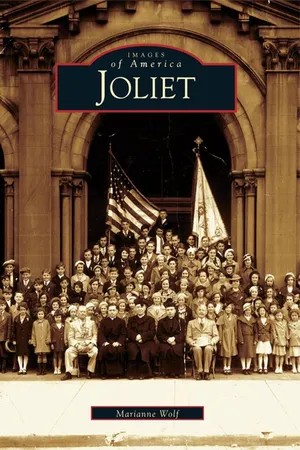
In vivid historical images and rare archival documents, see for yourself how Joliet became a quintessential American City.
Joliet once was a lush prairie bordered with scenic bluffs along the Des Plaines River. In the late 19th century, settlers and a large influx of Eastern European immigrants arrived, transforming the area into a bustling industrial community of steel, limestone, manufacturing, and transportation. In the 20th century, Joliet transformed itself from an industrial hub to a destination of entertainment and tourism. Tourism thrives as people visit the National Hot Rod Association drag strip, NASCAR track, two casinos, the JackHammers minor-league baseball team and baseball stadium, a water park, the historical museum, and library. Joliet depicts the rich cultural heritage impressed on the city and shows how the people lived and worked together, earning Joliet the title of All-American City in 1955 by the National Municipal League and Look magazine.
Information
Three
JOLIET WORKS
The Sanitary and Ship Canal and its predecessor, the Illinois and Michigan Canal, paired with intersecting railroads to launch Joliet into industrial growth of record proportions. While these industries employed thousands of workers, they were not the only means of earning a living in the city. Many men would save enough money from these industrial jobs to enable them to pursue independent businesses. Each neighborhood had its own ethnic shops, including bakeries, funeral parlors, meat markets, tailors, barbers, taverns, and shoemakers, and each played an important role in the development and vitality of the community. As the city’s population grew, so too did essential services.
The official “birth” of the Joliet Fire Department is recorded in handwritten minutes of a city council meeting on December 12, 1853. The department was composed of volunteers until chief engineer Henry Rub and the Committee on Fire and Water first organized a pay scale for fire personnel in May 1876.
The Juliet Courier (1839) was the first newspaper in the town, and over the years it would evolve and expand into the Joliet Signal (1843), the True Democrat (1847), the Joliet Daily Republican (1862), the Joliet Record (1870), the Joliet Sun (1872), the Joliet News (1877), the Joliet Herald (1904), and the Joliet Herald-News (1915). Then, in 1915, Col. Ira C. Copley consolidated the Joliet Herald and the Joliet News creating the Joliet Herald-News. The paper would outgrow two locations before settling into its current headquarters at 300 Caterpillar Drive in 1974. Today it is known as The Herald News.
By 1936, Joliet was the center of America’s wallpaper industry, with six mills employing more than 1,000 workers. Advertising for the company claimed production of up to 100 million rolls yearly.
Immediately following the start of World War II, Joliet became an extensive manufacturer of war materials. Jobs at the Joliet Arsenal caused a dramatic increase in Joliet’s population, including major growth in its black community.
Joliet is in the midst of a second renaissance. Just as it did in the beginning of the 20th century, the city is experiencing residential and commercial growth. The economic backbone has shifted from labor-intensive industry to one of entertainment and recreation. A 2000 census listed the city’s population at 106,221. By 2005, Joliet’s population had increased to over 129,000 residents covering an area of 41 square miles.

ADAM GROTH. Born in 1847 in Marburg, Germany, Adam Groth studied architecture and learned the stone-cutting trade in his native country before coming to Chicago in 1871. His profession led him in 1884 to take the job as foreman for E. R. Brainard, contractor for an addition to the Illinois State Penitentiary located in Joliet. By 1895, Groth had his own stone and contracting business on East Cass Street that employed more than 100 men. He was responsible for building Joliet’s Union Station, United States post office, public library, First National Bank, and the Joliet Central Township High School. In 1895, Groth was elected Joliet city treasurer. He died on December 5, 1919, while on a train trip out west with his family. Ninety-one-year-old Willa Schroeder is the granddaughter of Adam Groth, and still resides in Joliet at the Adam Groth Estate. (Courtesy of the Joliet Area Historical Museum.)

BLACKSMITH SHOP. Blacksmiths were vital craftsmen in Joliet. The job required both physical strength and skill to work with near molten-state iron and pound it with a hammer creating or repairing whatever tools his customer needed. This blacksmith may have purchased his horse and mule shoes from the Pheonix Horse Shoe Company. The Joliet plant was built in the early 1890s, and became a major Joliet employer, producing horseshoes for not only the national market, but for the European and South American trade as well. (Courtesy of the Joliet Area Historical Museum.)

ILLINOIS STATE PENITENTIARY OF JOLIET. The castle-like structure of the Illinois State Penitentiary had 25-foot-high, six-foot-thick walls. The car pictured here is standing in front of the prison walls...
Table of contents
- Title Page
- Copyright Page
- Dedication
- Table of Contents
- LETTER FROM THE MAYOR OF JOLIET
- INTRODUCTION
- One - THE NEIGHBORHOODS
- Two - SLOVENIAN ROW
- Three - JOLIET WORKS
- Four - SCHOOL DAYS
- Five - MEMBERS ONLY
- Six - STEPPING OUT
- ACKNOWLEDGMENTS
Trusted by 375,005 students
Access to over 1.5 million titles for a fair monthly price.
Study more efficiently using our study tools.
Frequently asked questions
Yes, you can cancel anytime from the Subscription tab in your account settings on the Perlego website. Your subscription will stay active until the end of your current billing period. Learn how to cancel your subscription
No, books cannot be downloaded as external files, such as PDFs, for use outside of Perlego. However, you can download books within the Perlego app for offline reading on mobile or tablet. Learn how to download books offline
Perlego offers two plans: Essential and Complete
- Essential is ideal for learners and professionals who enjoy exploring a wide range of subjects. Access the Essential Library with 800,000+ trusted titles and best-sellers across business, personal growth, and the humanities. Includes unlimited reading time and Standard Read Aloud voice.
- Complete: Perfect for advanced learners and researchers needing full, unrestricted access. Unlock 1.5M+ books across hundreds of subjects, including academic and specialized titles. The Complete Plan also includes advanced features like Premium Read Aloud and Research Assistant.
We are an online textbook subscription service, where you can get access to an entire online library for less than the price of a single book per month. With over 1.5 million books across 990+ topics, we’ve got you covered! Learn about our mission
Look out for the read-aloud symbol on your next book to see if you can listen to it. The read-aloud tool reads text aloud for you, highlighting the text as it is being read. You can pause it, speed it up and slow it down. Learn more about Read Aloud
Yes! You can use the Perlego app on both iOS and Android devices to read anytime, anywhere — even offline. Perfect for commutes or when you’re on the go.
Please note we cannot support devices running on iOS 13 and Android 7 or earlier. Learn more about using the app
Please note we cannot support devices running on iOS 13 and Android 7 or earlier. Learn more about using the app
Yes, you can access Joliet by Marianne Wolf in PDF and/or ePUB format, as well as other popular books in History & North American History. We have over 1.5 million books available in our catalogue for you to explore.