Analyzing Talk in the Social Sciences
eBook - ePub

Analyzing Talk in the Social Sciences

Narrative, Conversation and Discourse Strategies

  1. 240 pages
  2. English
  3. ePUB (mobile friendly)
  4. Available on iOS & Android
eBook - ePub

Analyzing Talk in the Social Sciences

Narrative, Conversation and Discourse Strategies

About this book

Talk is one of the main resources available to qualitative researchers. It offers rich, meaningful data that can provide real insights and new perspectives. But once you have the data how do you select an appropriate means of analysis? How do you ensure that the approach you adopt is the best for your project and your data?

The book will help you choose strategies for qualitative analysis that best suit your research. It walks you through key decisions, provides actionable game plans and highlights the advantages and challenges of the main approaches. It is packed full of real examples designed to showcase the different tools you might use to meet your own objectives.

Each section of the book focuses on one popular strategy for analyzing talk-based data:

  • Narrative Analysis
  • Conversation Analysis
  • Discourse Analysis 

Taken together these sections will help you to fine-tune the link between your primary research question and your methods; to ensure that your theoretical stance fits with your methods; and to reason through your analysis in a way that will be recognizable to the intellectual communities of narrative, conversation, or discourse analysts.

This book is both starting point and map for any social scientist looking to strategically and purposefully analyse talk data.


Frequently asked questions

Yes, you can cancel anytime from the Subscription tab in your account settings on the Perlego website. Your subscription will stay active until the end of your current billing period. Learn how to cancel your subscription.
No, books cannot be downloaded as external files, such as PDFs, for use outside of Perlego. However, you can download books within the Perlego app for offline reading on mobile or tablet. Learn more here.
Perlego offers two plans: Essential and Complete
  • Essential is ideal for learners and professionals who enjoy exploring a wide range of subjects. Access the Essential Library with 800,000+ trusted titles and best-sellers across business, personal growth, and the humanities. Includes unlimited reading time and Standard Read Aloud voice.
  • Complete: Perfect for advanced learners and researchers needing full, unrestricted access. Unlock 1.4M+ books across hundreds of subjects, including academic and specialized titles. The Complete Plan also includes advanced features like Premium Read Aloud and Research Assistant.
Both plans are available with monthly, semester, or annual billing cycles.
We are an online textbook subscription service, where you can get access to an entire online library for less than the price of a single book per month. With over 1 million books across 1000+ topics, we’ve got you covered! Learn more here.
Look out for the read-aloud symbol on your next book to see if you can listen to it. The read-aloud tool reads text aloud for you, highlighting the text as it is being read. You can pause it, speed it up and slow it down. Learn more here.
Yes! You can use the Perlego app on both iOS or Android devices to read anytime, anywhere — even offline. Perfect for commutes or when you’re on the go.
Please note we cannot support devices running on iOS 13 and Android 7 or earlier. Learn more about using the app.
Yes, you can access Analyzing Talk in the Social Sciences by Katherine Bischoping,Amber Gazso in PDF and/or ePUB format, as well as other popular books in Social Sciences & Social Science Research & Methodology. We have over one million books available in our catalogue for you to explore.

Part I Analyzing Narratives

Is narrative analysis right for my data? What is a narrative and how is it different from a story? How do I go about narrative analysis? What do I look for? These are some of the questions that concern us when we have collected talk data and are considering whether or not narrative analysis is a suitable strategy with which to approach it. We speak to these concerns in this chapter.
Narrative analysis will appeal to you if you are a humanist, interested in understanding individuals’ and communities’ quests for meaning. Narratives tell us about the perceptions individuals and communities have of everyday life experiences and about how what is meaningful is expressed. You might equally be intrigued by how narratives reflect social norms, mores, and values about what the form and content of a ‘good story’ should be, as well as larger, more abstract social structures, and institutions. Because narratives are told in interaction between two or more people, at the same time as they are situated in wider and changing contexts, both local and global, narrative analysis will offer you distinctive opportunities to examine the theoretical juncture of the micro and the macro.
While there have been many scholarly waves of interest in narrative analysis, it is presently rising on the same tide as the social and political rights movements and identity politics of the 1960s onwards. Narrative analysis is valued because it can reveal diverse lives, including those that may be bracketed as unusual or socially deviant, those that are broadly perceived as normative, and those that are largely unsung or overlooked. To present the stories of the subjugated can be a means of witnessing and drawing attention to the social inequalities and oppression they experience. As we read for this part of the book, seeking out examples, we felt spoiled for choice, as voices and personalities came powerfully and vividly to the fore. Narrative analysis, if done well, can captivate your readers and persuade them in a distinctive manner.
Narrative analysis offers unique charms for the methodologically minded, too. The strategies we discuss in this part of the book are derived from an extraordinarily wide range of disciplines, each bringing something to the party. You will find historians and psychologists, philosophers and journalists, poets and geographers, anthropologists and more, jostling noisily and happily. The challenge is largely to synthesize their offerings. Many typologies of narrative analysis are available, most notably that developed by American sociologist Catherine Kohler Riessman (2005). But, when we compare her fourfold typology to those outlined by United Kingdom (UK) health researchers Phoenix, Smith, and Sparkes (2010) or South African education researchers Rogan and de Kock (2005), or UK psychologist Nollaig Frost (2009) we find the same terms, such as ‘structural’ or ‘performative’ narrative analysis, to have inconsistent or even contradictory meanings. Our solution has been to avoid choosing amongst the mid-range theorizing that these typologies represent. Instead, we situate NA research questions, concepts, and analytic strategies in relation to their ontological and epistemological underpinnings.
So, what is a narrative? We begin by defining stories or narratives, two terms we use interchangeably, as recountings of experiences that have taken place over time. Time is an essential element of narratives, whether we are thinking of talk about a specific period, such as this afternoon, about what has been continuous over time, such as our habit of having tea together, or about change, such as what happened after 9/11. Time matters because when narrators turn the vast complexity of their experiences into the stories that they tell, they are mustering what they now understand to be most important about what happened into a parsimonious sequence. To analyze a story is to analyze the consequences, the meanings explicit or implicit in it, to understand how narrators are answering questions such as: What is the essence of what happened? Was what happened ethical? Was it desirable – and by what system of values? Why did it happen? What caused things to differ from ‘the usual’? How did I understand it then? What does it mean for me, and others, now? What is to be learned?
Image 4
We begin with a chapter on ‘broad strokes’ strategies of working with oral histories or life histories, using narratives to understand the past, or treating narratives as speaking to the perspectives of the present. The next chapter of ‘fine-grained’ narrative analysis strategies take a magnifying lens to stories and the surrounding text, drawing on literary and psychoanalytic perspectives. It is in Chapter 4, on interviewing, that we shift from thinking of stories as texts to thinking of them as told in the moment of the interview, jointly constructed by narrators and listeners who come to the interview from different social locations, and are caught up in each others’ presences as stories emerge. The interdisciplinary party that is narrative analysis smiles on all of these strategies, combining them freely, mixing grain and grape in a way that you will not see elsewhere in this book.

Two Broad Strokes Approaches to Narrative Analysis

Broadly different research questions and different ways of conceiving of time inform how we have divided this chapter into sections. We start off with the oral historian’s question: ‘What exactly happened?’ The strategies for answering all orient to time as though it were a river that flows clearly forward from a fixed, knowable past into the present. As we will explain, to believe that this question can make sense in the first place is to rely on positivist/realist paradigms.
Next, we take heed of how time can instead be conceived of as a river’s eddy. That is, from the standpoint of the storytelling present at the eddy’s center, narrators can be thought of as looking back upon their past experiences. What they see there informs how they gaze toward the future; likewise, what they today imagine or hope their futures will be whirls back to inform how they look back upon their pasts (see Ricoeur, 1984). With this conception of time, narratives do not track the ‘real’ course of the past, but instead speak to the perspectives of the present and to projections of the future. Exploring narratives in this way involves shifting – to various degrees – toward a constructionist paradigm for research, one that values the multiplicity of narrators’ possible subjective interpretations and meanings, and the processes by which they arrive at them. The three broad strokes strategies that we set forth use narratives to explore: present-day meanings of the past; the transitions, turning points, and interconnectedness of lives; and the relation of narrative to the self and its mutability over time.

Knowing the Past through Oral History

Ontology and Epistemology in the Realist Paradigm

Within the discipline of history, the 1960s and 1970s saw a fresh blossoming of oral history research, in which personal narratives were recognized as a valuable source of information about overlooked or obscured aspects of the past. At the outset of that new blossoming, historians had predominantly endorsed positivism. In response to the ontological question, ‘What can be known?’ positivist historians would say, ‘Facts about what took place in the past.’ (Historians have likewise tended to be realists, which means that they believe some real past does exist, independent of anyone’s observing it. If a tree falls in a realist’s forest, it always makes a sound.)
With regard to the epistemological question, ‘How do we know?’ positivist historians would answer that they are objective knowers, ones who observe the past from a neutral, value-free position. Thus, although many practitioners of oral history had avowedly political motivations for posing research questions about the hidden histories of subjugated groups, positivism informed how those in history departments defended the validity of their sources and analyses to colleagues accustomed to scrutinizing written sources. ‘Our analyses are valid because memories canbe accurate,’ the oral historians would have said, falling back to the position that if the vagaries of oral narrators’ memories and ephemerality of talk had tainted their data, so too had the subjectivity of the document writers of times past.
It was historian Luisa Passerini who, in 1979, made a significant intervention into her discipline’s paradigm with her interviews about Italy under fascism. Passerini (1979) maintained that the conflicted feelings that her working class narrators recounted did not taint her project of discovering the objective truths of the past so much as they served as truths of a qualitatively different character. That her narrators had felt their labor to be a moral duty at the same time as they found it alienating helped to explain why they initially did not revolt against fascism, but later did: their subjectivity held the seeds for revolt. Since Passerini’s intervention, oral historians in history departments have been far less apologetic about working with subjective data. In so doing, those seeking out the truths of the past have not had to abandon their positivist paradigm. As Guba and Lincoln (1994) explain, positivism can be stretched to incorporate and welcome subjective data, treating it as commensurate with what more objective sources offer. Thus, to technical analyses of the 1984 Bhopal, India industrial disaster, Mukherjee (2010) adds the voices of survivors as they recount their first glimpses of the strange white mist that would change their lives, their harrowing stampede for survival, and the continuing ordeal of unpredictable health conditions that they experience as monstrous.

Strategies for Rigorous Realist Analysis

Within both positivism and realism, reliance on talk data gathered well after events have passed means that errors of memory are seeping in, muddying oral historians’ views into the past. Important criteria for such an analysis are whether it minimizes such errors and assesses whether data reliably point to clear conclusions: every single strategy we outline is concerned with achieving rigor by that definition. A first strategy is to take into account oral historians’ experiences with the reliability of various kinds of oral evidence. Finnegan (2006) provides a most helpful summary of the reliability of key data involved in tracking individuals. While people’s memories of place names tend to be highly reliable, memories of first names and of dates are fraught with error, owing to nicknaming, mix-ups with similar names, differences between baptism and birth years, and the like. Attending to respondents’ comments about the accuracy of their memories of various kinds of information may be useful if they themselves can make comparisons to other sources of data, such as personal notebooks (e.g., Turnbull, 2000); otherwise, say Neisser and Libby (2000), it would be illogical to depend upon respondents’ memories of how good their memories are.
When talk data are about long past events or from cultures that rely more upon the knowledge technologies of orality than those of literacy (see Ong, 2012), additional considerations may come into play. Rather than calling your data oral history, you may speak of it as part of oral tradition. That is, consisting of cultural knowledge such as laws, legends, proverbs, origin myths, and children’s play songs, that have been passed down without having been recorded in writing. The foundational text to consult is Jan Vansina’s (1985) Oral Tradition as History, which provides additional strategies for assessing the messages from the past, such as asking whether maintaining the reliability of these messages has been culturally rewarded, or whether there are material objects, such as treasured heirlooms or marred landscapes, that serve as mnemonic devices.
Psychologists’ studies of memory can also be useful to oral historians – but within limits. Oral historians are interested in memories based in natural settings, be they factories, homes, or battlefields. Most psychologists, however, prefer to study memories created in laboratory settings, where they can control the stimuli to which subjects are exposed. Oral historians are often interested in long-term memories accrued over the years. However, few psychologists study such long-spanning autobiographical memories. In fact, psychological studies of autobiographical memory need not cover years of lived experience. Studies of it can assess how well subjects remember events that might be only a few hours past. (Psychologists distinguish such memory from working memory, which lasts for just the few seconds needed to write down a telephone number.) Thus, relatively few cognitive psychological studies can help us understand particularities of how the more remote past is remembered.
To assess sources, we can factor in these studies’ insights about the broader processes by which memories of personal experiences tend to stay stable or alter. Autobiographical memory researchers have found that memories of events are generally more likely to be accurate when the events are more recent, distinctive, or highly emotionally charged (Bauer, 2007), and when the memories have frequently been retold (Neisser and Libby, 2000). Further, in what’s termed the reminiscence bump, events experienced between the ages of 10 and 30 are more available and reminisced about than others, perhaps because these ages include distinctive and important changes in social roles (see Bauer, 2007). Meanwhile, common errors of memory include hindsight, which makes us believe we always could have foretold what has come to pass, consistency bias, wherein we tend to remember our past selves in ways that make them more predictive of our present ones (see Albright, 1994), and misattribution, wherein we cease to unite information about an event into a whole, and thus confuse one event with another (Schacter, 2001).
As an example, we can consider how co-author Katherine’s mother Johanna once said that she remembered gathering with her family around the radio so as to listen to the first shots of World War II being fired on Poland (see Bischoping, 2014), a distinctive event, but one that was over 30 years past by the time that Johanna told Katherine about it. Johanna’s memory does not entirely make sense, since German radio would hardly have announced a surprise attack as part of its programming. However, it’s possible that she had mixed elements of this event up with a subsequent radio dramatization. Indeed, it is sometimes to an astonishing extent that what narrators report as vivid personal autobiographical memory can turn out to be filled in with media and mass cultural depictions (for example, see Figes, 2008).
Moving beyond errors in memory, Martha Howell’s (2001: 60–8) From Reliable Sources: An Introduction to Historical Methods can be consulted for its excellent overview of historians’ strategy of assessing the accuracy of sources through several criteria. These include trustworthiness (i.e., whether narratives are shaded by vanity, fear, political preferences, and the like), competence (i.e., the term that covers how factors such as individual interests, expertise, and capacity for comprehension can influence accounts), and authority (i.e. whether the writer was an eyewitness to an event or providing a hearsay account). Whether the account is internally consistent and plausible in light of other information is assessed too.
Image 4
To see how these criteria of competence and authority work in practice, we focus again on Johanna’s not-quite-plausible story of what she had heard on German radio. It makes sense to wonder about Johanna’s competence to understand what she might have heard on the radio: born in 1935, she had been not quite four years old on the day that Germany began its attack. Further, because Katherine had herself heard this story in her childhood, her own competence to understand it can be questioned. Finally, we have the issue of Katherine’s authority in transmitting Johanna’s story second-hand. Although precisely what had been playing on the radio cannot be known, stepping back from that matter, the story can be thought of as offering a vivid and plausible fragment of information about how one German family had understood the importance of the attack on Poland.
For a stronger claim to be made would require additional narrators’ voices, bu...
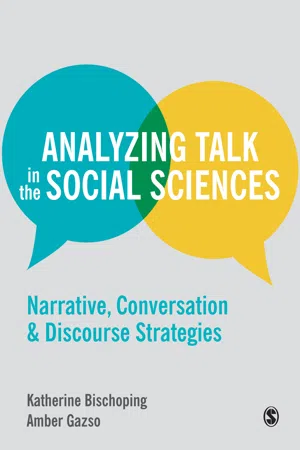
Table of contents

  1. Cover
  2. Half Title
  3. Publisher Note
  4. Title Page
  5. Copyright Page
  6. Acknowledgements
  7. Table of Contents
  8. About the Authors
  9. About The Companion Website
  10. One Introduction
  11. Part I Analyzing Narratives
  12. Two Broad Strokes Approaches to Narrative Analysis
  13. Three Fine-grained Analyses of Meaning
  14. FOUR The Interview in Narrative Analysis
  15. Part II Analyzing Talk-in-interaction
  16. Five The Basics of Conversation Analysis
  17. SIX Conversation Analysis Approaches to Social Categories
  18. SEVEN Institutional Talk-in-interaction
  19. Eight The Interview in Conversation Analysis
  20. Part III Analyzing Discourse
  21. Nine Foucauldian Discourse Analysis
  22. Ten Critical Discourse Analysis
  23. ELEVEN Garden-variety Discourse Analysis
  24. TWELVE The Interview in Discourse Analysis
  25. Thirteen Conclusion
  26. References
  27. Index