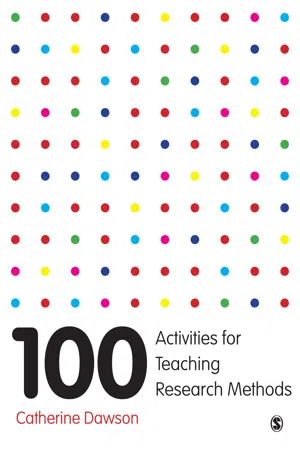
100 Activities for Teaching Research Methods
eBook - ePub

100 Activities for Teaching Research Methods

  1. 384 pages
  2. English
  3. ePUB (mobile friendly)
  4. Available on iOS & Android
eBook - ePub

100 Activities for Teaching Research Methods

About this book

A sourcebook of exercises, games, scenarios and role plays, this practical, user-friendly guide provides a complete and valuable resource for research methods tutors, teachers and lecturers. 

Developed to complement and enhance existing course materials, the 100 ready-to-use activities encourage innovative and engaging classroom practice in seven areas:

  • finding and using sources of information
  • planning a research project
  • conducting research
  • using and analyzing data
  • disseminating results
  • acting ethically
  • developing deeper research skills.

Each of the activities is divided into a section on tutor notes and student handouts. Tutor notes contain clear guidance about the purpose, level and type of activity, along with a range of discussion notes that signpost key issues and research insights. Important terms, related activities and further reading suggestions are also included.

Not only does the A4 format make the student handouts easy to photocopy, they are also available to download and print directly from the book's companion website for easy distribution in class.

Frequently asked questions

Yes, you can cancel anytime from the Subscription tab in your account settings on the Perlego website. Your subscription will stay active until the end of your current billing period. Learn how to cancel your subscription.
No, books cannot be downloaded as external files, such as PDFs, for use outside of Perlego. However, you can download books within the Perlego app for offline reading on mobile or tablet. Learn more here.
Perlego offers two plans: Essential and Complete
  • Essential is ideal for learners and professionals who enjoy exploring a wide range of subjects. Access the Essential Library with 800,000+ trusted titles and best-sellers across business, personal growth, and the humanities. Includes unlimited reading time and Standard Read Aloud voice.
  • Complete: Perfect for advanced learners and researchers needing full, unrestricted access. Unlock 1.4M+ books across hundreds of subjects, including academic and specialized titles. The Complete Plan also includes advanced features like Premium Read Aloud and Research Assistant.
Both plans are available with monthly, semester, or annual billing cycles.
We are an online textbook subscription service, where you can get access to an entire online library for less than the price of a single book per month. With over 1 million books across 1000+ topics, we’ve got you covered! Learn more here.
Look out for the read-aloud symbol on your next book to see if you can listen to it. The read-aloud tool reads text aloud for you, highlighting the text as it is being read. You can pause it, speed it up and slow it down. Learn more here.
Yes! You can use the Perlego app on both iOS or Android devices to read anytime, anywhere — even offline. Perfect for commutes or when you’re on the go.
Please note we cannot support devices running on iOS 13 and Android 7 or earlier. Learn more about using the app.
Yes, you can access 100 Activities for Teaching Research Methods by Catherine Dawson in PDF and/or ePUB format, as well as other popular books in Social Sciences & Social Science Research & Methodology. We have over one million books available in our catalogue for you to explore.

Part 1 Tutor Notes

Section 1 Finding and Using Sources of Information

Activity 1 Distinguishing Between Primary and Secondary Sources

Student handout page 271

Tutor Notes

  • Purpose: This activity helps students to understand the differences between primary and secondary sources when they are searching for, and using, information for their course and/or their research. A student worksheet helps to introduce the topic and encourages students to think about the differences between the two types of source material.
  • Type: Student worksheet (during independent study or in class).
  • Level: Beginner (for students who have limited knowledge of primary and secondary sources).
  • Duration: Up to 30 minutes.
  • Equipment/materials: None required.
  • Prerequisite activities: None.
  • Learning outcome: By the end of this activity students will be able to distinguish between primary and secondary sources.

The activity

Give your students Handouts 1 and 2. Ask your students to work through the questions on Student Handout 2, using Handout 1 as a guide. This worksheet will help your students to think more about the differences between primary and secondary sources. It can be followed by a tutor-led discussion, if you think it is necessary.

Key issues

This short, simple activity was developed when it became clear that some students enrolling on my research methods courses did not have a basic understanding of the differences between primary and secondary sources. The worksheet was designed as a quick and simple way to get them thinking about the issues involved. However, it is far too basic for some students (such as those with a background in history): discretion should be used when deciding whether or not to use this activity.
Students are sometimes confused about whether a journal paper is a primary or secondary source. You may need to point out that this depends on the type of paper. If a journal paper is purely a report of an original piece of research, carried out by the author(s), it is most likely a primary source. However, a critique, review or analysis of this paper carried out by another researcher is a secondary source. Also, if a journal paper is reporting an analysis of data that has already been collected by another researcher this is a secondary, rather than a primary, source. Some journal papers can be both primary and secondary source material; for example, a researcher might report on their original piece of research (primary source), but might also include a comprehensive literature review (secondary source).
It is important to point out to students that sources that are primary to the originator (the statistician, film-maker, writer, clinician or researcher, for example) become secondary when they are interpreted and analysed by others.
The answers to the questions on the worksheet are as follows:
  • Source 1: primary
  • Source 2: secondary
  • Source 3: primary
  • Source 4: primary
  • Source 5: primary
  • Source 6: secondary
  • Source 7: primary
  • Source 8: primary
  • Source 9: combination
  • Source 10: secondary
  • Source 11: secondary
  • Source 12: primary
  • Source 13: secondary
  • Source 14: primary
  • Source 15: primary

Useful terms

See Student Handout 1 for a definition and examples of ‘primary sources’ and ‘secondary sources’.

Related activities

  • Activity 2: Finding and using primary sources
  • Activity 6: Using the internet for background research
  • Activity 7: Evaluating sources

Preparatory reading

Chapters 2 and 3 of Brundage (2013) provide some useful information about primary and secondary sources, and offer advice about how to find different sources.
If you are teaching research methods in the behaviour sciences, you may find Sections 2.3 and 2.4 of Gravetter and Forzano (2012) useful when teaching about primary and secondary sources.

Further reading

Brundage, A. (2013) Going to the Sources: A Guide to Historical Research and Writing, 5th edition. Chichester: John Wiley & Sons. This book is aimed at history tutors and students, but has some interesting material about finding and engaging with sources that is relevant for students studying other social science and humanities subjects.
Gravetter, F. and Forzano, L. (2012) Research Methods for the Behavioral Sciences. Belmont, CA: Wadsworth.

Activity 2 Finding and Using Primary Sources

Student handout page 275

Tutor Notes

  • Purpose: This activity is a student worksheet that helps students to find primary sources and use them effectively (ensuring that relevant information is gathered, recorded, stored and referenced correctly).
  • Type: Student worksheet.
  • Level: Beginner.
  • Duration: Several hours during independent study.
  • Equipment/materials: Students will need access to the relevant resources and details of the referencing system used at your institution.
  • Prerequisite activities: If students are new to this topic they may find it useful to work through Activity 1: Distinguishing between primary and secondary sources, although this is not a prerequisite activity.
  • Learning outcome: By the end of this activity students will know how to identify, locate, use, record and reference primary sources of data.

The activity

Ask your students to work through the activity in the student handout. This directs them to choose three primary source categories from the given list and then identify a specific source within each of the three chosen categories. Once they have done this they should answer the questions posed on the worksheet. This activity helps students to:
  • think about the most useful and accessible primary sources for their subject, and consider sources they may not otherwise have considered;
  • analyse possible problems with accessing sources and work out strategies to overcome these problems;
  • decide what information needs to be gathered to critique, analyse and evaluate the primary source;
  • work out what information needs to be gathered so that they can reference or cite the source correctly;
  • decide how to store and record the information they have gathered.

Key issues

The following list provides examples of the type of information that students should collect when they are critiquing, reviewing and referencing primary sources:
  • author’s name, details and credentials;
  • date of publication;
  • edition or revision (if relevant);
  • publisher;
  • type of publication (journal article, photograph, manuscript, for example);
  • intended audience;
  • coverage of topic;
  • reasoning, if relevant (for example, whether statistics are valid and reliable and conclusions are backed up by evidence);
  • methods;
  • style (writing style, type of image or style of recording, for example);
  • practical information required to reference the source, such as journal name, volume and number, image medium, photographer’s name, date of image, URL and so on.
Referencing software enables students to keep a record of any background information they use for their research. It is important to be organized from the start as this will enable them to find information easily and organize and manage their references as their research progresses. Popular software includes RefME (www.refme.com), CiteULike (www.citeulike.org), EndNote (http://endnote.com) and Zotero (www.zotero.org).
Students in the UK may find Copac (http://copac.ac.uk) useful when searching for primary sources. This service enables students to access ‘rare and unique research material’ by bringing together the catalogues of over 90 major UK and Irish libraries, including the British Library, the National Library of Scotland, the National Library of Wales and the libraries at the National Trust and the Royal Botanic Gardens Kew. Copac does not hold any of the materials, so students will need to arrange an inter-library loan with their local or university library. Students in the USA can use the Library of Congress (www.loc.gov) to access books, recordings, photographs, maps and manuscripts. See Activity 6: Using the internet for background research for more online catalogues, archives and libraries (worldwide).
Activity 10 requires students to design and test a tool that will enable them to record, store, organize and manage their critiques and reviews of research papers and scientific material. You can use Activity 10 together with this activity to help your students organize their critiques and reviews of primary sources, if you think it would be of benefit.

Useful terms

See Student Handout 1 in Activity 1 for a definition of ‘primary sources’ and ‘secondary sources’. A description of ‘primary sources’ is also contained in the student handout for this activity. See Activity 6: Using the internet for background research for a definition of ‘Boolean logic’ (or Boolean search) in the context of data search techniques.

Related activities

  • Activity 1: Distinguishing between primary and secondary sources
  • Activity 10: Managing critiques and reviews
  • Activity 11: Critiquing quantitativ...

Table of contents

  1. Cover
  2. Half Title
  3. Publisher Note
  4. Title Page
  5. Copyright Page
  6. Contents
  7. Activity Level Index
  8. Sidebar List
  9. Sidebar List
  10. Sidebar List
  11. Sidebar List
  12. Sidebar List
  13. Sidebar List
  14. Sidebar List
  15. Sidebar List
  16. Sidebar List
  17. Sidebar List
  18. Sidebar List
  19. Sidebar List
  20. Sidebar List
  21. Sidebar List
  22. Sidebar List
  23. Sidebar List
  24. Sidebar List
  25. Sidebar List
  26. Sidebar List
  27. Sidebar List
  28. Sidebar List
  29. Sidebar List
  30. Sidebar List
  31. Sidebar List
  32. Sidebar List
  33. Sidebar List
  34. Sidebar List
  35. Sidebar List
  36. Sidebar List
  37. Sidebar List
  38. Sidebar List
  39. Companion Website
  40. About the Author
  41. Introduction
  42. Part 1 Tutor Notes
  43. Section 1 Finding and Using Sources of Information
  44. Section 2 Planning a Research Project
  45. Section 3 Conducting Research
  46. Section 4 Using and Analysing Data
  47. Section 5 Disseminating Results
  48. Section 6 Acting Ethically
  49. Section 7 Developing Deeper Research Skills
  50. Part 2 Student Handouts
  51. Student Handouts