How to Succeed at University
eBook - ePub

How to Succeed at University

An Essential Guide to Academic Skills, Personal Development & Employability

  1. 288 pages
  2. English
  3. ePUB (mobile friendly)
  4. Available on iOS & Android
eBook - ePub

How to Succeed at University

An Essential Guide to Academic Skills, Personal Development & Employability

About this book

Achieve all your goals for university – whatever they are!

How to Succeed at University provides straightforward, practical advice for anyone experiencing university life.  Introducing the personal, academic and life skills you need to succeed - both at university and in today's competitive job market – you'll find help with managing your time and budget, and guidance on a range of study skills including skills for research and examination success.  You'll also learn how to identify and develop key transferable skills that will stay with you throughout your professional life.

Discover how to:

  • Improve your employability prospects and give yourself the advantage in the job market
  • Benefit from other students? experience, with top tips and insider advice on succeeding in your studies
  • Explore the uses of digital technologies in learning and assessment
  • Use what you learn right away, with handy downloadable checklists and worksheets.

Pragmatic, up-front and sympathetic, this is an essential companion for all undergraduate students, as well as anyone preparing for study at university.

The Student Success series are essential guides for students of all levels. From how to think critically and write great essays to planning your dream career, the Student Success series helps you study smarter and get the best from your time at university. Visit the SAGE Study Skills hub for tips and resources for study success!

Frequently asked questions

Yes, you can cancel anytime from the Subscription tab in your account settings on the Perlego website. Your subscription will stay active until the end of your current billing period. Learn how to cancel your subscription.
No, books cannot be downloaded as external files, such as PDFs, for use outside of Perlego. However, you can download books within the Perlego app for offline reading on mobile or tablet. Learn more here.
Perlego offers two plans: Essential and Complete
  • Essential is ideal for learners and professionals who enjoy exploring a wide range of subjects. Access the Essential Library with 800,000+ trusted titles and best-sellers across business, personal growth, and the humanities. Includes unlimited reading time and Standard Read Aloud voice.
  • Complete: Perfect for advanced learners and researchers needing full, unrestricted access. Unlock 1.4M+ books across hundreds of subjects, including academic and specialized titles. The Complete Plan also includes advanced features like Premium Read Aloud and Research Assistant.
Both plans are available with monthly, semester, or annual billing cycles.
We are an online textbook subscription service, where you can get access to an entire online library for less than the price of a single book per month. With over 1 million books across 1000+ topics, we’ve got you covered! Learn more here.
Look out for the read-aloud symbol on your next book to see if you can listen to it. The read-aloud tool reads text aloud for you, highlighting the text as it is being read. You can pause it, speed it up and slow it down. Learn more here.
Yes! You can use the Perlego app on both iOS or Android devices to read anytime, anywhere — even offline. Perfect for commutes or when you’re on the go.
Please note we cannot support devices running on iOS 13 and Android 7 or earlier. Learn more about using the app.
Yes, you can access How to Succeed at University by Bob Smale,Julie Fowlie in PDF and/or ePUB format, as well as other popular books in Study Aids & Research in Education. We have over one million books available in our catalogue for you to explore.

Part I How to Develop Your Personal Skills

1 How to Prepare Yourself for Higher Education

Overview – what’s in this chapter?

Image 4
  • Why do you need to upgrade your personal skills?
  • Handling the transition into higher education
  • Orientating yourself to your studies
  • Recognising your own motivation to learn, grow and develop
  • Understanding your emotions in the developmental process
  • Developing your self-efficacy and self-confidence
  • Follow-up activities, further reading and websites to look up
  • Time for review and reflection

Why do you need to upgrade your personal skills?

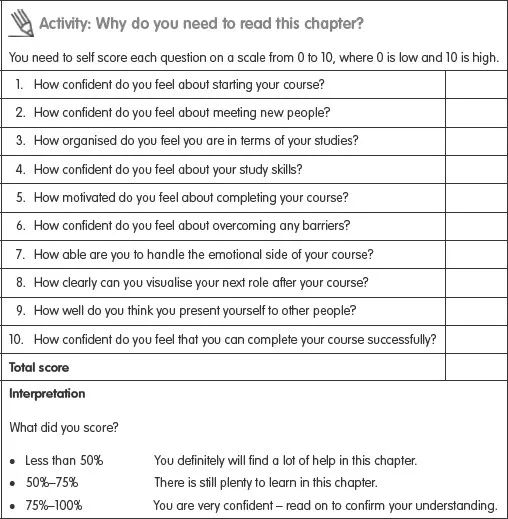
Try completing the short self-scoring test overleaf, to assess your own level of confidence in relation to developing your own personal skills in order to complete your course successfully.
Image 7

What do you want to achieve by studying in higher education?

This is a question that you may already be asking yourself. Understanding your answer will have a lot to do with you successfully completing your course.
This chapter starts by helping you to make a successful transition into higher education. How was your induction? You may have felt confused or overloaded by the end of day one. Then there are the problems of meeting new people, settling into accommodation, maybe living away from home for the first time and getting your studies organised.
The chapter next considers your motivation – what you hope to achieve and why. What barriers there are to be overcome and how will you do this? How anxious are you about the process? Keeping motivated and handing any anxieties will be vital to you in achieving success at university. The chapter then goes on to look at how you can handle your emotions in what will be a developmental process.
The chapter also looks at self-efficacy and how you can build self-confidence in order to succeed in your studies, in employment and in all that lies ahead. You might think that this is rather too soon and that perhaps it should be later in the book, and may be something to look at the end of your course – but read on, it’s what it’s all about!
Finally there are some follow-up activities, suggested further reading, websites to look up, and some space for review and reflection. Reflection will be a recurring theme of this book. It is simply about thinking – but in a structured way – in order to help us learn, grow and develop.

Handling the transition into higher education

Things to do before you arrive

There are quite a few things you can do before you arrive to smooth your transition into university life. Being prepared will help you feel more relaxed and confident when you arrive. Try to work through our suggestions in the following activity.

Activity: Getting prepared

Image 5
  • Check through all the information you have been sent and look at the university website. You may find a ‘new student area’ on the website which will be dedicated to helping you make this transition.
  • Look for student groups on social networking sites. Increasingly students find there is a group dedicated to their course or location and if not, you can start one. This can be really useful in developing a ‘starter pack’ of friends before you arrive.
  • Talk to anybody you know who has been to university and find out what their experience was and what you can learn from this.
  • Make a list of everything you want to take with you, including some home comforts to make your university accommodation more like home.

How did you feel on the first day?

The first day in higher education can be quite traumatic for many new students. There will almost certainly be an induction programme organised for you and it could last for a whole week or even for two. Many people feel that they are subject to information overload as a series of well meaning ‘talking heads’ supply endless information – all of which, they tell you, is absolutely essential.

Activity: How did you feel at the start?

Image 5
  1. Write a paragraph expressing how you felt on the first day in higher education.
  2. Write another paragraph about how you felt at the end of the first week. Was it better or worse?
  3. Write a paragraph about how you felt at the end of the first month. You might need to make a diary date to do this.

What is culture shock?

Culture shock is experienced when people are first exposed to a new and alien culture. They may feel confused and disorientated. When people enter higher education there is always an element of culture shock, because virtually everyone was somewhere else with a different culture before they arrived. International students are often more prone to suffering from culture shock, not only because of differences in the education system, but also because of language and cultural differences. Similarly, if you are a mature student or studying part-time, then you may also feel it more. Indeed it is generally true to say that the greater the difference between where you came from and where you are now, the more likely you are to feel the effects of culture shock.
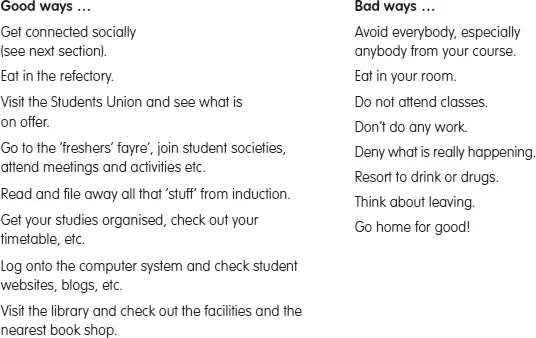
There are good and bad ways to help overcome culture shock. Consider the following two lists.
Image 7a

Activity: Overcoming culture shock

Image 5
  1. Have a look through the ‘good ways’ outlined above and make a list of things that you need to do over the first few days and weeks.
  2. Keep the list in a place where you can see it and tick off things as you achieve them. It’s important to record your successes!

Do you feel homesick or like leaving your course?

Culture shock can lead to homesickness, and you may feel like packing up and going home. It’s very common to feel like this, particularly if you feel overwhelmed by the workload, the place or the people – perhaps all three!
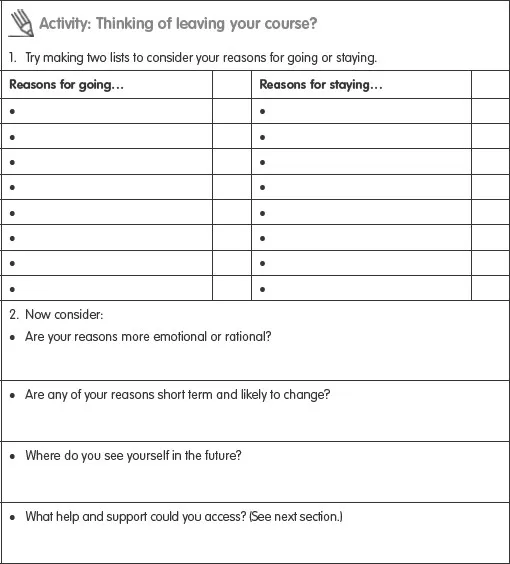
Leaving your course is a really big life-changing decision and so deserves really thorough consideration. Knowing why you want to leave or why you want to stay will be really important if you are going to make the right decision for you.
Image 8
Here are some more things you really sh...

Table of contents

  1. Cover
  2. Half Title
  3. Publisher Note
  4. Title Page
  5. Copyright Page
  6. Contents
  7. Illustration List
  8. Table List
  9. Biographical Details
  10. Preface to the Second Edition
  11. Acknowledgements
  12. Introduction
  13. Part I How to Develop Your Personal Skills
  14. 1 How to Prepare Yourself for Higher Education
  15. 2 How to Plan Your Personal Development
  16. 3 How to Improve Your People Skills
  17. 4 How to Look After Yourself and Upgrade Your Self-Nurturing Skills During the Developmental Process
  18. Part II How to Develop Your Academic Skills
  19. 5 How Do You Learn and How Do You Know What is Required of You?
  20. 6 How to Plan, Conduct and Review your Research
  21. 7 How to Write Up and Present Your Work in Order to Get Better Results
  22. 8 How to Develop Successful Examination Techniques
  23. Part III How to Develop Your Personal Skills
  24. 9 How to Understand What is Required for Your Success in Gaining Internships, Placements and Jobs
  25. 10 How to Understand the Application Process in Order to Get Shortlisted
  26. 11 How to Give Yourself the Best Chance of Success in the Selection Process
  27. 12 How to Continue Developing Yourself for your Future Success
  28. References
  29. Index