1.1 Introduction: why does it matter?
This is, perhaps, the most difficult aspect of career planning. Indeed, it is so daunting for some that we were reluctant to put it here, at the beginning of this guide. But then we decided to be realistic about the task ahead of you: until you know who you are in terms of employability then you cannot move ahead effectively. This is not going to be the fastest leg on your employability journey, as we were reminded just this morning. One of us was called ‘the tech queen’ of a virtual learning environment, much to her surprise. In our enthusiasm to get on with the job in hand, teaching students, we have both acquired skills and experience without necessarily reflecting on the fact that this is happening. She is unlikely to go for a job at an IT call centre, but it is something that, after that stray comment, is going straight on her CV ready for her next appraisal.
Our point is that all of us change and our skills and experience evolve as we go along. Your task at the moment (and at any future points when you are making career choices) is to capture an image of the person you are in terms of your employability. This needs to be a well-rounded image; not just what do you have to offer, but what do you expect in return? Not just what could you do, but what would you prefer to do? Successful employees, those worth investing in, are people who have found a good fit between the people they are and the roles they are fulfilling. That means knowing yourself well in a career context.
Context is all-important here. The employability image you have of yourself will become more clearly defined as you work through this section, but it is not going to be the same as the image others have of you when they think of you as a friend, or a team mate, or a relative. Although you will bring aspects of these ‘selves’ to your current challenge, your career self will be different in some respects from any of these. That is not to say, though, that those who know you in those roles cannot be of great value. As well as using this guide, we will be prompting you from time to time to get some feedback from relatives, friends and colleagues.
An accurate image of yourself will be complicated – usually in a good way – by your experience. Again, there is no need to assume that the view others have of you (your friends all recall your great time on holiday last year) is the only self you have to offer. As you work through this section you will gain a better sense of which experiences you would like to promote and which you would be happy to leave behind. It is a similar story with your motivation. You might be hugely competitive in a quiz team but would prefer to work by consensus in a workplace team. As you evaluate all of these aspects of yourself, a clearer image of your work self will emerge and that will lay a firm foundation for the task ahead of you.
In this, the first step on your journey, we will aim to walk you through the ways in which you can get a clear image of yourself in the career market by answering common questions about the process. We will be looking at six distinct topics: personality, experience, qualifications, qualities, motivation and worth.
Remember!
One function of a career is to make you happy. Happiness is a complicated concept but a good rule of thumb is: if you feel uncomfortable about the person you are presenting to the job market, go back and rethink before you take the next plunge.
Remember!
The person anyone else thinks you are is not a complete picture of who you are in the career market – self-awareness is important in these early stages.
1.2 My personality and preferences
What is ‘my personality at work’?
Your personality at work will have been crafted by the people with whom you work. Each colleague will have found out some part of you that contributes to an overall picture of who you are. The first impressions that were made about you were well within your control and you may have had other opportunities to present the polished ‘work you’. However, we must accept that sometimes we let slip a part of ourselves that we did not intend to show; these moments may be during a stressful time when you feel at the end of your tether or during moments of delight when you have finally worked out how the photocopier works! At this stage, you may find that your personality at work is wildly different from your private personality or you may find it is very similar. The further we move away from our ‘true selves’, the more tiring it is to sustain an image. If you have to change your personality a huge amount to be able to fit into a job, you may need to consider a whole new career.
How can I tell how near my work self is to my true self?
The more you look into this, the more you will notice that there is not really any ‘true self’ for any of us, but rather the series of people we are in different contexts. Later on, we will be talking about personality tests that can help you work out what styles of working might suit you best, but it would help you to know whether the way you are working now (either in the workplace or study situation) is true to how you would like to work. There are signs you could look for that might suggest you are not working in a way that suits you (see Exercise #1 at the back of this book).
How can I get a better picture of my career self?
To get a better picture of your career self, find the time to search for evidence of how you are perceived at work (see Exercise #2).
It may be that your colleagues believe you to be very calm in difficult situations and yet you feel that you tend to panic in the same situations. Do not worry – this is very good information to have as it means you have just learnt that you are extremely good at appearing calm, even in situations that have you worrying in the middle of the night. This does not necessarily mean that you find it comfortable using this skill all of the time but it is lovely to know that you can do it.
Who can help with self-review?
You may have heard of a 360-degree review. In this you get feedback from your subordinates, your peers and your supervisors, to which you add self-evaluation. The purpose of this is to get a well-rounded review of your work and your professional development, and to be able to set realistic targets.
Although there might be systems within your workplace where you can get feedback, what should you do if you are not in work?
Well, you will be pleased to know that you can undertake the same process using the people around you.
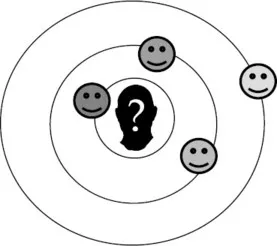
Think about getting opinions from people in your inner circle such as your best friend or a close family member (the inner circle). Go on to get feedback from those who are on the next circle out, such as friends, and then get feedback from old colleagues, tutors and those people who do not know you so intimately (the outer circle). This will give you some idea about the qualities people see in you. You probably do not want your new employer to know that you are a fan of horror films or that you cried during the latest romantic film you watched. However, you are starting to build up a picture of yourself and you can then decide which parts of you will make up the ‘career personality’ that you will use.
Remember!
You need to get as many views as you can if you are to craft a realistic sense of who you are in the workplace or study situation, but it is easy here to lose the wider sense of yourself. Take time during the process to reflect on what you are learning about yourself, and keep notes on what you think of what you are learning. That way you can keep control of the process rather than trying to become what you think you should be, or mourning the loss of who you thought you were.
Where can I find an honest opinion for self-review?
There are some pitfalls to asking for an assessment of your personality from a wide range of people. Your friends and family, for example, see you in informal, social settings and will not want to offend you. At the opposite end, your manager or supervisor may not know you well enough to give you a well-rounded opinion. The best thing to do is to ask opinions from people you trust and respect and then piece together the commonalities. If most of the people you ask state that you are ‘conscientious’ then you can be fairly sure that this is an accurate assessment of your personality.
Remember!
One of the most difficult things to do can be to be honest with yourself, but you need this honesty to gain an accurate picture. This will help you to be successful in your chosen career.
What external tests might I do?
There are many personality tests out there. A useful one to complete is the Myers Briggs personality test as it is often used by professionals and you can access this at www.myersbriggs.org
You may also find the following websites helpful (see page 38 for more information about these): www.humanmetrics.com/cgi-win/jtypes2.asp and www.personalitypathways.com/type_inventory.html
There are other tests that you may be asked to do and so it can be reassuring to find out a bit more about them. The Belbin test is one that looks at which role you would play within a team or organisation. If you would like to find out more see www.belbin.com/rte.asp
RIASEC is another personality test and the acronym stands for ‘realistic’, ‘investigative’, ‘artistic’, ‘social’, ‘entrepreneurial’, and ‘conventional’. You will be given an acronym that suits you at the end of the test and you can click on a link to look at the types of jobs that may suit you. You can complete this test at http://personality-testing.info/tests/RIASEC.php
You may choose to practise aptitude tests online, but it is important that you use a website that you can trust. Try to avoid giving out your personal details as you could end up with a lot of unwanted emails and, finally, practise the tests that you believe you are likely to be asked to undertake in your interviews. There is not much point in taking lots of numerical aptitude tests if the job you are going for does not involve mathematics!
Careful!
We are suggesting some websites that will give you reliable information on psychometric tests, but these can be expensive to undertake. There are three ways to approach this: pay the money, trawl through the internet until you find free options, or go along to an interview for a job that you would be happy to take but that is not your completely ideal job and take the tests as part of that process, then ask for a copy of the results.
What is the difference between an aptitude test and a psychometric test?
There is...