Introduction
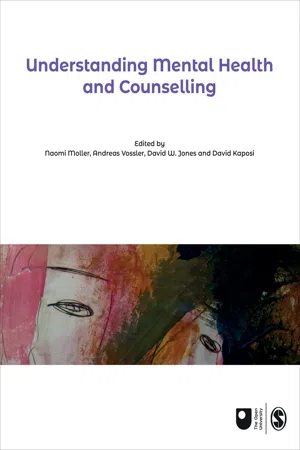
‘Breathe’ by Joanna Crane
Questions about ‘mental health’ and ‘mental illness’ loom large amid many media discussions about the health and well-being of the population and society. Those individuals understood as suffering from some form of mental distress or unhappiness might be offered, or may seek, help from a variety of sources, including psychologists, psychiatrists, mental health nurses, social workers, counsellors and psychotherapists. All these professionals might become involved in the provision of care or treatment. They might be employed within state-run hospitals or clinics, or they might provide private treatment for those willing and able to pay. This chapter will suggest that our awareness of the contemporary scene of mental health and illness can be aided by understanding where its ideas and practices have come from.
This chapter presents a history of ‘psychiatry’, with the word used as shorthand for the development of a set of ideas and practices that deal with what came to be defined as ‘mental illness’. While the emergence of psychiatry was largely led by those who saw themselves as working within a medical specialism, many other interest groups and forces have shaped the development of the various institutions and practices surrounding the world of mental illness. Since any history limited to a single chapter can only tell part of the story, the focus here is on how that history needs to be understood as shaped by contradictory forces: power and control versus care and concern.
Indeed, it can reasonably be claimed that there are two contrasting versions of the history of psychiatry. The first might be called ‘the progressive view’ of the development of a dedicated field of practice that specialised in the treatment of ‘mental’ illness. It recognised areas of human suffering and misery that could be amenable to cure or alleviation if the right treatments were discovered and made available. The second, more critical view, is the anti-psychiatry perspective, which suggests that the profession of psychiatry and the surrounding notions of mental illness and health developed as important tools of a culture that has sought to marginalise and control those individuals whose behaviour deviates from the norm and might pose a threat to the social order.
The focus here is on the emergence of psychiatry within Great Britain, but it should be noted that its early development was embedded in European endeavours, with North American practices becoming important later on. It is certainly the case that psychiatry, now global in its reach, was very much a western enterprise. It is also important to be aware that, as this chapter deals with historical matters, it draws on language (e.g. ‘lunacy’ and ‘mad’) that would be considered offensive if used in the present day. These terms are preserved here, since there is uncertainty about how accurately they could be translated into modern language. Nowadays the term ‘mad’ tends to be equated with something like psychosis, where a person loses touch with reality, whereas in the past it has been used more generally to refer to states of mental turmoil.
This chapter aims to:
- demonstrate how the field of psychiatry has been shaped through its development as a medical speciality, but also by the emergence of a psychological outlook that theorised a ‘mind’ that could become disordered and, therefore, could be subject to psychological treatment
- show that wider issues of social policy and criminal justice have also left their mark on the field of psychiatry
- highlight the considerable public debate surrounding the field, and the influence of popular opinion
- explore the increasing scope of psychiatry, which now covers all areas of life (from cradle to grave) and an ever-growing array of disorders.
1 ‘Madness’ before psychiatry
While the recognisable profession of psychiatry only emerged in the nineteenth century, ‘madness’, as Porter (2002, p. 10) suggests, ‘may be as old as mankind’; follies, fools, madness, grief and despair are staples of Shakespeare’s plays (performed for the first time roughly between 1590 and 1610), for example. By the time that popular ideas and everyday concerns were being written down and printed (a process only just beginning in the seventeenth century), there was apparent interest in what we would now view as ‘mental illness’.
Often mentioned as a milestone on the path to the establishment of a systematic literature was Robert Burton’s (1638) The anatomy of melancholy, first published in England in 1621. The word ‘melancholy’ here appears not to specifically mean ‘sadness’ in the modern sense, but rather conveys some general malaise or mental distress. It is a sprawling compendium of seventeenth-century knowledge and philosophy and an attempt to grapple with the causes of human happiness and unhappiness. It was to be a hundred years later that books more recognisable as medical texts on mental illness began to emerge. Notable was The English malady written by George Cheyne in 1733, or as its subtitle further explained, ‘a Treatise of nervous diseases of all kinds; as spleen, vapours, lowness of spirits, hypochondriacal, and hysterical distempers, etc.’. Cheyne (1733, p. i) notes the observation of an English malady that came from ‘foreigners and all our neighbours on the continent’, and acknowledges its accuracy, suggesting as many as one-third of the population were so afflicted. He proposed that among the causes were ‘the moisture of our air, the variableness of our weather’ as well as modern social conditions including ‘the richness and heaviness of our food’, the ‘wealth and abundance of the inhabitants’, the sedentary lifestyles of the better off, and the difficulties of ‘living in great, populous, and consequently unhealthy towns’ (Cheyne, 1733, pp. i–ii).
It is difficult to know how well Cheyne’s proposed eclectic jumble of causes and cures (including the importance of diet, exercise, greed, consumerism and state-of-the-art knowledge of physiology and the workings of the nerves) was received at the time. Most people could not read, let alone afford to buy a book (Stone, 1969), so Cheyne’s ideas would have been seen by a tiny minority of the population on which he was commenting. In this respect, MacDonald’s (1981) analysis of the notes made by the seventeenth-century English medic Richard Napier perhaps give us a rare insight into the maladies suffered by ordinary people who sought help, and the available treatments before there were any recognisable specialist mental health professionals. While we might take some care not to simply translate Napier’s categories (listed in the table below) into modern equivalents, the list that MacDonald creates does certainly look remarkably familiar (see Table 1.1).
Table 1.1 (Source: based on MacDonald, 1981, Table 4.1, p. 117)
The most common varieties of unhappiness seem to be versions of anxiety and fear, or of sadness: grief, melancholy and mopishness. MacDonald (1981) suggests that patients overwhelmed with feelings of sadness and lethargy and who were drawn from the peasant classes were likely to be labelled as ‘mopish’ b...