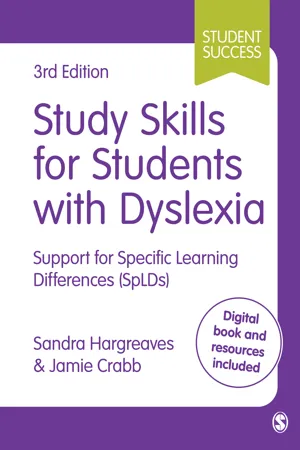
Study Skills for Students with Dyslexia
eBook - ePub

Study Skills for Students with Dyslexia

Support for Specific Learning Differences (SpLDs)

  1. 248 pages
  2. English
  3. ePUB (mobile friendly)
  4. Available on iOS & Android
eBook - ePub

Study Skills for Students with Dyslexia

Support for Specific Learning Differences (SpLDs)

About this book

Do you want to improve your study skills? Packed full of advice on topics including note taking, essay writing, reading strategies and exam techniques, Study Skills for Students with Dyslexia is an essential read for students with dyslexia and other Specific Learning Differences (SpLDs) in further and higher education.

The guidance and tools provided help you organise and plan your work, improve your skills and boost your confidence, so you succeed throughout your studies. The new edition contains:

  • A new chapter on critical thinking, giving you confidence in analysing information and expressing an argument
  • A new chapter on how to make the most of lectures, to ensure you're maximising your learning opportunities
  • The latest IT and software references, including links to online assistive technologies
  • A toolkit of downloadable resources to help you plan and study with ease, including templates, planners, tasks and activities, and toolsheets.

This edition also comes with a fully editable digital download of the book, so you can access it in your preferred reading format.Practical and interactive, this book motivates, inspires and guides you through all your studies.

The Student Success series are essential guides for students of all levels. From how to think critically and write great essays to planning your dream career, the Student Success series helps you study smarter and get the best from your time at university. Visit the SAGE Study Skills hub for tips and resources for study success!

Frequently asked questions

Yes, you can cancel anytime from the Subscription tab in your account settings on the Perlego website. Your subscription will stay active until the end of your current billing period. Learn how to cancel your subscription.
At the moment all of our mobile-responsive ePub books are available to download via the app. Most of our PDFs are also available to download and we're working on making the final remaining ones downloadable now. Learn more here.
Perlego offers two plans: Essential and Complete
  • Essential is ideal for learners and professionals who enjoy exploring a wide range of subjects. Access the Essential Library with 800,000+ trusted titles and best-sellers across business, personal growth, and the humanities. Includes unlimited reading time and Standard Read Aloud voice.
  • Complete: Perfect for advanced learners and researchers needing full, unrestricted access. Unlock 1.4M+ books across hundreds of subjects, including academic and specialized titles. The Complete Plan also includes advanced features like Premium Read Aloud and Research Assistant.
Both plans are available with monthly, semester, or annual billing cycles.
We are an online textbook subscription service, where you can get access to an entire online library for less than the price of a single book per month. With over 1 million books across 1000+ topics, we’ve got you covered! Learn more here.
Look out for the read-aloud symbol on your next book to see if you can listen to it. The read-aloud tool reads text aloud for you, highlighting the text as it is being read. You can pause it, speed it up and slow it down. Learn more here.
Yes! You can use the Perlego app on both iOS or Android devices to read anytime, anywhere — even offline. Perfect for commutes or when you’re on the go.
Please note we cannot support devices running on iOS 13 and Android 7 or earlier. Learn more about using the app.
Yes, you can access Study Skills for Students with Dyslexia by Sandra Hargreaves, Jamie Crabb, Sandra Hargreaves,Jamie Crabb in PDF and/or ePUB format, as well as other popular books in Study Aids & Research in Education. We have over one million books available in our catalogue for you to explore.

Information

1 Managing Your Study

Developmental objectives

This chapter:
  • explains the importance of developing organisational skills
  • outlines the overall structure of university life including the main things you have to consider
  • suggests developing a mindful approach to study to support wellbeing and motivation
  • outlines ways of planning your workload so that you can complete assignments on time and still enjoy some leisure and exercise
  • introduces useful assistive technology and software to help with organization
  • provides examples and templates of weekly timetables, ‘To-do’ lists and other useful resources (Digital-Download).

Studying at college or university

Studying at college or university can be an exciting and inspiring time. There is greater opportunity to explore subjects and social activities that reflect your individual strengths and interests, or reflect a future career choice. When choosing a university or college course it is important that the subject area inspires your interest, and the teaching and assessment methods reflect your thinking and learning styles (see chapter 2).
Furthermore, many colleges and universities offer a range of social activities, groups and societies organised by the student union. Make the most of these opportunities to develop new friendships, interests and access support or interest groups. You can find information about your student union through your university or college website, the National Union of Students (NUS) website: www.nus.org.uk/ or by visiting your student union office. In addition, making contact with student services at the beginning of your studies can ensure you are aware of the support and reasonable adjustments available (see Introduction).
Choosing a subject area that reflects your genuine interests and strengths, engaging in wider activities on offer, and identifying appropriate support early on are essential ingredients to support positive wellbeing during your studies.

Organisation

The demands of college or university study are very different from the more organised environment of school. Apart from your timetabled lectures, tutorials, seminars and examinations, how you organise your time will be up to you. Difficulties with organisation can be experienced by students with dyslexia and other specific learning differences (SpLDs) due to difficulties with processing information (see Introduction). Difficulties with organisation experienced early in your studies may lead to falling behind with your commitments, and the possibility of failing modules, resubmissions and resits. Consequently it is important to explore and develop effective strategies for organisation to support you through your course. Many strategies for organisation including the use of assistive technology software (see Introduction) and smartphone/tablet applications (Apps) are offered throughout this chapter.

Main features of university study

  • Weekly lectures, tutorials, seminars, practical sessions or workshops on campus.
  • Assignments or essays, reports, journals, presentations. This may include individual and group work.
  • Examinations.
  • Independent study in the library or at home.
The timetabled elements of your course may vary according to whether, for example, you are following a science subject, with a lot of practical work or arts and humanities, where there will be more free time intended for reading and writing independently.
As you begin your studies it is advisable to:
  • Visit student services for information about accommodation, finance and support for students with dyslexia and other SpLDs (see Introduction).
  • Get to know your college environment well, so you can locate classes easily and factor in sufficient travel time if you live off campus.
  • Attend a library induction and get to know your subject librarian and other support staff.
  • Ensure you attend any IT training or inductions and study skills sessions.
  • Register with a local doctor.

Developing a mindful approach to study for positive wellbeing

The new challenges presented by university life may sometimes feel overwhelming. Difficulties engaging with methods of teaching and learning can cause stress and impact upon your wellbeing. Wellbeing relates to your ability to take care of yourself to manage stress and difficulties during your study. As a result, it can be helpful to develop a mindful awareness of your personal wellbeing throughout your study.
Mindfulness is a practice of paying attention to how you are feeling in the present moment with an attitude of non-judgement. Practising mindfulness offers the possibility of achieving more insight into your emotions, boosting your attention and concentration and improving relationships (Williams and Penman, 2011). Developing mindful self-awareness can help you to draw on appropriate strategies to support positive wellbeing. For example, if you are experiencing feelings of stress when struggling with an essay, using a simple breathing exercise can help you to practise non-judgement, calm your thoughts and consider alternative options for managing your difficulties such as seeking support, taking a break or using a different study strategy.
Take a mindful pause to focus on the present moment before continuing to the next section:
  • Close your eyes and sit comfortably
  • Breathe in, gradually drawing full breath, filling your stomach and chest
  • Breathe out and allow your body to relax
  • Breathe in, notice the air filling your body
  • Breathe out, relax your mind and body
Explore using this short exercise before undertaking a study activity, or at times of stress.
Being mindful of the present moment can be practised at any time. For example:
  • Practise a series of simple yoga poses by following a guide on YouTube or a smartphone/tablet App.
  • Take a walk, paying attention to the quality of the ground under your feet and the air as it touches your body.
  • Wash the dishes focusing attention upon the sensations of the water against your skin.
  • Listen, sing or dance to some calming or inspirin...

Table of contents

  1. Cover
  2. Half Title
  3. Publisher Note
  4. Title Page
  5. Copyright Page
  6. Contents
  7. Sidebar List
  8. About the Digital-Download
  9. Accessing the Digital-Download
  10. About the Editors
  11. About the Contributors
  12. Acknowledgements
  13. Introduction
  14. 1 Managing Your Study
  15. 2 Understanding How You Think and Learn
  16. 3 How to Make the Most of Your Lectures
  17. 4 Note Taking and Note Making
  18. 5 Reading Strategies and Speed Reading
  19. 6 Answering Essay Questions
  20. 7 Structuring Different Writing Genres
  21. 8 Critical Thinking
  22. 9 Improving Your Grammar, Spelling and Punctuation
  23. 10 Improving Your Mathematics Skills and Using Statistics
  24. 11 Revision and Examination Techniques
  25. 12 Presentations and Collaborative Learning
  26. 13 The Dissertation
  27. Glossary
  28. References
  29. Useful Websites
  30. Index