![]()
Part I Core Skills
The first section of this book will introduce ten key themes. These encompass the core skills required for social work which is underpinned by a commitment to humane, relationship-based practice (Featherstone et al., 2014). To a certain extent, there has always been an acknowledgement that relationships are central to good social work practice, whatever your theoretical standpoint (Ruch, 2010).
However, in recent years there has been a resurgence of interest in the professional and academic discourse of relationship-based practice (RBP) and its value for social work professionals as well as other disciplines. It has also been acknowledged that the task of adopting RBP is no longer straightforward in our bureaucratic, interdisciplinary and ever-changing world of social work. Notwithstanding, the conceptualisation of RBP has been developed, particularly from a person-centred point of view (Murphy et al., 2012), and this is reflected in the chapters contained within Part I.
Before going any further, it is useful to delineate our understanding of the term ‘relationship-based practice’ as this refers to a range of different ways of working. Indeed, existing literature explores a relational approach to ‘people work’ from many different theoretical bases (Trevithick, 2003), including the discipline of psychology (for example, in psychodynamic theory), to the person-centred approaches that have developed since the 1940s and 1950s from the work of counsellor Carl Rogers. In this book we employ the term RBP in its broadest sense and we are influenced by the person-centred ethos of Rogers (1965). We do, however, note the constraints and limitations of RBP, particularly in work that involves the highest level of risk and invokes safeguarding concerns. Notwithstanding, we adhere to a position that believes that RBP should be used where possible as it requires the application of some of the most fundamental values in social work, including respect and empathy.
The aim of Part I, then, is to give the reader a sense of the range of principles that are embedded within our relationship-based approach along with some more concrete ways to embed these into your work through skilful practice. Finally, as RBP is widely recognised as an approach that encourages reflexivity and the ‘use of self’ in the application of social work skills and knowledge, it is highly compatible with anti-oppressive practice and a commitment to social justice.
![]()
1 Person-Centred Communication
Dawn Whitaker
Links to the Professional Capabilities Framework
- • Professionalism • Values and ethics • Diversity and equality • Knowledge • Critical reflection and analysis • Skills and interventions
Links to the Knowledge and Skills Statement for Child and Family Practitioners
- • Child development • Communication • Adult mental ill-health, substance misuse, domestic violence, physical ill-health and disability • Abuse and neglect of children • Relationships and effective direct work • Child and family assessment • Analysis, decision-making, planning and review • The law and the family and youth justice systems • The role of supervision
Links to the Knowledge and Skills Statement for Social Workers in Adult Services
- • The role of social workers working with adults • Person-centred practice • Safeguarding • Mental capacity • Effective assessments and outcome-based support planning • Direct work with individuals and families
Key messages
- Personalised practice means being led by the uniqueness of every individual, in everything you do, every day.
- Communication is a two-way, interactive process.
- Everyone communicates.
- Person-centred thinking is vital to person-centred communication.
- Person-centred communication is vital to achieving person-centred support.
Introduction
Much of our thinking about person-centred communication stems from the work of Carl Rogers relating to person-centred counselling. Although not a social work approach per se, its ‘techniques for talking, listening and being with people’ are influential to how we understand and engage in person-centred and relationship-based practice (Lomax and Jones, 2014: 46).
The ethos of being person-centred is firmly embedded in UK health and social care policy; indeed, it is now a legal right for adults and carers assessed as eligible for social care support under the Care Act 2014. This reflects what is often referred to as the personalisation agenda, specifically the transformation of public services, from the traditional one size fits all approach, to one in which care and support should be tailored to individual requirements.
However, critics argue that personalisation is too often reduced to narrow, tokenistic descriptions of ‘increased choice and control’ (Beresford et al., 2011: 24) as opposed to ‘a completely different way of seeing and working with people’ (Sanderson et al., 2007 cited in Parley, 2001: 301). Whilst a full appraisal of these debates is beyond the scope of this chapter, the fundamental message is that person-centredness is ‘not another job – it’s the job’ (Glynn et al., 2008 cited in Carr, 2012: 80).
This chapter introduces the essential components of general communication skills, before explaining the importance of person-centred communication and illuminating different methods for achieving it in practice. Whilst the focus of the chapter relates to adults rather than children, much of the content is relevant to both adults and children. See Chapter 3, for a dedicated discussion on communicating with children.
Introducing communication
Communication theory explains the essence of communication as follows:
- A means of conveying a message (language, gesture, writing);
- The decoding of the message by the recipient (hearing, seeing reading);
- Making a response on the basis of the interaction (reply). (Randall and Parker, 2000 cited in Parker, 2010: 124)
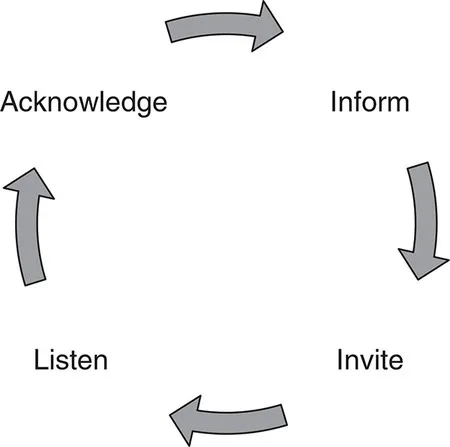
This is illustrated by Collins’s communication cycle: it acts as a helpful reminder to provide as many opportunities for communication as possible during the communication process:
- Inform: Present the information to be conveyed (in whatever format works best for the person).
- Invite: Wait for a response (allow as much time as the person needs, and provide whatever communication aids/resources the person needs to enable them to respond).
- Listen: Listen to, and/or recognise the person’s response, using whatever methods are appropriate to check you have heard what the person intended you to hear.
- Acknowledge: Demonstrate that you have listened, heard and understood before moving on to another piece of communication. (Collins: 2009: 30)
Figure 1.1 Collins’s communication cycle (Collins, 2009: 30)
Source: Collins, Effective Communication A Workbook for Social Care Workers, 2009. Reproduced with permission of the Licensor through PLSclear.
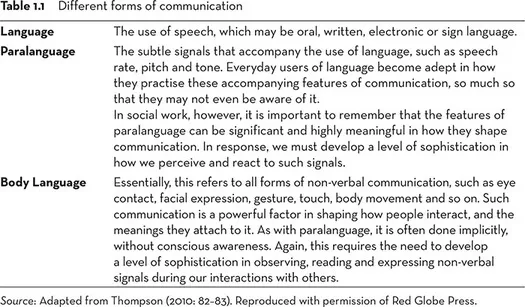
Remember that as you work through the cycle above, the act of communication can take many forms (see Table 1.1).
Table 1.1 Source: Adapted from Thompson (2010: 82–83). Reproduced with permission of Red Globe Press.
In practice, it is useful to tune in to each of these forms of communication simultaneously. Understanding a person’s statement that they are angry will be more successful if you tune in to their pitch and tone of voice, paralanguage and associated non-verbal communication. This will better enable you to assess how to respond to the person, and adapt your speech, paralanguage and non-verbal expression accordingly.
Listening as well as talking
It is imperative that we understand the point of view of the people we are working with. This is identified as a ‘recurring theme in conversations about person-centred support’ with people who use services. (Beresford et al., 2011: 249)
Silence is communication: Silence is not necessarily negative. Indeed, the use of silence offers space to think about and reflect on what has been communicated, as well as what is yet to be communicated. It is not always useful to fill the silence. Instead, use the time to ask yourself some reflective questions, such as:
- Do you or the person feel awkward – if so, why might this be the case?
- Have you posed a difficult or complex question, and does the person need time to think?
- Is the person waiting for you to respond to something they have said?
You could acknowledge the silence by saying something like ‘talking is difficult sometimes’, or perhaps return to what was being said previously by summarising their last comment or stating ‘you were saying …’ (Koprowska, 2008: 78). Whichever approach you take, it is important to ‘respect the silence’ and ‘remain engaged’ with the person (Lishman, 2009: 106). For further information on active listening skills, see Chapter 2.
What is person-centred communication?
In essence, person-centred communication is the adaptation of the different forms of communication outlined above, to the uniqueness of the individual you are working with, and their particular communication style. By doing so, we should be better able to communicate with all people, regardless of their method of communication.
This is relevant to all of us, every day. For example, you may have had the experience of communicating with another person, and although they did listen, perhaps you did not feel heard. Whilst having our communication taken seriously is something we all value. It is particularly important to people receiving health and social care, as it often dictates the basis for subsequent intervention; that is, the identification of needs and associated responses.
All of us have preferred methods of communication, or communication comfort zones, and this is not particular to people with specific needs. However, as social workers, we do work with people that have identified communication needs; for example, people with some form of cognitive impairment, such as a learning disability, brain injury or dementia. We also work alongside people who experience other forms of neurodiversity or mental distress, or some form of physical impairment that affects communication, such as a visual or hearing impairment.
It is important to remember, however, that regardless of the level of communication difficulty a person may experience, all people communicate in one way or another, including individuals who are non-verbal. This may include pictorial communication, sign language, paralanguage, the use of bespoke communication aids and/or behavioural communication through body language and so on. In essence then, ‘We cannot not communicate, whatever we do, individually or collectively, gives off messages to other people, whether intentionally or not’ (Thompson, 2010: 81). It is important to remember that lack of verbal skills does not amount to an inability to communicate. In such a circumstance, the onus is upon us as social workers to step outside of our communication comfort zone, in order to ascertain and work within the person’s own communication style.
On this basis, it is imperative that we take all action practicable to enable the people we work with to communicate. Failure to do so can result in significant consequences for the individual; for example, not being able to:
- Have a conversation;
- Make choices about what they need and want;
- Exert mental capacity to make decisions;
- Express and fight for their rights;
- Access facilities a...