eBook - ePub
The Learning Framework in Number
Pedagogical Tools for Assessment and Instruction
- 184 pages
- English
- ePUB (mobile friendly)
- Available on iOS & Android
eBook - ePub
The Learning Framework in Number
Pedagogical Tools for Assessment and Instruction
About this book
This latest book in the bestselling Mathematics Recovery® series gives mathematics educators a complete research-based framework for assessment, instruction and intervention in whole number arithmetic across grades K to 5. The integrated set of classroom tools includes:
- Nine carefully designed schedules of assessment tasks
- Nine models of learning progressions
- Ten teaching maps that guide the instructional progressions across key topics
The book offers guidance on innovative video-based assessment, and an overview of principles of intervention instruction, giving you an integrated resource for supporting the children you teach.
The Learning Framework in Number will be a useful guide for all primary and elementary school classroom teachers and assistants, and specialist teachers, including experienced Mathematics Recovery® instructors. The book will also be of significant interest to teacher educators and researchers.
Frequently asked questions
Yes, you can cancel anytime from the Subscription tab in your account settings on the Perlego website. Your subscription will stay active until the end of your current billing period. Learn how to cancel your subscription.
No, books cannot be downloaded as external files, such as PDFs, for use outside of Perlego. However, you can download books within the Perlego app for offline reading on mobile or tablet. Learn more here.
Perlego offers two plans: Essential and Complete
- Essential is ideal for learners and professionals who enjoy exploring a wide range of subjects. Access the Essential Library with 800,000+ trusted titles and best-sellers across business, personal growth, and the humanities. Includes unlimited reading time and Standard Read Aloud voice.
- Complete: Perfect for advanced learners and researchers needing full, unrestricted access. Unlock 1.4M+ books across hundreds of subjects, including academic and specialized titles. The Complete Plan also includes advanced features like Premium Read Aloud and Research Assistant.
We are an online textbook subscription service, where you can get access to an entire online library for less than the price of a single book per month. With over 1 million books across 1000+ topics, we’ve got you covered! Learn more here.
Look out for the read-aloud symbol on your next book to see if you can listen to it. The read-aloud tool reads text aloud for you, highlighting the text as it is being read. You can pause it, speed it up and slow it down. Learn more here.
Yes! You can use the Perlego app on both iOS or Android devices to read anytime, anywhere — even offline. Perfect for commutes or when you’re on the go.
Please note we cannot support devices running on iOS 13 and Android 7 or earlier. Learn more about using the app.
Yes, you can access The Learning Framework in Number by Robert J Wright,David Ellemor-Collins in PDF and/or ePUB format, as well as other popular books in Education & Teaching Mathematics. We have over one million books available in our catalogue for you to explore.
Information
1 The Learning Framework in Number: An Overview
We organize our approaches to assessment and teaching using what we call a learning framework. We name it the Learning Framework in Number: the LFIN. There are several major features in the LFIN: bands, domains, schedules, models, teaching charts, ranges, dimensions, and so on. The LFIN is a rich system which connects all these features into a coherent approach to instruction in children’s number knowledge. This chapter explains the main features in the LFIN, how the pedagogical tools are organized in the LFIN, how the LFIN is used to support instruction, and further information related to the LFIN.
An introduction to using the LFIN
The LFIN is organized into nine key domains of number knowledge, and incorporates three main types of pedagogical tools. Here is a brief example of how the domains and tools are used to organize assessment and teaching.
A teacher, Vicki, selects three domains to address with her student, Sam, broadly appropriate for Sam’s number knowledge. Vicki uses a distinctive approach to initial assessment: Video-recorded Interview-based Assessment (VIBA). The VIBA approach is explained in Chapter 2. The assessment involves Vicki conducting an assessment interview with Sam, using the three assessment schedules – the first main type of tool – for the three selected domains. The schedules are presented in Chapter 3. Each assessment schedule provides refined groups of assessment tasks, which Vicki works through strategically, to assess Sam’s knowledge in that domain.
After the assessment interview, Vicki reviews the video-recording of the interview, annotating Sam’s responses on each assessment schedule. Each of the three domains she has assessed has associated models of the learning progressions in the domain – the second main type of tool – which give sequences of levels or stages of knowledge. The models are presented in Chapter 4. Vicki analyses Sam’s responses to determine levels and stages which give a profile of his current knowledge across the three domains.
Next, Vicki consults a teaching chart for each domain – the third main type of tool – to develop an instructional plan targeting Sam’s level of knowledge in each domain. The teaching charts are presented in Chapter 6. As Vicki’s teaching gets underway, the teaching charts guide the subsequent progressions in the instruction. In the next school term, Vicki can assess Sam again, using the same three schedules, and analyse the levels on the same models, to track his progress.
In summary, the teacher uses assessment schedules to assess a student’s knowledge, she uses models to summarize those assessments, and she uses teaching charts to guide instruction that responds to those assessments. The assessment schedules, models and teaching charts are the three main types of pedagogical tools of the teacher’s trade. The LFIN enables coordination of the tools across the domains.
The first three sections of this chapter explain these domains and tools, and how they are coordinated. The latter two sections provide further information related to the LFIN.
Bands and domains in the LFIN
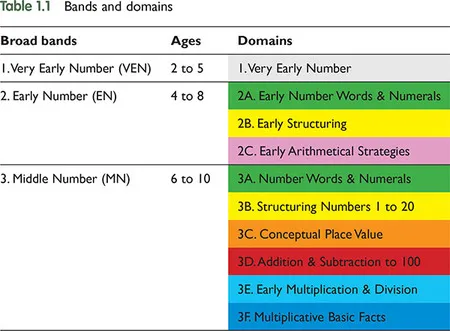
The LFIN spans three broad bands of number learning. Table 1.1 sets out the three bands and indicative age ranges for each. Our main focus is on Band 2, Early Number (EN), and Band 3, Middle Number (MN).

Within Band 2 and Band 3, the LFIN identifies key domains of number learning. The table sets out these domains – three in Early Number and six in Middle Number. The domains have letter codes, 2A to 2C and 3A to 3F, and colour codes, which we use throughout the materials.
Domains
Our sense of these domains has developed over years of our research and teaching. Each domain is regarded as a substantial area of number learning. From the perspective of the teacher, each domain can be somewhat distinct from the other domains, involving distinctive assessment tasks and instructional procedures. Each is worth sustained instructional attention over many months, probably two to three years in the case of the larger domains (e.g. 3B, 3D and 3F). Acquiring sound knowledge of a domain is a significant accomplishment in mathematics learning.
There are, of course, important connections and overlaps between the domains. Instruction within each domain includes developing these connections to other domains.
Overview of each domain
Below is a brief description of each domain. More detailed accounts of each domain are developed in later chapters, through the descriptions of the assessment schedules, models and teaching charts in each domain.
1. Very Early Number
Our purpose in including Very Early Number as Band 1 is to highlight that typically, children acquire significant number knowledge prior to starting school. As well, there is significant very early number knowledge that is not included in the curriculum for students in the first year of school. Insights into this knowledge are provided by the work of developmental psychologists who have observed and documented the number knowledge typical of, for example, 2-, 3- and 4-year-olds.
2A. Early Number Words and Numerals
This domain involves knowledge of basic spoken number word sequences by ones, both forward and backward, such as ‘one, two, three, … twenty’ and ‘thirty-two, thirty-one, thirty, twenty-nine, twenty-eight’. The domain also involves reading and writing numerals. For both number words and numerals, the domain focuses on the range up to 100.
2B. Early Structuring
This domain involves knowledge of finger patterns for numbers up to 10, and standard spatial configurations, such as dice and domino patterns. The domain also involves knowledge of small combinations and partitions, such as small doubles (1&1, 2&2, 3&3, 4&4, 5&5), and five-pluses (5&1, 5&2, 5&3, 5&4, 5&5), and additional emerging knowledge of addition and subtraction in the range 1 to 10.
2C. Early Arithmetic Strategies
Early arithmetic strategies refers to a progression of counting-based strategies that children use to solve counting, additive and subtractive tasks, such as counting the items in a collection, determining the number of items in two collections, or the number of items remaining after some items are removed. These strategies arise in situations where the items to be counted are in the child’s visual field or are screened and thus unavailable to count perceptually. These strategies include the advanced counting-by-ones strategies, that is, counting-on and counting-back.
3A. Number Words and Numerals
This domain extends from Domain 2A, into the range to 1000 and beyond. The domain involves knowledge of number word sequences and numeral sequences, including sequences by 1s, 10s and 100s. This domain also involves reading and writing numerals, up to 5-digit numerals and further.
3B. Structuring Numbers 1 to 20
This domain involves number combinations and partitions in the range 1 to 20, and facility with mental strategies for addition and subtraction that do not involve counting-by-ones. The domain progresses from the finger patterns of Domain 2B, to the use of five-frames, ten-frames and the arithmetic rack, and increasingly to reasoning about bare numbers with independence from any such settings. The domain includes the significant sub-domain of Structuring Numbers 1 to 10.
3C. Conceptual Place Value
This domain involves flexibly incrementing and decrementing numbers by 1s, 10s and 100s. This informal knowledge of 1s, 10s and 100s is foundational in mental strategies for multi-digit computation, and can be distinguished from conventional place value knowledge.
3D. Addition and Subtraction to 100
This domain involves facility with mental computation for addition and subtraction in the range to 100, and beyond, using relatively sophisticated mental strategies. The domain includes the sub-domain of Higher Decade Addition and Subtraction.
3E. Early Multiplication and Division
This domain involves the early development from perceptual, counting-based strategies toward abstract multiplicative reasoning. The domain is focused in the range 1 to 30, and involves facility with basic multiplicative context...
Table of contents
- Cover
- Half Title
- Publisher Note
- Title Page
- Copyright Page
- Brief Table of Contents
- Detailed Table of Contents
- Sidebar List
- Sidebar List
- Illustration List
- Table List
- About the Authors and the Contributor
- Foreword
- Acknowledgements
- Catholic Education Melbourne A special acknowledgement
- Series Preface
- Online Resources
- Introduction
- 1 The Learning Framework in Number: An Overview
- 2 Approach to Assessment
- 3 Assessment Schedules
- 4 Models of Learning Progressions
- 5 Approach to Instruction
- 6 Teaching Charts
- Glossary
- Appendix 1 Instructional Settings
- Appendix 2 LFIN Models Chart Models of Learning Progressions
- References
- Index