An essential guide to critical care nursing that includes all the key scientific knowledge and procedures you will need to know when entering the critical care environment.
Written by a dedicated team of lecturers and practitioners with extensive experience in critical care nursing, this textbook covers all the key elements involved in nursing critically ill adults, with individual chapters on managing problems associated with different organ systems and the pathophysiology behind these disorders. It also features coverage of psychological care and infection prevention, and includes a consistent focus on the importance of a person centred, evidence-based approach to critical care delivery.
To further support your learning, the book is full of activities that enhance your knowledge and test your understanding, including clinical case studies, critical thinking tasks, and reflective practice exercises. For lecturers and instructors, there is a collection of online resources including a testbank of multiple-choice questions, links to relevant videos for each chapter, and PowerPoint slides for each chapter.
The ideal textbook for nursing students studying critical care, undertaking clinical placements in intensive care, or nurses new to the critical care environment.
eBook - ePub
Essentials of Nursing Critically Ill Adults
- 408 pages
- English
- ePUB (mobile friendly)
- Available on iOS & Android
eBook - ePub
Essentials of Nursing Critically Ill Adults
About this book
Information
1 The History and Development of Critical Care Nursing
Critical care nursing is an area of adult nursing with a focus on the care of a person experiencing critical illness. As a critical care nurse, you are the linchpin, coordinating the team and ensuring compassionate, person-centred care is provided for those most to seriously ill along with caring for their families, it is an amazingly rewarding place to nurse.Orla, Staff Nurse who has worked in critical care for 9 years
I was completely awestruck by the nurses on my first week of placement on the critical care department. I then researched all about critical care services and it’s fascinating to read about how critical care and care nursing has evolved over the years. I can’t wait to apply once I qualify!Hadi, 3rd Year Student Nurse
Learning outcomes
When you have finished studying this chapter you will be able to understand:
- The history and development of critical care
- Critical care environment
- The development of evidence-based practice and care bundles
- Working with the Critical Care team
- The importance of reflection and self care
Introduction
This chapter aims to provide you with some of the historical context of critical care and how critical care nursing has developed. The chapter will explore the nature of current critical care services and the configuration of care delivery. We will discuss contemporary critical care nursing and how evidence-based nursing in the area is progressing. In this chapter, the importance of professional issues in critical care and multi-professional team working – both of which are vital in this clinical setting – will be explored. The use of evidence-based care bundles are common and therefore the concepts of delivering care in this way will be introduced. The chapter will highlight some of the potential political, legal, ethical and moral dilemmas which you may meet. The notion of reflective practice and the importance of your personal self-care will also be incorporated.
The history and development of critical care
First let’s look back. Considering the establishment of critical care from a historical perspective may help us appreciate the important role nursing has within this environment.
Organising care, so that groups of the most unwell patients are nursed together, started during the 1940s and 1950s (Fairman, 1992), though it could be argued that there were several key events before this that shaped the development of critical care. Florence Nightingale in the 1850s demanded that those most seriously ill, as a result of fighting in the Crimean war, were placed near to the nurses station (Vincent, 2013).
As with a lot of medical development, many advances are due to activity during wartime and, over the early 1900s, medical and surgical technology was developing rapidly. However, one of the most significant groupings of seriously unwell patients was in the 1950s. This was as a result of several large polio epidemics, the most famous one being in Copenhagen. Within weeks, more than 300 patients developed respiratory paralysis and the ventilator facilities within the hospital were completely overwhelmed (West, 2005). The solution to the crisis was manual ventilation using a rubber bag attached to a tracheostomy tube. Around 200 medical students delivered the patients’ ventilation around the clock and some patients were ventilated in this way for several weeks. Respiratory failure experienced by those who contracted polio resulted in the development and increased use of the iron lung ventilator (See Figure 1.1).
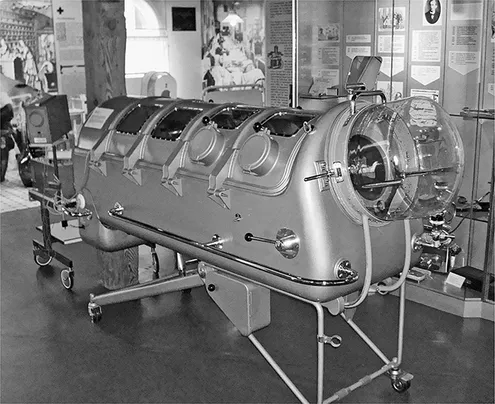
Figure 1.1 Iron lung ventilator
Source: Wikimedia Commons, URL: https://commons.wikimedia.org/wiki/File:Museum-gt-eiserne-lunge.webp (accessed October 28, 2020).
Reproduced under the Creative Commons Attribution 3.0 Unported License (CC BY 3.0), https://creativecommons.org/licenses/by/3.0/deed.en
Over the next decade intensive care units were created in hospitals across America, Europe and Australia. Advances in medical technology, such as ventilation and monitoring, drove all of this development. The most recent significant change to UK critical care services began with the publication of Critical to Success (Audit Commission, 1999) and Comprehensive Critical Care (Department of Health, 2000). Both of these publications influenced care delivery and how critical care as a service was viewed. This development will be explored in more detail in Chapter 3.

This topic is also covered in chapter 3
There are very few accounts of the historical development of critical care nursing. Yet during the development of critical care there has been a reliance on nurses to closely monitor vital signs and provide continuous bedside interventions. As technology and treatments have advanced, so have the knowledge and skills of the nurses who work in critical care. As the care became more complex, so has the role, requiring the nurse to have in-depth knowledge of the speciality and the ability to apply that knowledge in line with professional standards. Changes in educational provision and concern about variation across the UK resulted in the development of the Steps Framework for Adult Critical Care Nurses (Critical Care Network – National Nurse Leads (CC3N), 2018) which focuses on the development of a competent critical care nurse.
Based on a series of competency statements it describes an ability or level of knowledge considered to be a requirement of a particular role. The step competencies provide a national framework for nurses to ensure care delivery is consistent, safe and of a high standard (Deacon et al., 2017). The framework for critical care nursing currently has four steps; Step 1 covers core skills for those new to the environment, Steps 2 and 3 encompass more advanced skills alongside academic development and Step 4 provides a competency structure for the development of senior leaders within critical care nursing (CC3N, 2018). There are also competencies for specialist areas such as neurological, trauma and burns critical care specialities. Although England has introduced national standards for critical care competence, there is some variation, for example, Wales have their own adapted version with similar principles and requirements. The steps and how they link together can be seen in Figure 1.2.
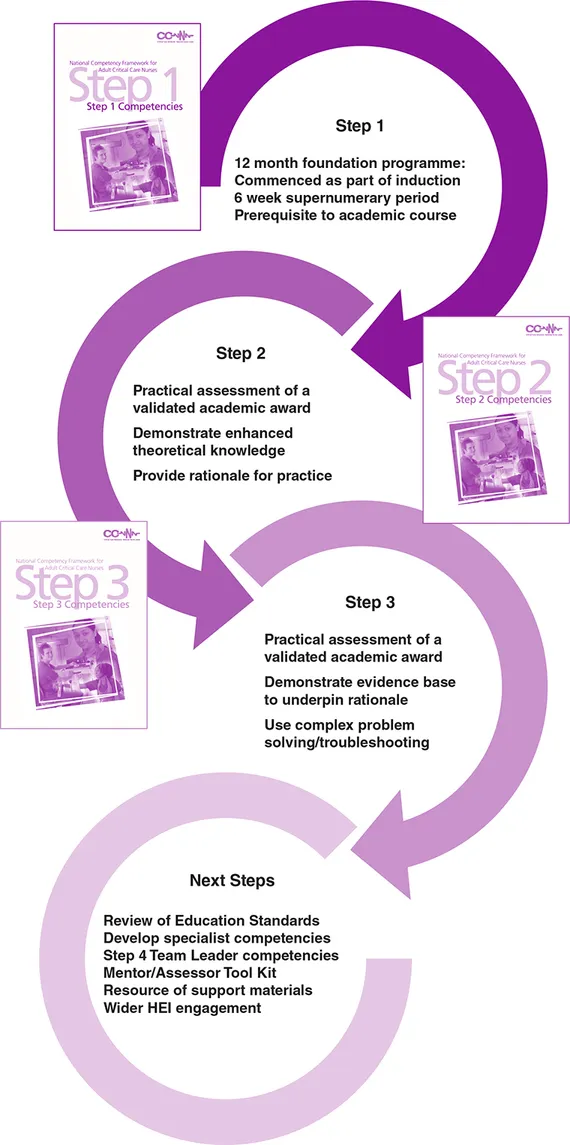
Figure 1.2 The three steps of the National Competency Framework.
S...
Table of contents
- Cover
- Half Title
- Publisher Note
- Title Page
- Copyright Page
- Contents
- The Sage Essentials of Nursing Collection
- About the Authors
- About the Contributors
- Acknowledgements
- Introduction
- Note to lecturers: Access to additional teaching resources
- 1 The History and Development of Critical Care Nursing
- 2 Humanising Critical Care
- 3 The Critical Care Continuum
- 4 Infection Prevention and Control in the Adult Critical Care Unit
- 5 Critical Care Related to the Respiratory System
- 6 Critical Care Related to the Cardiac System
- 7 Critical Care Related to Systemic Inflammatory Response
- 8 Critical Care Related to the Pathophysiology and Management of Renal and Liver Disorders
- 9 The Complex Patient: Scenario 1
- 10 Critical Care Related to the Gastrointestinal System
- 11 Critical Care Related to Neurology, Physiology and Disorders
- 12 Critical Care Related to the Skin and Integumentary System
- 13 The Complex Patient: Scenario 2
- 14 Critical Care Related to Women During Pregnancy band Childbirth
- 15 The Psychological Care of the Critically Ill
- 16 Supporting Those at the End of Life in Critical Care
- 17 Rehabilitation After Critical Illness
- Appendix
- Glossary
- Index
Trusted by 375,005 students
Access to over 1.5 million titles for a fair monthly price.
Study more efficiently using our study tools.
Frequently asked questions
Yes, you can cancel anytime from the Subscription tab in your account settings on the Perlego website. Your subscription will stay active until the end of your current billing period. Learn how to cancel your subscription
No, books cannot be downloaded as external files, such as PDFs, for use outside of Perlego. However, you can download books within the Perlego app for offline reading on mobile or tablet. Learn how to download books offline
Perlego offers two plans: Essential and Complete
- Essential is ideal for learners and professionals who enjoy exploring a wide range of subjects. Access the Essential Library with 800,000+ trusted titles and best-sellers across business, personal growth, and the humanities. Includes unlimited reading time and Standard Read Aloud voice.
- Complete: Perfect for advanced learners and researchers needing full, unrestricted access. Unlock 1.5M+ books across hundreds of subjects, including academic and specialized titles. The Complete Plan also includes advanced features like Premium Read Aloud and Research Assistant.
We are an online textbook subscription service, where you can get access to an entire online library for less than the price of a single book per month. With over 1.5 million books across 990+ topics, we’ve got you covered! Learn about our mission
Look out for the read-aloud symbol on your next book to see if you can listen to it. The read-aloud tool reads text aloud for you, highlighting the text as it is being read. You can pause it, speed it up and slow it down. Learn more about Read Aloud
Yes! You can use the Perlego app on both iOS and Android devices to read anytime, anywhere — even offline. Perfect for commutes or when you’re on the go.
Please note we cannot support devices running on iOS 13 and Android 7 or earlier. Learn more about using the app
Please note we cannot support devices running on iOS 13 and Android 7 or earlier. Learn more about using the app
Yes, you can access Essentials of Nursing Critically Ill Adults by Samantha Freeman,Colin Steen,Gregory Bleakley in PDF and/or ePUB format, as well as other popular books in Medicine & Nursing. We have over 1.5 million books available in our catalogue for you to explore.