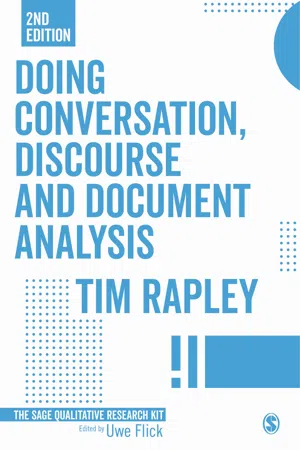
Introducing the theory and practice of conversation, discourse and document analysis, this book proves how useful these methods are in addressing key questions in the social sciences. A true masterclass on practical issues such as generating an archive, transcribing video material, and analyzing discourses using a full range of documentary and verbal data. It is the essential guide to exploring the rich rewards of working with text and talk.
- 176 pages
- English
- ePUB (mobile friendly)
- Available on iOS & Android
eBook - ePub
Doing Conversation, Discourse and Document Analysis
About this book
Information
Chapter One Studying discourse
Contents
- Some introductory thoughts2
- Some thoughts on origins4
- Some thoughts on what is to come6
Chapter objectives
After reading this chapter, you should:
- know about some of the assumptions and ideas central to the study of discourse; and
- be familiar with the general outline and the purpose of this book.
Those undertaking work on conversations, discourse and documents are fascinated by language, written or spoken. I am not actually sure what those interested in discourse have not studied yet – like the Internet, nearly all the areas of human (and non-human) conduct have been investigated. There are classic pieces of work that focus on racism, sexuality and madness, but these days anything goes: from the role of ‘uh huh’ in talk between friends to government legislation on genetically modified food. The range of sources of potential materials to analyze is equally massive: official documents, political debate, all the types of media outputs, casual conversations, talk in workplaces, interviews, focus groups, ethnography, blogs, chat rooms, and so on. This book aims to explore how you can research language-in-use. It aims to outline in detail the very practical issues that you might face and the very practical solutions you can employ.
Some introductory thoughts
The term ‘discourse analysis’ is often used to describe the style of work you will see in this book. Unfortunately for you, that term has many meanings. Some people take it to mean focusing on how some specific discourses, say ‘racism’ and ‘nationalism’, are used across a range of interview transcripts or a range of newspaper editorials. Others may take it to mean focusing on how specific words, like ‘the evidence suggests’ or ‘obviously’, are used in an audiotape of a conversation or a single scientific research article to argue a specific case. Irrespective of the approach, for those analyzing discourse the primary interest is in how language is used in certain contexts. And the context can range from a specific moment in a conversation to a specific historical period.
On a general level, people studying discourse see language as performative and functional: language is never treated as a neutral, transparent, means of communication. But rather than talk in the abstract, let me give you a ‘classic’ example: Two reporters see a man being shot. The next day one headline reads ‘Freedom Fighter Kills Politician’ and the other headline reads ‘Terrorist Kills Politician’. Some of the questions you could ask are:
- Which one is true?
- Which one is correct?
- Which one is factual?
And this is not just a philosophical or abstract question. We have seen this being explored in our recent history through the debates about the status of the people moved from Afghanistan to the American enclave in Cuba and interned in Guantanamo Bay. One of the debates has centred on whether these people are to be understood as ‘prisoners of war’ – and therefore to have specific sets of legally binding human rights – or as ‘unlawful combatants’. Similarly, Pervez Musharraf, Pakistan’s tenth president, is one of many political leaders that have commented on the contemporary difficulties in defining just who is a ‘freedom fighter’ and who is a ‘terrorist’. So as these examples begin to show, language is constructive, it is constitutive of social life. As you speak and write you produce a world.
So the interest for those analyzing discourse is on how language is used. The focus is on what specific version of the world, or identity, or meaning is produced by describing something in just that way over another way; what is made available and what is excluded by describing something this way over an alternative way. I can offer you another classic, albeit more mundane, example. Note that the elements of the following list are all ‘true’, ‘correct’ and/or ‘facts’ about me:
- I am old.
- I am young.
- I am a doctor.
- I am not a doctor.
- I was born on 10 August 1973.
- I was born on 9 August 1973.
Let us take the simplest of these contrasting statements about me – the old/young dichotomy. Well, at some moments, with some people, I get referred to as ‘young’. For example, I taught some mature students and one of them entered the room late and refused to believe that someone my age could be the teacher; as she noted, ‘I was just too young’. And it is not hard to imagine other moments when I am classified as ‘old’. Am I too old to go clubbing? For me the feeling of ‘being too old’ is massively dependent on such factors as the other clubbers’ ages. So such categorizations can be dependent on such contextual factors as the age of the other people, the specific context or social norms.
If we think about the second pair on the list, as I work in a medical school, I am routinely reminded of my fluid and impermanent status as a ‘doctor’. At various moments I have been asked, ‘What kind of doctor are you?’. When I explain I have a PhD some people, most often medical practitioners, have been known to reply, ‘Oh, so you’re a PhD’. My mother has commented, albeit jokingly, that ‘You may be a doctor, but you’re not a useful one’. Also, when trying to recruit medical practitioners for research, to get access to them, I often tell the receptionist that I am ‘Doctor Tim Rapley’ as I know from experience that a plain ‘Tim Rapley’ will only get a message taken whereas the added descriptor will often get me put directly through to them. So how I choose to describe myself and how others describe me, can, and does, have effects.
Finally, the two references to my date of birth refer to two different documents that I possess. One is my birth certificate, which offers one of the dates; I recently discovered the other date when I saw a copy of my birth record that was completed by the midwife who oversaw my delivery. As I am adopted I have no way of knowing which date is ‘real’. However, the date on my birth certificate is orientated to by various institutions and institutional actors as having ‘a factual status’. In terms of my passport, tax forms, insurance policies, and so on, only one of the documents, only one of the dates, is relevant. However, in terms of my personal narrative, my identity as an ‘adoptee’, both documents are relevant. Documents produce specific realities and the realities they produce have effects.
So I can and do describe myself in a multitude of ways and others can and do describe me in different ways. I am a son, a partner, an academic, a researcher, an employee, a seminar leader, a patient, and so on. The point is to focus on which description, or to put it more technically, which identity, membership category or subject position, among the many, is relevant, the ‘work’ that it does, and how that is tied to specific contexts and connects to broader culture.
Some thoughts on origins
There is no simple creation story about the birth and development of the study of discourse. Rather than see it as a single, unitary, approach to the study of language-in-use, we could see it as a field of research, a collection of vaguely related practices and related theories for analyzing talk and texts, which emerge from a diverse range of sources. It is often seen to emerge, in part, from the tradition of social constructionism. Vivian Burr (2015) offers four ideas that social constructionists often work with:
- A critical stance towards taken-for-granted knowledge and understanding.
- That our knowledge of the world is both historically and culturally specific.
- That this knowledge is created, sustained and renewed by social processes.
- That our knowledge and actions are intimately related and reflexively inform each other.
Put simply, our understanding of things, concepts or ideas that we might take for granted like ‘sexuality’, ‘madness’ or ‘instincts’ is not somehow natural or pregiven, but rather is the product of human actions and interactions, human history, society and culture. For example, why should childcare responsibilities be something that is tied to specific divisions of society – most often women? Is being a parent a set of practices, skills or resources that are somehow just innate to some divisions of society and similar throughout the globe, or is it culturally and historically specific? Is being a parent somehow only a product of genetics, biology or blood, or is it a set of social knowledges and actions that are practised, that we do parenting? Is our knowledge of being a parent something that all people just know or is this knowledge learned and generated in and through our interactions with others?
So social constructionism asks questions about everything we might take for granted – our identities, practices, knowledges and understandings. Such discussions do not necessarily have to lead us into debates about what is ‘real’ and what is not ‘real’. As Rose notes, ‘The realities that are fabricated, out of words, texts, devices, techniques, practices, subjects, objects and entities are no less real because they are constructed, for what else could they be?’ (1998, p. 168). It offers us a direction of research, one in which we take seriously how parenting (or gender, sexuality, ethnicity, facts, truth, and so on) is produced and negotiated, the practical, active, knowledge and action that is engaged in as part of our everyday lives, and take seriously the historical, social and cultural specificity of these knowledges and actions.
The study of discourse has also been influenced by other related theories and ideas emerging from such sources as linguistics, critical psychology, deconstructionism, phenomenology, poststructuralism, postmodernism, pragmatism, and writers such as Austin, Foucault, Goffman, Garfinkel, Sacks, Schutz and Wittgenstein (to name but a few). You also have a confusing array of contemporary research traditions that focus on, at some points, the analysis of language-in-use in talk and/or texts; this includes researchers undertaking:
- Actor network theory.
- Conversation analysis (which is seen by some as a ‘child’ of ethnomethodology).
- Ethnomethodology.
- Ethnography of communication (often connected to anthropology).
- Critical discourse analysis (often connected to linguistics).
- Critical psychology.
- Discursive psychology (which used to be referred to as ‘discourse analysis’).
- Foucauldian research (which also used to be referred to as ‘discourse analysis’).
- Interactional sociolinguistics.
- Membership categorization analysis (which is related to both conversation analysis and ethnomethodology).
- Sociology of scientific knowledge (which is sometimes referred to as science and technology studies or social studies of science and technology).
Each tradition has its own assumptions about what counts as ‘appropriate data’ or ‘materials’ to do this type of work with and just how this type of work should be done. Also each tradition has its own terminology. For example, some people talk about ‘discourses’ whereas others refer to ‘interpretive repertoires’; similarly some talk about ‘identities’, others ‘subject positions’, and others ‘categories’ or even ‘membership categories’.
However you conceive of its origins, the best way to get a sense of understanding what the study of discourse is about is to go and read other people’s work. And unfortunately, there are no hard-and-fast rules or methods that are easily translatable into something that may look like ‘a set of hard-and-fast rules or methods’. One writer describes such work as ‘a craft skill, more like sexing a chicken than following a recipe for a mild chicken rogan josh’ (Potter, 2011, p. 189).
Some thoughts on what is to come
This book is designed to offer you access to ‘the craft skill’ of collecting and working with discourse from a range of contexts and a range of perspectives. The next chapter discusses how to generate your research archive – the ‘dataset’ that you will find yourself working with on a day-to-day basis. I offer you a brief tour of the massive range of researchable materials that are potentially available to you. I also provide some examples of how I and other researchers found, collected and analyzed various materials. Chapter 3 then shifts to a discussion of ethics and confidentiality. I outline some general principles you should consider as well as some more detailed guidelines that may help you think about your specific research project. Thinking about the ethical implications of your research is never just a bureaucratic or organizational requirement or hurdle. It is essential that anyone who wants to conduct research has respect for those people they are researching, and demonstrates this with their actions throughout the life of the project.
The next two chapters focus on the generation and transcription of audio and video recordings. Chapter 4 outlines the types of recording devices that are currently available. It then goes on to discuss how to recruit participants, generate research questions and record field encounters. Each of these three issues is discussed in relation to both so-called ‘researcher-prompted data’ – focus group or interview-based research – and so-called ‘naturally occurring data’ – audio- or video-based ethnographies of action and interaction. Chapter 5 then outlines different ways that you can transcribe the recordings that you generate. I use some materials that I have collected – a recording of people preparing a meal – to demonstrate some of the different ways that you can transcribe the same recording.
In Chapter 6, I then focus on how you can study talk and conversations. I show how people, mainly from the research traditions of conversation analysis and discursive psychology, work with audiotapes and videotapes of talk and interaction. Through a discussion of a range of transcripts of talk, I outline some of the key features of talk that people often focus on when analyzing conversations. The next chapter shifts to exploring how documents and texts are created, used and spoken for in various contexts. It focuses on how documents, and other ‘non-human things’ (like pens or computers), co-ordinate and produce people’...
Table of contents
- Cover
- Half Title
- Series
- Title Page
- Copyright Page
- Contents
- Sidebar List
- Editorial Introduction Uwe Flick
- About this Book and Its Second Edition Uwe Flick
- Acknowledgements
- Chapter One Studying discourse
- Chapter Two Generating an archive
- Chapter Three Ethics and recording ‘data’
- Chapter Four The practicalities of recording
- Chapter Five Transcribing audio and video materials
- Chapter Six Exploring conversations
- Chapter Seven Exploring conversations about and with documents
- Chapter Eight Exploring conversations and discourseSome debates and dilemmas
- Chapter Nine Exploring documents
- Chapter Ten Studying discourseSome closing comments
- Glossary
- References
- Index
Trusted by 375,005 students
Access to over 1.5 million titles for a fair monthly price.
Study more efficiently using our study tools.
Frequently asked questions
Yes, you can cancel anytime from the Subscription tab in your account settings on the Perlego website. Your subscription will stay active until the end of your current billing period. Learn how to cancel your subscription
No, books cannot be downloaded as external files, such as PDFs, for use outside of Perlego. However, you can download books within the Perlego app for offline reading on mobile or tablet. Learn how to download books offline
We are an online textbook subscription service, where you can get access to an entire online library for less than the price of a single book per month. With over 1.5 million books across 990+ topics, we’ve got you covered! Learn about our mission
Look out for the read-aloud symbol on your next book to see if you can listen to it. The read-aloud tool reads text aloud for you, highlighting the text as it is being read. You can pause it, speed it up and slow it down. Learn more about Read Aloud
Yes! You can use the Perlego app on both iOS and Android devices to read anytime, anywhere — even offline. Perfect for commutes or when you’re on the go.
Please note we cannot support devices running on iOS 13 and Android 7 or earlier. Learn more about using the app
Please note we cannot support devices running on iOS 13 and Android 7 or earlier. Learn more about using the app
Yes, you can access Doing Conversation, Discourse and Document Analysis by Tim Rapley,Author in PDF and/or ePUB format, as well as other popular books in Social Sciences & Social Science Research & Methodology. We have over 1.5 million books available in our catalogue for you to explore.