Challenge Number 1: The Distinctiveness of Young People’s Non-formal Learning
For readers who are not youth workers, the meaning of ‘youth work’ can be difficult to pin down. ‘Youth work’ has been used to refer to a wide variety of activities, from working with a group of scouts, running a youth club or making contact with groups of young people on an estate to addressing anti-social behaviour.
The definition of youth work used in this book is from the National Youth Agency in the UK:
Youth work helps young people learn about themselves, others and society, through informal educational activities which combine enjoyment, challenge and learning.
Youth workers work typically with young people aged between 11 and 25. Their work seeks to promote young people’s personal and social development and enable them to have a voice, influence and place in their communities and society as a whole.
Youth work offers young people safe spaces to explore their identity, experience decision-making, increase their confidence, develop inter-personal skills and think through the consequences of their actions. This leads to better informed choices, changes in activity and improved outcomes for young people. (NYA, 2014b)
As a learning experience youth work is influenced by key educationalists’ ideas, such as the importance of emancipatory education (Friere, 1972), the role of race, capitalism and gender in the perpetuation of oppression and the need to celebrate invisible histories and cultures (hooks, 1994), and the role of critical pedagogy and empowerment (Giroux, 2001; McLaren et al., 2010); it is important to revisit the principles of these key figures when planning an evaluation of youth work.
As the NYA quote above shows, youth workers are often defined as informal educators (Rosseter, 1987), and youth work is often described as an informal process (Merton et al., 2004; NYA, 2014b). We, and others, believe that the word ‘informal’ can be problematic, and it has been increasingly suggested that the appropriate term for planned interventions with clear purposes being applied throughout Europe is ‘non-formal education’ (Festeu and Humberstone, 2006).
When we talk about projects with young people in this book we refer to non-formal learning. Non-formal learning involves learning through planned activities that take place outside school or college, but which involve some form of facilitation. The evaluation practice described in this book can also be applied to formal and informal learning settings, but principally we refer to non-formal projects throughout this text. So what is the difference?
Non-formal learning is learning outside the formal school, vocational training or university system. Non-formal learning takes place through planned activities, in other words, activities that have goals and timelines. Non-formal learning involves facilitation. This does not equate to ‘teaching’ as the role of the student as an active participant is stressed. It tends to be short-term, voluntary, and have few if any prerequisites, although it can have a curriculum and can overlap with formal learning (Batsleer, 2008). Youth work is often non-formal in that there may be a session plan and intended outcomes. A session watching a DVD might, for example, have intended outcomes that include listening skills, discussion and increased awareness of the subject on the DVD. The session plan might also detail what the youth workers will do with the young people to enable them to gain the outcomes from watching the DVD.
Informal learning is learning that is not organised or structured in terms of goals, time or instruction. There is no teaching or facilitation and as such it refers to skills acquired through life and work experience in the private and social lives of learners. It also includes the informal learning that occurs around educational activities, rather than as an intended aspect of a planned educational intervention. Young people hanging out in the park together may learn social skills for example. This spontaneous informal learning may also occur in a formal setting, with young people, for example, learning about social norms in a classroom setting whilst formally being taught, say, geography.
Formal learning is planned learning that takes place in schools, colleges and universities. It involves a teacher planning a series of lessons that cover a curriculum and can be highly bureaucratic and institutionalised. The teacher may use interactive teaching styles, or may predominantly ‘transmit’ or tell the young people what they need to know. A lesson on citizenship for example may require the young people or ‘students’ to listen to the teacher, read a section of text, and then complete some comprehension questions.
The key difference between these forms of learning is the degree of power that young people have. In formal learning the young person has very little power over what is planned, delivered or assessed. In informal learning the young person has all the power. In contrast, non-formal learning shares power with young people and takes the development of the young people themselves and of their life-world as the point of engagement (Batsleer, 2008).
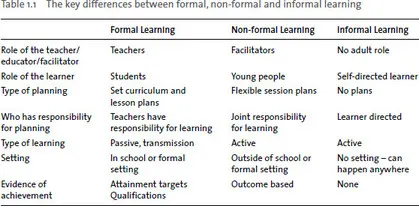
The differences between these types of learning are set out in Table 1.1. The difference between these three forms of learning is significant in evaluation as two of them are predisposed to having a predetermined set of outcomes to work towards, and one intentionally has no outcomes. Because formal learning is pre-planned, it is predictable and relatively straightforward to monitor and ‘measure’ through the attainment of targets at key stages, and eventually through qualifications (often called ‘hard’ outcomes). Non-formal learning is less predictable, although there are goals and timelines, these are flexible and outcomes are often more concerned with the social or personal development of the young person (‘developmental outcomes’ or ‘soft outcomes’). As a consequence, planning, implementing, monitoring and ‘measuring’ outcomes is a complex process. Informal learning is completely unpredictable and so even more difficult to monitor and ‘measure’. Perhaps because of this, formal learning has often been privileged as the ‘best’ way to learn, as it is simpler to evidence attainment.
Youth workers have championed the non-formal/informal approach to working with young people, as has the United Nations Education, Scientific and Cultural Organisation (UNESCO, 2012) who have recently called for the validation of non-formal and informal learning in the EU by 2015 to ensure that the outcomes of formal, non-formal and informal learning are equally valued. This drive is also championed by the Organisation for Economic Growth and Development (Werquin, 2010).
Unfortunately, this move comes with a cost. Given the nature, aims and practices of informal and non-formal education ‘demonstrating success’ has proved notoriously difficult. However, it is exactly these forms of learning that youth work practitioners are being asked to evaluate and demonstrate the ‘success’ of. It is clear that one of the challenges for people working with young people in informal or non-formal settings is to develop effective and appropriate ways of evaluating and demonstrating the success of their practice, of this distinct form of learning.
Pause for Thought
Think about a project that you have been involved in:
- How would you classify the type of learning? Identify critical elements within this using Table 1.1.
- Why does it not fit into other types of learning?
- What are some of the ‘hard’ and ‘soft’ outcomes of the project?
Challenge Number 2: The Professional Context
The discussion of formal, non-formal and informal learning showed that previously formal learning has been privileged as it was possible to evidence outcomes and attainment in this style of learning. Education, and the well-being of young people more generally is often subject to changes in the political leadership of countries. This can lead to differences between countries at different points in history. Currently in the UK it is the age of evidence. Here, evidence currently counts above all else in the realms of policy making, health, social care, education and youth work. In the next section we identify some of the other recent pressures coming to bear on youth work at local, national and global scales, including drives for the free market economy, managerialism and individuation.
The free market economy
The drive for free market economy is based on assumptions that competition and user choice will raise quality as organisations compete to offer the best service to consumers. As youth work projects are pitched against one another in price wars for funding, the result may actually be a decrease in quality as the temptation is to reduce services to reduce costs (Baldwin, 2011: 188). Supermarkets, one could argue, need a free market economy to keep them competitive to ensure that their profits are balanced with low prices for customers. They deal with food commodities and profit margins. Youth services, on the other hand, do not have consumers who pay them money. They are largely funded by local authorities or trust funds. Forcing such organisations into competition does not therefore benefit the end consumer – the young person – nor are services necessarily improved by fierce competition. The free market economy drives evaluation to demonstrate the cost benefits of youth work.
The free market economy is now also a global phenomenon, with the United Nations and OECD developing many European and global databases of indicators showing how well countries manage to look after their young people (among other things). The first youth work indicators have just been developed by the Commonwealth, called the Youth Development Index (The Commonwealth, 2013). This index has measured educational, health, employment, and civic and political participation of young people aged 15–29 across all the Commonwealth countries. Some of the indicators, for example, are: D1.3...