Introduction
In this chapter, the nature and origins of social research are described and the various forms it takes discussed. It is important for intending users of social research to understand the context in which the methods of social research have been developed and applied so that they are aware of their uses and limitations.
Social research methods are used in a number of quite distinct social sciences. They are not exclusive to any one particular social science such as sociology. Each of the social sciences uses research methods in ways deemed to be most suitable to their fields of study.
Research methods have traditionally been differentiated in terms of whether they involve the collection of quantitative or qualitative data. Quantitative data is data where concepts are measured on a numerical scale. Examples of such concepts would be a rating of a teacher’s effectiveness, say, on a 7-point scale, or asking people to indicate their agreement with an attitude statement by assigning a numerical value to represent their opinion. Qualitative data is data for which no numerical measure has been assigned. Such data can be textual as in a description of the effectiveness of a teacher by a former student, visual as in a picture or film segment, or observational as in a description of children interacting in a playground.
In some social sciences, such as psychology, until recently quantitative methods have predominated, while, in others, for instance anthropology, qualitative methods have been more widely used. But all social sciences use both.
Newer, emerging fields within the social sciences such as criminology, evaluation and policy analysis have embraced a wide range of research methods. Indeed, evaluation has pioneered the use of mixed-methods research, as will be outlined later in this chapter. An example of an evaluation study using mixed methods is provided in Box 1.1. What this study shows is how a range of research methods can be used in a single study to provide information – in this case, about the success of a programme whereby changes to the environmental conditions are made, designed to increase physical activity in communities as a way to improve public health.
Mixed methods refers to the combination of quantitative and qualitative methods in the one study. The term is of recent origin but, as pointed out by Fetters (2016) and Maxwell (2016), there is a long history of studies combining qualitative and quantitative methods. What is new about mixed methods is that it systematizes the ways in which these methods can be fruitfully combined.
The background to the emergence of mixed methods as a research strategy has been the longstanding debate between proponents of quantitative methods and those of qualitative methods as being most appropriate for the social sciences. This debate will be described in more detail later in this chapter. But, to understand the debate, a discussion of research methodology and the influence of philosophical positions about what constitutes knowledge, is needed.
Before discussing these debates, some general background about the nature and goals of social research is outlined. This is followed by a discussion of debates around research methodology and the emergence of mixed methods.
Box 1.1 An example of an evaluation study using mixed methods
Brownson et al. (2012) reported an evaluation of a programme termed Active Living by Design (ALbD) to increase physical activity in 25 communities across the USA. The programme was designed to modify the environment so as to promote increased healthy lifestyle changes through physical activities such as walking, cycling, and so on. To evaluate the outcome of this programme, the authors used eight research methods comprising quantitative and qualitative methods. These were: a survey of partnerships in the 25 communities to identify capacity to identify social and public health problems; a concept-mapping exercise involving selected community representatives to determine priorities for creating change to increase physical activities; a progress reporting system designed to document activities and accomplishments; key informant interviews with individuals who have expertise or experience in implementing changes; focus group interviews with individuals representing various sub-groups in the communities to find out what changes had been implemented and how successful they had been; photos and videos of completed projects; environmental (community) audits to determine whether environmental conditions for increased physical activity had changed as a result of the programme; and direct observations of community members using facilities provided by the programme.
The evaluation using all these methods found that the programme had succeeded in increasing physical activity in those projects that had been completed at the time the evaluation was conducted. Some large-scale changes were still in progress and thus couldn’t be evaluated.
The authors added that using mixed methods enabled the effects of changes to be more clearly identified by overcoming the limitations of any one method.
Categories of Social Research
It is important to identify the type of social research being planned as each type has a different focus and aim.
Three major categories of social research have traditionally been identified. These are: basic research, strategic research and applied research. While the differences among these can sometimes be blurred, the general thrust of each is usually evident in any particular research project. The characteristics of these three types will now be outlined.
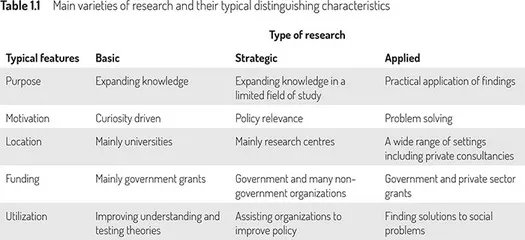
Basic research is research conducted with the aim of extending knowledge in the field in which the research is conducted. It is said to be curiosity driven. That is, a researcher seeks to answer questions posed by gaps in knowledge arising from existing research. It is not designed to provide solutions to practical problems nor is it designed to further the goals of governments or other organizations. This does not mean, however, that basic research does not have any practical application. Indeed, many basic research findings across a wide range of scientific areas have provided breakthroughs in providing solutions to practical problems. It is, of course, likely that furthering knowledge in any scientific area will lead to useful applications, but this is an incidental consequence of basic research rather than its goal.
Much basic research involves theory testing. That is, social scientists devise theories to explain social processes, deduce predictions from these theories and conduct research to test these predictions. Should the predictions be confirmed by the research findings, the theory is supported; whereas if the predictions are not confirmed, the theory is either rejected or modified.
When basic research is conducted to test theories, the focus of the research is specific and tends to be narrow. The methods used tend to be single methods such as the randomized control trial, to be discussed in Chapter 5. Mixed methods have not typically played a major role in such research.
Basic research is conducted primarily in universities or research centres and is funded predominantly by government grants.
Strategic research is research conducted in specific areas considered to be important by governments. It shares many features in common with basic research but tends to be more narrowly focused – for example, research focused on ageing where the aim is to understand the problems faced by elderly citizens so that governments can devise programmes to address these problems.
Strategic research is conducted predominantly in research centres established either by governments or non-government organizations such as philanthropic, service provider or other non-profit organizations to conduct research in a specific area considered to be important to policy. An example of such a research centre is the Johns Hopkins Center on Aging and Health at the Johns Hopkins University in Baltimore, Maryland. This centre was established in 1998 to conduct research aimed at improving the health of older adults. An example of a non-university research centre is the Social Impact Research Center located in Chicago, Illinois. This centre is part of the Heartland Alliance programme, a non-profit organization in the USA dedicated to ending poverty.
While strategic research is focused on a particular policy area, it tends to be broader in scope than basic research. Mixed methods are more likely to play a role in the conduct of strategic research than in basic research, although, as we will see, mixed methods are increasingly being used in all forms of research.
Applied research is research conducted to address specific issues or problems considered to be of practical significance. The focus of applied research is on problem solving rather than on expanding the knowledge base in a discipline or area of research. Bickman and Rog (1998: x) have defined applied research as research which ‘uses scientific methodology to develop information to help solve an immediate, yet usually persistent, societal problem’.
Applied research is usually commissioned by governments, industry or non-profit organizations with interests in specific social issues or problems to gain more information on the nature of the issue or problem. These organizations fund the research and decide the questions to be answered. The funding body then awards the contract to the applied researcher who then reports the findings to that body.
Programme evaluation can be regarded as a form of applied research since it is aimed at determining whether a programme, such as a mental health rehabilitation programme, is effective. The evaluation outlined in Box 1.1 is an example of such a piece of applied research.
Action research is a form of applied research that aims to bring about social change. Participatory action research (Kemmis and McTaggart, 2003) likewise aims to confront and overcome irrationality, injustice, alienation and suffering by involving local communities in research to improve their social conditions.
Mixed methods have played a major role in applied research, particularly in programme evaluation, as we have seen. This is because finding solutions to social problems involves collecting information from as many sources and in as many forms as necessary to understand the problem and find possible solutions.
While there are other classifications of varieties of research (e.g. Bulmer, 1978, 1986), the one presented here is widely accepted.
The main features of these types of social research are summarized in Table 1.1.