- 208 pages
- English
- ePUB (mobile friendly)
- Available on iOS & Android
eBook - ePub
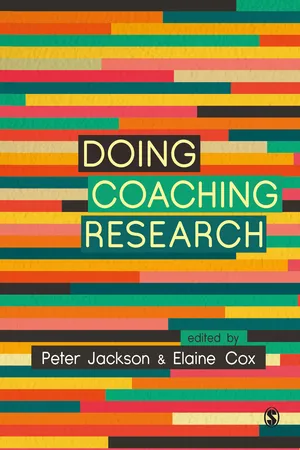
Doing Coaching Research
About this book
This is your student guide to research in the field of coaching. It answers your questions about doing research and explores the challenges and opportunities presented by different ways of doing research specifically in coaching. An ideal introduction for trainees and practitioners looking to understand the what, the why, and the how of coaching research.
Information
Publisher
SAGE Publications LtdYear
2020Print ISBN
9781526459473
9781526459466
Edition
1eBook ISBN
9781529725995
Part I Introduction to coaching research
1 Introduction
Purpose of the book
This book contributes to a growing collection of SAGE books which concern the practical challenges of doing research in a particular context. It aims to support students carrying out research projects in the field of coaching on master’s and doctoral programmes which include the completion of independent research projects (MA, MSc, DProf, DCM, PhD).
While there is an extensive and mature literature in social research methods as well as excellent manuals describing how to carry out research projects, research students also experience particular difficulties applying this knowledge to their specific research projects. The existing methodology literature tends to explain approaches in ideal terms. In carrying out real research, researchers have real questions that are not answered in these textbooks. In this book we intend to outline the dimensions and challenges of researching in the field of coaching and demonstrate how researchers have engaged with them. It is about researchers sharing their practical experience of doing research.
This is why we called it Doing Coaching Research.
As the prevalence of coaching as a legitimate organisational and work intervention has grown, so too has the demand for a specific body of knowledge to understand the practice, its place in human endeavour, what it means to those affected by it, and how best to do it. A growing number of practitioners are now interested in extending their knowledge, skills and contribution to the field through advanced educational programmes, including those at postgraduate and doctoral level. Various such programmes at universities around the world have now been in place for around two decades, each growing out of different disciplinary roots, especially psychology, education and business, but with legitimate influences drawn also from other fields such as philosophy and sociology, and extensively from counselling and psychotherapy. We feel that doing coaching research has specific challenges and to some extent these challenges are related to the very same influences that give the field its great sense of vibrancy and opportunity. The diversity of theoretical and practice roots has presented both opportunities and challenges. On the one hand it enables a wide range of approaches, perspectives and interests expressed through research in coaching. For new researchers, moreover, the opportunities to contribute useful knowledge through their work are an exciting prospect. On the other hand, coaching research has struggled to date to establish a unique character and identity. Consequently, the reassurance of norms and standards of a disciplinary culture that may be more available to researchers in more established disciplines, are not so clear to coaching researchers.
With this in mind, we are faced with a choice of taking one of two generalised stances. Do we attempt to pin down the discipline, its precepts, its reference points in an ontological exercise to frame what could and should be done? Or do we engage with uncertainty from a more critical perspective to explore what might be there and hold open the creative opportunities of such a complex domain? It will be no surprise to learn that we feel that the most appropriate help to provide in these circumstances is to combine an explanation as best we can of the challenges that face coaching researchers, with some clear accounts of the challenges faced and negotiated by our peers in the field. It is a pragmatic and constructivist programme which is entirely in keeping with both our own philosophy of practice (see for example, Cox, 2013; Jackson and Cox, 2018) and our philosophy of coach education (see Bachkirova et al., 2017). There is some overlap here between our values and interests as coaches and our values and interests as researchers and academics. That said, we strongly believe that methods of research can be entirely independent of the methods of the coaching being investigated. Many a student, for example, has tried to argue that as emotion is ontologically subjective it cannot be researched in an objectivist manner (it seems entirely possible to us). Or, has asked us whether it is appropriate to carry out face to face interviews in an investigation into telephone coaching (again, yes, it may well be). As I commented to a colleague recently, I can study kangaroos without learning to hop (though I may be asking a different question)! Consequently (and notwithstanding that Elaine Cox has a specific interest in action research which is reflected in her contribution to Chapter 9 in Part II of the book), our approach to learning should not be taken to mean that we favour the presentation of pragmatist and constructivist research. Our intention has been to present a range of research perspectives that closely reflects the current state of diversity of coaching research agendas. In summary, we wish to make as many opportunities available as possible to researchers seeking to produce excellent work.
In this introductory chapter we set out first the structure of the book as a whole and how the parts fit together. We then discuss how research contributes to professional practice. This is an important premise for Doing Coaching Research in the first place. Finally, there is a short introduction to the features of the book under the heading ‘How to read the book’.
The structure of the book
The book is structured in three parts. In Part I we attempt to establish a shared basis and vocabulary for the discussion of the specific application of different research strategies. The current introductory chapter, in addition to an overview of the purpose and contents of the book, includes a discussion of how research knowledge contributes to the development of professional practice. While coaching may be an interesting site for other disciplinary theorising, its uniqueness springs from the practice that it encompasses. The strong link with this practice motivates and enables research. Two further chapters deal with the theoretical foundations of research and with establishing an outline structure for the research project itself. The first of these chapters is included because we feel very strongly that the discussion of research paradigm, ontology and epistemology is presented in confusing and contradictory ways in the research literature. Perhaps reflecting the cross-disciplinarity of the coaching field, this can leave the coaching research student bewildered. An outline of the history of the paradigm argument in social research, and a comparison of some of the language used for different concepts, is intended to help the reader make sense of their own research outlook. Later chapters also refer to relevant paradigmatic, ontological and epistemological stances in the process of situating and legitimising the research approaches under discussion. We have not imposed on contributing authors a single framework or vocabulary for these discussions and they therefore reflect the diversity of terminology in the field. We intend that Chapter 2 will help the reader to develop a constructive understanding of these issues and in doing so better connect with the richness of this diversity. Chapter 3 outlines the underlying framework of the research process, identifying areas where coaching research presents particular challenges, or suggests particular ways of doing things. It will be presented in two sections. First, there is a discussion of the framing of the project (formulating a research question, developing and gaining approval for the research proposal, carrying out a literature review). Second, there is a discussion of research ethics and ethical research practice (as distinct from the professional ethics of coaching practice – in particular in relation to ‘insider’ research), and the mechanics of approval. This leads on to Part II: ‘Research strategies’.
Part II consists of six chapters dealing with different research strategies. These chapters have been written by researchers active in using the methodological strategies they discuss. They each explore the distinctive features of the strategy, the role of the researcher, the relationship with participants, and the types of questions best handled by the particular strategies. While the theoretical frames within which the strategies sit are explained, there is an equal emphasis on the practical issues and the particular challenges of using the strategy in the context of coaching. For this reason, many of the chapters have been co-authored by recent doctoral graduates who discuss the particular challenges they experienced in their research. We see these chapters as complementary to more detailed works on the strategies themselves that can be found elsewhere. Such works will be recommended in each case.
One of the motivations for embarking on this project was the observation that while there is an infinite range of research questions, our set of established methodologies is more limited. It may seem paradoxical, therefore, that we should concentrate on a limited number of approaches. By concentrating on the strategies most frequently encountered in coaching research, however, we hope to illustrate the creativity in methodological problem-solving that advanced research demands. The creation of knowledge will always be a meeting between the researcher, the research question, the common understandings of the research community and the reality of the domain under study. For this reason, no coll...
Table of contents
- Cover
- Title Page
- Copyright Page
- Contents
- About the editors and authors
- Part I Introduction to coaching research
- 1 Introduction
- 2 Theoretical foundations of research
- 3 Designing your research project
- Part II Research strategies
- 4 Grounded theory
- 5 Phenomenological approaches
- 6 Autoethnography
- 7 Quantitative and statistical approaches
- 8 Case study research
- 9 Action research
- Part III The impact of research
- 10 The experience of research
- 11 The dissemination and implementation of research-based coaching knowledge
- Index
Trusted by 375,005 students
Access to over 1.5 million titles for a fair monthly price.
Study more efficiently using our study tools.
Frequently asked questions
Yes, you can cancel anytime from the Subscription tab in your account settings on the Perlego website. Your subscription will stay active until the end of your current billing period. Learn how to cancel your subscription
No, books cannot be downloaded as external files, such as PDFs, for use outside of Perlego. However, you can download books within the Perlego app for offline reading on mobile or tablet. Learn how to download books offline
Perlego offers two plans: Essential and Complete
- Essential is ideal for learners and professionals who enjoy exploring a wide range of subjects. Access the Essential Library with 800,000+ trusted titles and best-sellers across business, personal growth, and the humanities. Includes unlimited reading time and Standard Read Aloud voice.
- Complete: Perfect for advanced learners and researchers needing full, unrestricted access. Unlock 1.5M+ books across hundreds of subjects, including academic and specialized titles. The Complete Plan also includes advanced features like Premium Read Aloud and Research Assistant.
We are an online textbook subscription service, where you can get access to an entire online library for less than the price of a single book per month. With over 1.5 million books across 990+ topics, we’ve got you covered! Learn about our mission
Look out for the read-aloud symbol on your next book to see if you can listen to it. The read-aloud tool reads text aloud for you, highlighting the text as it is being read. You can pause it, speed it up and slow it down. Learn more about Read Aloud
Yes! You can use the Perlego app on both iOS and Android devices to read anytime, anywhere — even offline. Perfect for commutes or when you’re on the go.
Please note we cannot support devices running on iOS 13 and Android 7 or earlier. Learn more about using the app
Please note we cannot support devices running on iOS 13 and Android 7 or earlier. Learn more about using the app
Yes, you can access Doing Coaching Research by Peter Jackson, Elaine Cox, Peter Jackson,Elaine Cox,Author in PDF and/or ePUB format, as well as other popular books in Social Sciences & Social Science Research & Methodology. We have over 1.5 million books available in our catalogue for you to explore.