Can you demonstrate a clear understanding of systematic synthetic phonics?
If you are training to be a primary school teacher you need to have, and to demonstrate, a clear understanding of systematic synthetic phonics to meet the Teachers? Standards. This companion text to the popular Teaching Systematic Synthetic Phonics in Primary Schools enables you to audit your knowledge, making you more aware of the subject and the areas in which you need to know more. In all chapters, self audits are accompanied by guidance on next steps for developing your knowledge. All chapters feature sections that link your learning to the classroom, showing you how to use your knowledge to teach phonics. Designed to help build your confidence and develop your knowledge of phonics, this text supports your development as an effective teacher of reading.
This is a companion text to:
Teaching Systematic Synthetic Phonics in Primary Schools
Joliffe, Waugh and Carss
David Waugh is Director on Primary PGCE at Durham University where he is also the subject leader for English. He has published extensively in Primary English. David is a former deputy head teacher, was Head of the Education department at University of Hull, and was Regional Adviser for ITT for the National Strategies from 2008 to 2010.
Ruth Harrison-Palmer is a former acting head teacher. She has worked for the National Strategies and Cumbria Local Authority as a literacy consultant. Currently Ruth has a senior role in ITE at the University of Cumbria.
eBook - ePub
Teaching Systematic Synthetic Phonics
Audit and Test
- 136 pages
- English
- ePUB (mobile friendly)
- Available on iOS & Android
eBook - ePub
About this book
Information
| 1 | Discriminating sounds and phonemes |
Learning outcomes
This chapter will help you to audit your:
• understanding of key terminology;
• appreciation of the difficulties faced by adults and advanced readers in being able to discriminate phonemes and ways of overcoming them;
• understanding of different methods of checking phonemic awareness.
Work through each section below, responding to each question or task. When you have completed each section, you can read the answers at the end of the chapter. At the end of this chapter you can also find support for further reading and study related to discriminating sounds and phonemes.
Section 1: key terminology for discriminating sounds and phonemes
It is important that you understand the terms below before you move on to the next activity. Provide a definition of each and check your definitions against those given later in this chapter:
• phonemes
• graphemes
• phonological awareness
• phonemic awareness
• segmentation and blending
• adjacent consonants
Section 2: segmenting words
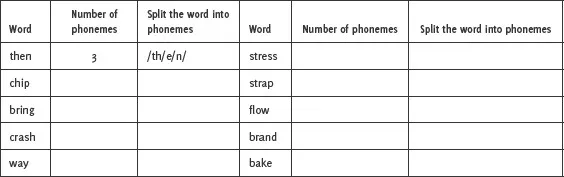
Test your knowledge by trying to work out the number of phonemes in the words below. Remember that there are always the same number of phonemes as graphemes, as a grapheme can be any number of letters that represent that phoneme.
Remember:
• in ‘bat’ we can hear 3 phonemes: b/ a/ t/
• in ‘ship’ we can hear 3 phonemes: sh/ i/ p/
• In ‘night’ we can hear 3 phonemes: n/ igh/ t/
Section 3: phoneme frames
In schools, many teachers use phoneme frames to help children to segment words into phonemes and graphemes. For example:

Use the frame below to segment the following words: blow, shortly, blast, window, draining:

Answers
Section 1: key terminology for discriminating sounds and phonemes
Phonemes
Phonemes are individual sounds. In English, there are around 44 phonemes (the number varies slightly according to accent and which phonics programme you look at).
Graphemes
Graphemes are phonemes written down, so in the word cat there are three phonemes and they are represented by three graphemes /c/a/t/. In the word shop there are three phonemes but the first is represented by two letters making one sound (a digraph):/sh/o/p/.
Phonological awareness
Phonological awareness involves being able to hear, recall and manipulate sounds.
Phonemic awareness
Phonemic awareness is the ability to hear and manipulate the phonemes in spoken words and to remember the order of phonemes in words. For example, the phonemes in the word big can be segmented as /b/ /i/ /g/.
Segmentation and blending
Oral blending and segmentation, which are the reverse of each other, help children to blend and segment for reading and spelling when they learn letters and sounds.
Adjacent consonants
Consonants which are side by side but have separate phonemes – for example, s/t in stop, c/l in club and s/t/r in strip. Although we blend these sounds together, it is important to emphasise that the letters each have individual sounds.
Section 2: segmenting words
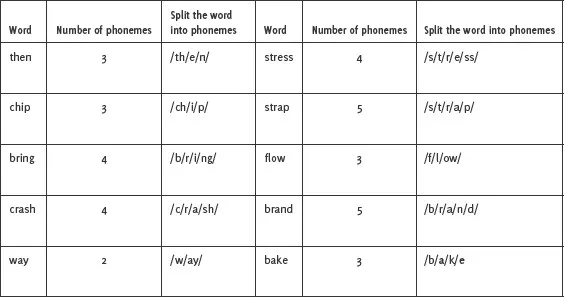
If you managed to segment all the words correctly, well done! If you didn’t you may have struggled because you are already a sophisticated reader who doesn’t always pay attention to every sound in a word. For example, you may have segmented stress as str/e/ss/ because you are used to seeing str in words and assume that this is a single sound. In fact, str is three sounds. Try saying the letter sounds slowly and notice what happens in your mouth: you make three different shapes – one for each letter sound or phoneme.
You may similarly have decided that crash should be segmented as cr/a/sh/ because you are familiar with words which begin with cr (crack, crumb, cricket). Again, try sounding the phonemes slowly and you will notice that your mouth makes two shapes as you do so. These groups of letters which occur frequently in words are called consonant clusters or consonant blends and more recently adjacent consonants. It is very useful for readers to be aware of them as their reading develops, but beginner readers need to be able to identify every sound in new words if they are to be able to say them correctly and then spell them accurately.
Section 3: phoneme frames
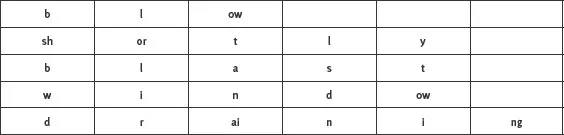
How did you manage this time? In the first word, blow, there are three phonemes and you needed not only to realise that bl represents two sounds, but also that ow represents a single sound which is represented by two letters: a digraph. Try saying ow, making the same sound as in blow. Notice that your mouth stays open throughout, which is a feature of vowel phonemes:
• In shortly, sh represents a single sound and both letters are consonants, so sh is a consonant digraph. The or part of the word is a single sound and even though r is a consonant the sound is a vowel sound, so or is referred to as a vowel digraph.
• Blast has five sounds, although the bl at the beginning and st at the end are consonant clusters, but each represents two sounds.
• Window has a vowel digraph at the end (ow) – notice that your mouth remains open as you make the sound.
• Draining includes the vowel digraph ai, which you probably spotted, but did you decide that the ng at the end was one sound or two? For most English-speakers ng is a single sound, but for some, particularly in parts of the English Midlands and some areas in Yorkshire, ng can be sounded as two sounds. Phonics programmes tend to regard ng as a single sound.
The split vowel digraph
In Chapter 5 you will look at words in which the vowel sound is made by two letters which are not immediately adjacent to each other (as in make, safe, bite etc.).
What to do next?
Reinforce your knowledge and understanding of segmenting by doing as many as possible of the following:
• Observe teachers working with children and note how they model segmenting. How do they show children how to count phonemes?
• Read Chapter 1 in Teaching Systematic Synthetic Phonics in Primary Schools (Jolliffe et al., 2012) to find out more about blending and segmenting.
• Practise with a colleague segmenting the follo...
Table of contents
- Cover Page
- Halftitle
- Title
- Copyright
- Contents
- About the authors and series editor
- Introduction
- 1. Discriminating sounds and phonemes
- 2. Challenges
- 3. Grapheme–phoneme correspondences and ‘tricky words’
- 4. Decoding and encoding text
- 5. Long vowel digraphs
- 6. Spelling
- 7. Teaching phonics in the early years
- 8. Multisensory approaches
- 9. Teaching a systematic and structured programme
- 10. Planning for phonics
- 11. Tracking and assessing pupils’ learning
- 12. Phonics at Key Stage 2
- 13. Using a range of programmes and resources
- Conclusion
- Appendix 1: initial audit answers
- Appendix 2: long audit
- Appendix 3: long audit answers
- Index
Trusted by 375,005 students
Access to over 1.5 million titles for a fair monthly price.
Study more efficiently using our study tools.
Frequently asked questions
Yes, you can cancel anytime from the Subscription tab in your account settings on the Perlego website. Your subscription will stay active until the end of your current billing period. Learn how to cancel your subscription
No, books cannot be downloaded as external files, such as PDFs, for use outside of Perlego. However, you can download books within the Perlego app for offline reading on mobile or tablet. Learn how to download books offline
Perlego offers two plans: Essential and Complete
- Essential is ideal for learners and professionals who enjoy exploring a wide range of subjects. Access the Essential Library with 800,000+ trusted titles and best-sellers across business, personal growth, and the humanities. Includes unlimited reading time and Standard Read Aloud voice.
- Complete: Perfect for advanced learners and researchers needing full, unrestricted access. Unlock 1.5M+ books across hundreds of subjects, including academic and specialized titles. The Complete Plan also includes advanced features like Premium Read Aloud and Research Assistant.
We are an online textbook subscription service, where you can get access to an entire online library for less than the price of a single book per month. With over 1.5 million books across 990+ topics, we’ve got you covered! Learn about our mission
Look out for the read-aloud symbol on your next book to see if you can listen to it. The read-aloud tool reads text aloud for you, highlighting the text as it is being read. You can pause it, speed it up and slow it down. Learn more about Read Aloud
Yes! You can use the Perlego app on both iOS and Android devices to read anytime, anywhere — even offline. Perfect for commutes or when you’re on the go.
Please note we cannot support devices running on iOS 13 and Android 7 or earlier. Learn more about using the app
Please note we cannot support devices running on iOS 13 and Android 7 or earlier. Learn more about using the app
Yes, you can access Teaching Systematic Synthetic Phonics by David Waugh,Ruth Harrison-Palmer,Author in PDF and/or ePUB format, as well as other popular books in Éducation & Méthodes pédagogiques pour la lecture. We have over 1.5 million books available in our catalogue for you to explore.