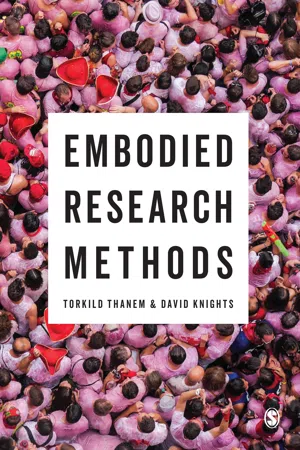
Disembodied research erects false dichotomies between flesh and reason, and between the corporeal and the social. By contrast, Torkild Thanem and David Knights engage with approaches and practices that exploit the body's capacity to generate knowledge, craft lively accounts, and create fleshy concepts. These approaches enrich our understanding of how people live, work, and interact with their bodies within the social world.
Thanem and Knights discuss methods, practices, and personal experiences which involve bodies in the research process – in generating and analysing empirical material, reflecting on the work they do as researchers, and turning research into written text.
Embodied Research Methods is an important and practical resource for undergraduate and postgraduate students across the social sciences, and a thought-provoking read for researchers in these areas.
- 184 pages
- English
- ePUB (mobile friendly)
- Available on iOS & Android
eBook - ePub
Embodied Research Methods
About this book
Information
Publisher
SAGE Publications LtdYear
2019Print ISBN
9781473904415
9781473904408
Edition
1eBook ISBN
9781526463890
1 Disembodied Methodology
Disembodied Tendencies in Social Science Research on the Body
It is difficult to date precisely when the body emerged as a distinct area of social science research, but in the 1980s and early 1990s a number of contributions began to appear which sought explicitly to address the body as a topic of social science enquiry. In 1984, the sociologist Bryan Turner published a book titled The Body and Society, which was one of the first systematic attempts to develop a sociology of the body; in 1995, he became the first editor of the journal Body & Society, which he co-founded with the cultural theorist Mike Featherstone. Although Turner (1984) acknowledges that the body has an independent existence beyond the social and linguistic processes that we employ to make sense of it, he is primarily concerned with the body as a problem of social order and regulation. For Turner, the task of society is to regulate the body, and he devotes a fair amount of his book to demonstrate how this is achieved through the disciplinary and discursive practices of patriarchy, religion and government.1, 2
While this has led critics to argue that Turner deals with the body in just as disembodied and distanced a manner as other sociological sub-fields approach their respective subject matters (e.g. Williams and Bendelow, 1998), Turner’s approach is not unique in this respect. Despite a number of efforts to embody sociology by engaging with the body as both a subject and an object of social action, knowledge and experience (e.g. Crossley, 1995; Radley, 1995; Williams and Bendelow, 1998), there was a tendency in many other writings to emphasize how the body is constituted as an object of discursive construction and disciplinary control.
An illustrative example of this is the sociologist Deborah Lupton’s (1995) book The Imperative of Health: Public Health and the Regulated Body. Here, Lupton offers an excellent analysis of how the discourses of ‘public health and health promotion act as an apparatus of moral regulation’ which privileges rational subjectivities that are capable and willing to manage and control their bodies (p. 158). The book includes an astute reading of contemporary public health policies and health campaigns, which are aimed to encourage people to exercise regularly, keep a healthy diet, refrain from tobacco and limit their alcohol consumption. However, little is made of the fact that public health and health promotion is targeted at real people with real bodies. The book is primarily concerned with analysing the intentions, contents, workings and alleged effects of public health and health promotion discourse rather than examining how ordinary people, who are faced with these discursive constructs, experience, live with and take care of their own bodies in everyday life.3
This tendency to investigate the body in a relatively abstract, distanced and disembodied manner coincided with social constructionism becoming a dominant perspective in qualitative research across the social sciences, and the works of Michel Foucault reaching canonical status for many a social scientist devoted to the study of bodies. Even though Foucault (esp. 1990 [1986]) acknowledged that there is a lively and evasive body outside of the orderly realm of discourse, his overall project focused on tracing the discursive and institutional practices through which the body became an object of knowledge and power.
In The Birth of the Clinic Foucault (1973 [1963]) showed how the diseased body came to be visualized, inspected and treated within the hospitals that emerged in the late 18th century; in Discipline and Punish he demonstrated how the prisoner’s body came to be monitored, disciplined and reformed within the panoptic structures of the 19th-century prison (Foucault, 1977 [1975]); and in several of his writings he showed how the bodies of the modern state’s citizenry came to be subjectified, policed and managed through biopolitical and governmental practices of schooling and education, public hygiene, social insurance and taxation (see, e.g., Foucault, 1979, 2009 [1977–8], 2010 [1978–9]). Thus, Foucault’s project was primarily an attempt to trace the discursive ruptures and transformations that have changed how the body is understood, treated and managed across different historical and institutional contexts rather than investigate the lives and bodies that were worked upon by discourse.4
We do not want to exaggerate this tendency to construe the body as a passive object of social and discursive construction, and we shall return to examine the growing mass of embodied methodologies in the next chapter. Also, we do not deny that discourse analysis may be an appropriate tool for examining how the body is constructed, subjectified and ordered through linguistic utterances and institutional practices. Discursive and constructionist studies have made important contributions to challenge dominant notions and subjectifications of the body. Nevertheless, it is important that we point out what is at stake when choosing to work with discursive and constructionist approaches.
One such thing is the meaning and status of reflexivity. Reflexivity has not only been seen as a key feature of embodied research (see, e.g., Crossley, 1995, 2006b), it has also become a catchphrase in discursive and constructionist approaches to qualitative research. While some of the discursive research on the body (e.g. Lupton, 1995) and some of the more influential writings on discourse analysis (e.g. Phillips and Hardy, 2002; Fairclough, 2013) have underlined the reflexive nature of social and discursive practices, there is a peculiar lack of reflexivity in many of these accounts. As we pointed out in the introductory chapter, assuming the body’s reflexivity implies that the body is both subject and object of one and the same action (Crossley, 2006b). However, when privileging what a discourse says about the body rather than listening to what the body has to say, it becomes an object rather than a subject of discourse. This makes it possible to understand how the body is constituted by discourse, but it does not shed light on how the various habits, gestures and utterances that we express through our bodies may inform or subvert that discourse.
Again, Lupton’s otherwise splendid study may serve as a useful illustration here, even though it was written more than 20 years ago. Whereas Lupton argues that researchers and practitioners need to exercise reflexivity by ‘question[ing] the practices, knowledges and belief systems of public health and health promotion, including their own privileging of “health”, “knowledge” and “rationality”’ (1995, p. 159), there is not any reflection in the book about how she relates to her own body or to the health discourse that she investigates. Moreover, the book offers no accounts to show how other people reflect about their bodies or about their relations to prevailing discourses of health.
Disembodied Methods Texts
This discussion remains significant, perhaps particularly because disembodied versions of reflexivity are deeply ingrained in more recent methodology texts that explicitly pursue a reflexive approach to qualitative research. For instance, Alvesson and Sköldberg’s (2009) Reflexive Methodology, which has become a bestseller in the genre of social science methods textbooks, offers chapters on a variety of research approaches commonly used by qualitative scholars, including grounded theory, discourse analysis, critical theory and poststructuralism. Interestingly, it is only in a sub-chapter on feminism that they discuss the role of reflection or consider how research may be informed by gendered experiences, feelings and emotions. No attention is given to the embodied and visceral aspects of such experiences, no significant mention is made of the body or embodiment, and the authors make no attempt to reflect about their own experiences from their long research careers.
Aull Davies’ (2008) book Reflexive Ethnography is another telling example in this context. In arguing for a ‘continuing reflexive awareness’ (p. 23), Aull Davies acknowledges the fundamental reflexivity of research in general and ethnographic research in particular. Pointing out that the researcher’s presence affects the social reality it is claimed merely to describe, she emphasizes the importance of personal and cultural reflexivity and the need to reflect about sociohistorical context and disciplinary belonging. However, this is largely discussed in cognitive terms, and, like Alvesson and Sköldberg, Aull Davies remains disembodied in her own text.
Such disembodied tendencies are equally apparent when looking at the broader area of textbooks on qualitative research in the social sciences. When we randomly examined 20 contemporary methods and methodology texts, we found that much attention was given to discursive and linguistic matters when employing commonly used techniques such as interviews, observations and focus groups (see, e.g., Jorgensen, 1989; Alvesson and Sköldberg, 2009; Kreuger and Casey, 2015). Only a handful of them made any reference to the body or embodiment. Out of these books, Atkinson et al.’s (2001) 507-page Handbook of Ethnography was perhaps the most explicit in this respect, with references to medical sociology and the sociology of the body (p. 182), the body–self relationship and the sensuous body (p. 157), the body being mediated by technology (pp. 264–5), and interpretations of women’s bodies in relation to their designation as working class (p. 427). The book also includes references to the embodiment of everyday activities in ethnomethodological research (pp. 118–30) and a claim that embodiment is ‘the work of ethnography’ (p. 444). On the whole, however, these points are made in passing with regard to specific ethnographic studies, and the handbook offers no discussion of the embodied aspects of actually doing ethnography.
Other books in our sample tended to mention the role of body language in various parts of the research process: Heath (in Silverman, 2004) emphasizes the importance of gestures, bodily comportment and bodily activity in the analysis of face-to-face interaction in video-recorded material, arguing that ‘Talk and bodily activity are mutually constituted’ to provide meaning (Heath, 2004, p. 275; part of this analysis is reproduced in Silverman [2006, pp. 255–7]). In a broader vein, Bryman (2012) makes 11 references to the body, most of them relating to gender and body language, but no references to embodiment. Of the remaining texts we examined there are only nine references to the body or embodiment. In summary, in well over 8,000 pages of methods and methodology texts, there are only 20 references to either the body or embodiment. It is remarkable that so little reference is made to bodily matters when considering the contingent, contextual and uncertain character of most social science research, which at least partly is an outcome of the obdurate yet vulnerable nature of human bodies.
In order to challenge this cognitivist and disembodied tradition, it is important that we try to understand what has made it possible. What lies behind this marginalization of the body, which Leder (1990) has called the body’s ‘absent presence’ in social science research? In the following pages, we shall therefore seek to trace this tradition through some of the most significant figures in the history of philosophy and into the methodo-logical conventions and research agendas that were pursued as the social sciences emerged as modern academic disciplines. Specifically, we will examine the status of the body in the philosophies of Plato, Aristotle, Descartes and Kant, as well as in the sociology of Emile Durkheim.
The Disembodied Heritage of Social Science Research
Plato’s denigration of the body
As we indicate above, the marginalization of the body goes far back in the history of philosophy, at least to Plato’s idealism. In the Phaedo, which is the first dialogue where Plato begins to articulate his idealist theory of forms, he invokes a strong dualism between the soul and the body to assert the immortality of the soul.5 Doing so, he depicts the body as being of a disruptive, polluting and evil nature which causes greed and war and obstructs the pursuit of knowledge.
When discussing ‘The philosopher’s detachment from the body’ (64c–67b),6 Plato argues that devotion to food, drink, sex and other bodily pleasures hinders the philosopher from seeking true knowledge (64d–e). To seek true knowledge, he insists, philosophers must rid themselves of their eyes, ears and ‘the body altogether’, because ‘when the body is the soul’s partner it confuses the soul and prevents it from coming to possess truth and intelligence [and] … grasp that which really is’ (66).7 What really is, Plato claims (78b–80c), is a thing like the soul, which ‘is immortal, indestructible, of a single form, accessible to thought, ever constant and … true to itself’ (80b).8 Although Plato recognizes that even the living philosopher is embodied, he insists that as long as we are alive ‘we shall be closest to knowledge if we refrain as much as possible from association with the body and do not join with it more than we must’ (67a; see also Protevi, 2001, p. 125). If we use the body and its senses to investigate things, our souls will wander off in a ‘dizzy drunken confusion’, and only be capable of ‘apprehending confused objects’ (79c). Assuming that the fleeting, unstable and untrustworthy nature of the body and its perceptions constitute a fundamental constraint on being, on the soul and on our capacity to reach true knowledge, he further argues that the soul must seek to master and control the body, making it a ‘slave and subject’ of its rule (80).
The soul/body dualism and the soul’s mastery of the body is reiterated in parts of The Republic. Here, Plato considers at length what training future philosophers need to undergo in order to nurture their souls and master their bodies. When discussing physical education, Plato argues that ‘physical excellence does not in itself produce a good mind and character’ (403d). Hence, the physical education of the philosopher in training should be ‘simple and flexible’ (404b). Moreover, the philosopher must learn to detest idleness, avoid filling his ‘bod[y] with gases and fluids’ (drunkenness has already been forbidden [398e, 403e]), and learn to take care of their own body and health so that intervention from medical doctors is only needed in case of ‘injury or regular disease’ (405d). While failure to do so suggests that one has a weak soul incapable of mastering the body, the ability to do so means that the pursuit of higher tasks avoids being disrupted by simple bodily matters (see also Protevi, 2001, p. 126). Thus, full attention can be devoted to the study of mathematics and pure philosophy, which Plato regards as the key subjects of philosophical education. The true philosopher, Plato insists, is someone whose ‘pleasure will be in things purely of the mind’ because ‘physical pleasures will pass him by’ (485d–e).
The soul’s mastery of the body is further expressed through the isomorphic analogy which underpins Plato’s theory of the state and renders the individual, society and the cosmos as being of the same form. Like the healthy body, which is mastered by the soul, the ideal, civilized and just society of the city-state that Plato outlines is governed by a philosopher ruler or a ruling class of philosophers. In the preliminaries, Plato refers to the civilized society as ‘the true’ society, ‘like a man in health’ (372e), which can only produce justice through a naturally given division of labour whereby ‘a man specializes appropriately on a single job for which he is naturally fitted, and neglects all others’ (370c). When he later considers justice in the state and the individual, Plato ar...
Table of contents
- Cover
- Half Title
- Publisher Note
- Title Page
- Copyright Page
- Acknowledgements
- Contents
- About the Authors
- Preface
- Acknowledgements
- Introduction The Embodied Turn in Social Science Research
- 1 Disembodied Methodology
- 2 Embodied Methodology
- 3 Initiating an Embodied Research Process
- 4 Embodied Immersion and Ethnographic Fieldwork
- 5 Embodying Interviews and Conversations
- 6 Recording and Documenting Embodied Lives
- 7 Embodied Analysis and Interpretation
- 8 Embodied Writing and Dissemination
- 9 Truth and Politics in Embodied Research
- Conclusion Embodied Imagination in Future Research
- References
- Index
Trusted by 375,005 students
Access to over 1.5 million titles for a fair monthly price.
Study more efficiently using our study tools.
Frequently asked questions
Yes, you can cancel anytime from the Subscription tab in your account settings on the Perlego website. Your subscription will stay active until the end of your current billing period. Learn how to cancel your subscription
No, books cannot be downloaded as external files, such as PDFs, for use outside of Perlego. However, you can download books within the Perlego app for offline reading on mobile or tablet. Learn how to download books offline
Perlego offers two plans: Essential and Complete
- Essential is ideal for learners and professionals who enjoy exploring a wide range of subjects. Access the Essential Library with 800,000+ trusted titles and best-sellers across business, personal growth, and the humanities. Includes unlimited reading time and Standard Read Aloud voice.
- Complete: Perfect for advanced learners and researchers needing full, unrestricted access. Unlock 1.5M+ books across hundreds of subjects, including academic and specialized titles. The Complete Plan also includes advanced features like Premium Read Aloud and Research Assistant.
We are an online textbook subscription service, where you can get access to an entire online library for less than the price of a single book per month. With over 1.5 million books across 990+ topics, we’ve got you covered! Learn about our mission
Look out for the read-aloud symbol on your next book to see if you can listen to it. The read-aloud tool reads text aloud for you, highlighting the text as it is being read. You can pause it, speed it up and slow it down. Learn more about Read Aloud
Yes! You can use the Perlego app on both iOS and Android devices to read anytime, anywhere — even offline. Perfect for commutes or when you’re on the go.
Please note we cannot support devices running on iOS 13 and Android 7 or earlier. Learn more about using the app
Please note we cannot support devices running on iOS 13 and Android 7 or earlier. Learn more about using the app
Yes, you can access Embodied Research Methods by Torkild Thanem,David Knights in PDF and/or ePUB format, as well as other popular books in Social Sciences & Social Science Research & Methodology. We have over 1.5 million books available in our catalogue for you to explore.