As a teacher, you are a magician. You conjure understanding where there was none.
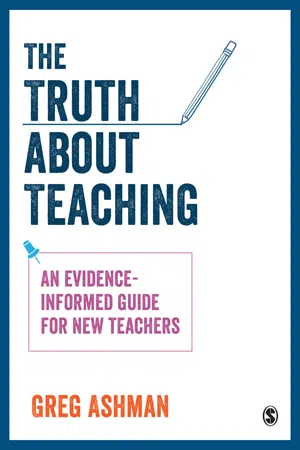
Drawing on years of experience teaching in a diverse range of schools and powered by a nuanced understanding of educational research, Greg Ashman presents the most vital ideas that you need to know in order to succeed in teaching. Find out how to avoid common mistakes and challenge some of the myths about what good teaching really is.
Evidence-informed, the book explores major issues you will encounter in schools, including the science of learning, classroom management, explicit forms of teaching, why the use of phonics has been such a controversial issue and smart ways to evaluate the potential of technology in the classroom.
If you are training to teach in primary or secondary education, or in the early stages of your teacher career, this book is for you.
- 200 pages
- English
- ePUB (mobile friendly)
- Available on iOS & Android
eBook - ePub
About this book
Information
1 A short history of education
Key Points
This chapter will:
- Outline some important developments in the history of education that affect teaching today
- Describe the philosophy of educational progressivism and attempt to explain its origins
- Look at how progressivism has waxed and waned in response to important events
- Ask how different education systems have been shaped by educational philosophies
- Show that investing more in education does not necessarily lead to gains in learning
- Suggest that we need to focus resources on initiatives that have a positive impact
A natural progression
As the new century advanced, key thinkers became increasingly concerned that school-based education was not adequately preparing young people for the demands of an unpredictable future. Some claimed that in the 20th century education would become ever-more important and take on a previously unknown ‘burden of responsibility’, but that this would require teachers to make use of new methods, materials and types of experiences (Bobbitt, 1918). One of the methods that showed promise was project-based learning.
William Heard Kilpatrick made the case for project-based learning in his 1918 essay ‘The Project Method’ (Kilpatrick, 1918). To Kilpatrick, involvement in a project was a ‘purposeful act’. A girl engaged in dressmaking, for instance, is pursuing a project that has meaning, is motivating and has a clear objective. Similarly, a boy or a group of children who create a school newspaper will have a clear goal. The value of projects was that children would invest their ‘whole heart’ into them rather than acting through compulsion.
This stress on the motivational aspect of project work is in keeping with Kilpatrick’s role as a leading light of America’s Progressive Education Association. A key element of early 20th century progressive education philosophy was that learning should be natural – even joyful – and so must follow the contours of children’s natural interests and be based in the activities they are naturally inclined to participate in (Egan, 2002). This implies a hands-off approach, where students figure things out for themselves with the teacher offering only guidance.
These ideas closely follow John Dewey who, in 1913, called time on the argument between those who wanted to make subjects interesting for students and those who preferred to emphasise the role of student effort. Instead, Dewey suggested that if we recognise there are ‘certain powers within the child’ that urgently need developing then, by following these natural, developmental impulses, students will be absorbed and whole-hearted, and learning will never be drudgery (Dewey, 1913). Dewey painted a picture of a unicorn that generations of teachers have been hunting.
As John Dewey later explained, while discussing the relative merits of different educational approaches, ‘There is … no point in the philosophy of progressive education which is sounder than its emphasis upon the importance of the participation of the learner in the formation of the purposes which direct his activities in the learning process’ (Dewey, 1938).
If any of this feels familiar, then that is because the philosophy of a natural form of learning, that follows the contours of children’s interests, is still a powerful force in contemporary education, as well as being one that accurately attracts the ‘progressive’ label. And it is important that we pay progressive education its due, follow Dewey’s example and describe it as a ‘philosophy’ rather than think of it as a bag of teaching tricks. Progressive education starts from principles and then selects curricula, teaching methods and even the objectives of education accordingly. Progressive education is ultimately about what educators believe education is rather than any classroom task.
Progressive education is not progressive politics. Instead, it represents a philosophy of learning that can be adopted regardless of political views. Although currently a default position of many on the political left, perhaps due to its name, progressive education was once the philosophy of Giovanni Gentile, Mussolini’s education minister. As such, it drew criticism from the Marxist philosopher Antonio Gramsci (Mayo, 2014). Progressivism tends to emphasise the individual, something that is often more a concern of the political right. And it is important to note that a belief that education is about the unfolding of a natural plan does not compel us to believe that everyone has the same natural plan. Some students may be naturally fitted for leadership and others for factory work. This is the implication of any argument in favour of nurturing individual talents (e.g. Robinson, 2017).
There are many teachers who, if asked, would claim no educational philosophy. They would insist that they are pragmatists who draw upon different methods and tactics as required. But this is not true. Everyone has a set of beliefs about teaching, even if they lie largely hidden. You either believe that education should be a natural process, like the unfolding of a flower, or you do not. You cannot believe this for some of the time or for part of a lesson. Perhaps you disagree with Dewey and believe that some objectives of education are worth having but require an element of drudgery to get there, and that they therefore need to be set and monitored by the teacher? If so, that’s part of your philosophy.
These are the two main ways of thinking about education. It is either a natural, drawing-out of something from within, or it is an effortful, sometimes painful process of passing knowledge from one generation to the next; a process that is not particularly natural. The dispute between these two positions has echoed through the ages.
Empty vessels
Educators have long taken inspiration from Ancient Greece. In the writings of Plato, we have an early description of the ideal curriculum for philosophers and leaders, provided by a form of boarding school for which students would be selected by aptitude at an early age. These ideas influenced later educational thinkers such as Jean-Jacques Rousseau (Jackson, 2012).
Plato believed that truths were immutable, and that education was the process of drawing out truths that people once knew in a previous life but have forgotten due to the corrupting influence of the world. He disliked the format of an audience listening to a poet reciting Homer, because he thought this was too passive, with no room for challenge or discussion. Instead, he provided his own instructional model by writing down the dialogues of his teacher, Socrates. Socrates constantly questioned the assumptions of those he conversed with (Jackson, 2012). This style has become known as ‘Socratic questioning’ and has gained popularity as a teaching approach (see Paul and Elder, 2007 for an overview).
Plutarch, a first century Greek essayist, is also an influence on education today, if for no other reason than an often-misattributed quote that ‘the mind does not require filling like a bottle, but rather, like wood, it only requires kindling to create in it an impulse to think independently and an ardent desire for the truth’ (Babbitt, 1927). Versions of this saying have been attributed to Socrates as well as W.B. Yeats (O’Toole, 2013). For instance, Gert Biesta deployed the Yeats version at the opening of his influential book The Beautiful Risk of Education (Biesta, 2015). Plutarch’s analogy is most often used to implicitly or explicitly support a theory of learning known as ‘constructivism’ (e.g. Kuhs and Flake, 1993).
The philosophy of constructivism asserts that people do not simply receive ideas from others. Instead, they must construct meaning for themselves, or perhaps as part of a group effort. Many educators then take the additional, if not inevitable (Mayer, 2004), step of drawing implications for methods of teaching; that we should avoid trying to transmit ideas through lecturing and instead focus on methods that allow students to figure things out and make connections for themselves (see Perkins, 1999). In this sense, constructivism follows, and perhaps derives from, early 20th century progressivism.
Plutarch is an odd recruit to this cause. His famous quote comes from an essay about listening to lectures. It was written for Nicander, a young man who had finished formal schooling, and it con...
Table of contents
- Cover
- Half Title
- Publisher Note
- Title Page
- Copyright Page
- Contents
- About the Author
- Preface
- Acknowledgements
- 1 A short history of education
- 2 Classroom management
- 3 The science of learning
- 4 Motivating students
- 5 Explicit teaching
- 6 Alternatives to explicit teaching
- 7 Planning lessons
- 8 Assessment and feedback
- 9 Using technology
- 10 The phonics debate
- 11 To be a teacher
- Index
Trusted by 375,005 students
Access to over 1.5 million titles for a fair monthly price.
Study more efficiently using our study tools.
Frequently asked questions
Yes, you can cancel anytime from the Subscription tab in your account settings on the Perlego website. Your subscription will stay active until the end of your current billing period. Learn how to cancel your subscription
No, books cannot be downloaded as external files, such as PDFs, for use outside of Perlego. However, you can download books within the Perlego app for offline reading on mobile or tablet. Learn how to download books offline
Perlego offers two plans: Essential and Complete
- Essential is ideal for learners and professionals who enjoy exploring a wide range of subjects. Access the Essential Library with 800,000+ trusted titles and best-sellers across business, personal growth, and the humanities. Includes unlimited reading time and Standard Read Aloud voice.
- Complete: Perfect for advanced learners and researchers needing full, unrestricted access. Unlock 1.5M+ books across hundreds of subjects, including academic and specialized titles. The Complete Plan also includes advanced features like Premium Read Aloud and Research Assistant.
We are an online textbook subscription service, where you can get access to an entire online library for less than the price of a single book per month. With over 1.5 million books across 990+ topics, we’ve got you covered! Learn about our mission
Look out for the read-aloud symbol on your next book to see if you can listen to it. The read-aloud tool reads text aloud for you, highlighting the text as it is being read. You can pause it, speed it up and slow it down. Learn more about Read Aloud
Yes! You can use the Perlego app on both iOS and Android devices to read anytime, anywhere — even offline. Perfect for commutes or when you’re on the go.
Please note we cannot support devices running on iOS 13 and Android 7 or earlier. Learn more about using the app
Please note we cannot support devices running on iOS 13 and Android 7 or earlier. Learn more about using the app
Yes, you can access The Truth about Teaching by Greg Ashman in PDF and/or ePUB format, as well as other popular books in Education & Teacher Training. We have over 1.5 million books available in our catalogue for you to explore.