1 Introduction
How do the problems that we experience individually in everyday life compare with some of the broader issues happening around us in wider society?
This chapter introduces one of the main pieces of sociological theory you will be working with throughout the book. As described in the Introduction to the book, there are three main sociological threads that form the theoretical backbone of this book: individuals and society, people and things and power and inequality.
1.1 Teaching aims
The aims of this chapter are for you to:
- be introduced to the sociological imagination as a way of understanding individuals and society
- understand how technology figures in individual problems and broader society
- challenge notions that technology is new.
2 What is the sociological imagination?
The focus of this chapter is the sociological imagination, which is both the title of a book and an idea that outlines how individual problems relate to issues in broader society.
In 1959, C. Wright Mills wrote a book, The Sociological Imagination, to clarify his ideas on how social scientists could think about and frame sociology. In the first chapter of his book Mills describes the promise of sociology: how it can help everyone better observe and understand society. He describes how sociologists must pay attention to both ‘personal troubles’ and ‘public issues’. This chapter of the text book will unpack what Mills meant and how we can apply his ideas to digital societies, as well as to contemporary issues in society more broadly.
Mills begins his description of the sociological imagination by describing the problem facing ‘ordinary men’.
What ordinary men are directly aware of and what they try to do are bounded by the private orbits in which they live; their visions and their powers are limited to the close-up scenes of job, family, neighborhood; in other milieux [social settings in which decisions are made], they move vicariously and remain spectators. And the more aware they become, however vaguely, of ambitions and of threats which transcend their immediate locales, the more trapped they seem to feel.
Underlying this sense of being trapped are seemingly impersonal changes in the very structure of continent-wide societies. The facts of contemporary history are also facts about the success and the failure of individual men and women. When a society is industrialized, a peasant becomes a worker; a feudal lord is liquidated or becomes a businessman. When classes rise or fall, a man is employed or unemployed; when the rate of investment goes up or down, a man takes new heart or goes broke. When wars happen, an insurance salesman becomes a rocket launcher; a store clerk, a radar man; a wife lives alone; a child grows up without a father. Neither the life of an individual nor the history of a society can be understood without understanding both.
(Mills, 2000, p. 3)
What is Mills describing here? He’s talking about individuals and their daily life. When life is stable for an ‘ordinary individual’, that person rarely looks beyond the immediate circumstances of their career, their family or where they live. However, Mills suggests that society impacts individual lives more than the ordinary person realises. Changes in society impact individuals. The examples that he gives talk primarily about economic shifts from a society becoming industrialised, but he also discusses temporary societal shifts such as war, and how they impact individuals and families.
Who was C. Wright Mills?
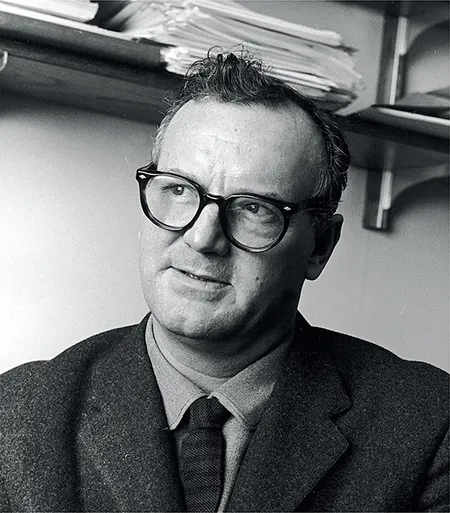
Figure 1.1 American sociologist Charles Wright Mills pictured towards the end of his life in 1960.
Charles Wright Mills (1916–1962) was an American sociologist who produced the bulk of his work in the mid 20th century. His writing focused on the roles of governments, military and bureaucracy and their collective impact on inequality in society. Mills completed his PhD studies on the sociology of knowledge before the start of World War II.
Post World War II, Mills’s writing focused on developing critical standpoints on social inequality, problems facing the middle class, and power held by the elite. Crucially, he often disagreed with sociologists of the same era and asserted that they were often too detached from the communities they claimed to study. He called for sociologists to be more concerned and involved with problems in everyday life, with the intention that sociologists should be activists, as well as researchers.
His most famous work is The Sociological Imagination, which is the focus of this chapter. The Sociological Imagination was written in 1959 and was intended to provide a way for people to observe and think about the relationship between individual experiences and world events or troubles.
Mills describes a framework for helping us, as social scientists, understand and observe how individuals relate to society. Although he wrote this text in the mid 20th century and uses some language and examples that might sound a bit outdated, are you able to identify examples of personal troubles and public issues?
The concept of the sociological imagination is helpful for when we ask questions about what is happening in digital societies and to whom.
2.1 Biography and history, troubles and issues
Mills sometimes describes his ideas with interchangeable terms. Instead of talking about ‘public issues’ he may refer to ‘history’. And other times, when talking about ‘personal troubles’, he may use the term ‘biography’. It may be more helpful for you to consider the sociological imagination in terms of personal ‘biography’ and a public ‘history’.
Mills defines troubles and issues thus:
Troubles occur within the character of the individual and within the range of his immediate relations with others; they have to do with his self and with those limited areas of social life of which he is directly and personally aware …
Issues have to do with matters that transcend these local environments of the individual and the range of his inner life. They have to do with the organization of many such milieux into the institutions of an historical society as a whole, with the ways in which various milieux overlap and interpenetrate to form the larger structure of social and historical life. An issue is a public matter: some value cherished by publics is felt to be threatened …
… consider unemployment. When, in a city of 100,000, only one man is unemployed, that is his personal trouble, and for its relief we properly look to the character of the man, his skills, and his immediate opportunities. But when in a nation of 50 million employees, 15 million men are unemployed, that is an issue, and we may not hope to find its solution within the range of opportunities open to any one individual.
(Mills, 2000, pp. 8–9)
2.2 Reading The Sociological Imagination today
Some of the texts that you will read in Understanding digital societies were written during a time where it was more the norm to use phrases or terms that we might find offensive nowadays. C. Wright Mills’s writing has quite a specific tone that is representative of a certain period. Sociological writing from the early to mid 20th century can sometimes be difficult to navigate as the reader is often assumed to be of a certain class, gender or education level. When The Sociological Imagination was written in 1959, far more men of middle and upper class backgrounds had access to higher education in comparison to women or those in the working class. This is reflected in the text, as Mills describes the sociological imagination with examples that seem to be rather masculine: they refer to an era where men were expected to be the breadwinners for the household. This approach might seem out of touch with contemporary living if you are part of a living situation where there are two or more incomes providing for the needs of the household. Although the examples that Mills and others sociologists of that era use to illuminate their ideas may seem outdated, the ideas themselves remain valuable in helping us examine the world around us. When reading these older sociological texts you should consider how their ideas could be used or challenged within the contemporary context.
Mills’s description of the sociological imagination can be helpful when we examine what is happening in contemporary society. Mills describes the relations between history and biography, along with the relations between personal troubles and public issues. Essentially, Mills’s sociological imagination shows us that problems we encounter individually can often be understood as contributing to the narrative of broader problems happening in society.
2.3 The sociological imagination and women’s cycling
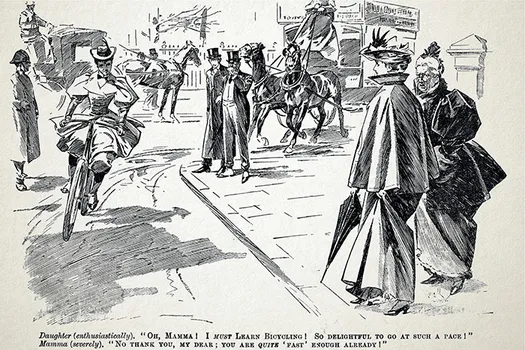
Figure 1.2 This cartoon from the late 1890s shows how it was considered controversial for women to be seen cycling in public.
One example of the relationship between individuals and society can be found in Kat Jungnickel’s book Bikes and Bloomers (2018), where she investigates the difficulties faced by upper and middle class women in 1890s Britain who wished to take up cycling. In her qualitative research Jungnickel describes the biographies of women who took up cycling. Using archive material such as newspaper and magazine articles, patents and birth, death and marriage registrations, she found out that women cycling along the streets of suburban Victorian London in the 1890s faced extreme danger due to the fact that women’s clothing often got caught in the bicycle’s moving parts. They also faced abuse on the street by pedestrians and passers-by that believed women of that social standing should not take part in such physical activity (Figure...