This book is based on an in-depth conversation with Alfred Mele, the William H. and Lucyle T. Werkmeister Professor of Philosophy at Florida State University. This wide-ranging conversation. This wide-ranging conversation examines free will and the different notions of free will that exist, the connections of free will with developments in neuroscience, social psychology and public opinion polls and Alfred Mele's key concern about how current and future insights might be directly applied to improve our world.This carefully-edited book includes an introduction, Down to Earth, and questions for discussion at the end of each chapter: I. Becoming A Philosopher - From Aristotle to IrrationalityII. Outlining The Problem - Defining "free will"III. Neuroscience - Benjamin Libet stirs things upIV. Social Science - Eating away at our sense of autonomyV. Next Steps - And mid-grade investigations About Ideas Roadshow Conversations: This book is part of a series of 100 Ideas Roadshow Conversations. Presented in an accessible, conversational format, Ideas Roadshow books not only explore frontline academic research featuring world-leading researchers but also reveal the inspirations and personal journeys behind the research.
- English
- ePUB (mobile friendly)
- Available on iOS & Android
eBook - ePub
Free Will: An Investigation - A Conversation with Alfred Mele
About this book
Information
Topic
PhilosophyThe Conversation
I. Becoming A Philosopher
From Aristotle to Irrationality
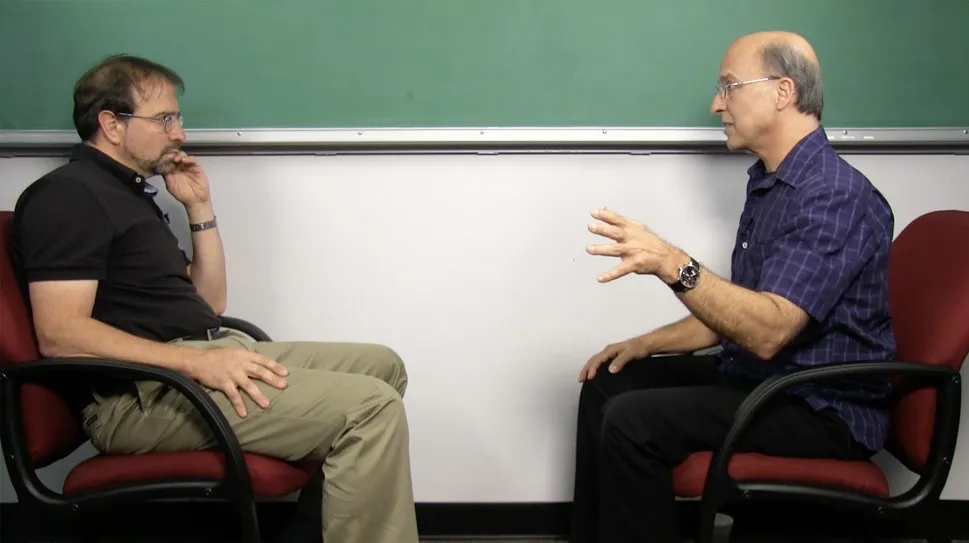
HB: So, philosophy for you: was it something that you were interested in for a long time? Would you describe yourself as a particularly “philosophical” child, say? I’m not so much asking you if your philosophical career was somehow predetermined—we’re going to get there soon enough, I suspect—but more generally assessing your early interests and tracing your trajectory into the field.
AM: As a youngster I didn’t even know what philosophy is. But, yes, I think I always had philosophical interests. I was raised in a religious household—Catholic—and I would just wonder how all these different things could work. I didn’t go to Catholic school until eighth grade, but I went to catechism when I was young and I learned that you’re supposed to love God more than your parents.
I asked my brother, Ron, one day: “Do you love God more than Mom and Dad? It doesn’t make any sense to me, because I don’t know God and I know Mom and Dad. How am I going to love Him more?”
And I remember Ron, who’s a year younger than me, telling me “Yes, I do, because that’s what I’m supposed to do.” But I just found that I couldn’t do it, so that was one of the things I worried about.
HB: Did Ron come into the equation too? Did you start measuring your love for Ron with respect to your love for your parents?
AM: No, I wasn’t clever enough back then. I remember trying to figure out how gravity worked using a globe and toy cars. Why do these cars just stay on the globe? Why don’t they fly off? So, there were things like that. Maybe most kids don’t think about them, I don’t know.
I got interested in philosophy in college. I started off as a math major. I liked math a lot; I still do. Then I took a math course that had a logic component, which I really enjoyed, so I took a logic course which was offered by the Philosophy Department and thought that was really cool.
And once I was in the Philosophy Department I looked around to see what other courses there were and the one that really got me hooked was one on Plato and Aristotle. These guys had views about everything, integrated views, and I thought, My goodness, this is amazing!
At the same time I was also taking some psychology courses, but this was at a time when behaviourism was dominant in much of psychology—certainly where I was—and I just didn’t find it all that exciting.
I was very interested in human behaviour right from the beginning in college, but I wasn’t able to get what I wanted from psychology. But I could, in a way, from Plato and Aristotle.
So after I took this Plato and Aristotle course, I decided to be a philosophy major. Then I went to graduate school in philosophy and wrote my dissertation on Aristotle and Aristotle’s theory of human motivation. Back then I could read ancient Greek pretty well.
HB: How did you pick that up? You must have had to do quite a bit of extra work there.
AM: In graduate school. I went to a Catholic high school, so I learned Latin then; and then in college I learned Spanish. But neither of them would qualify for the language requirement in graduate school at the University of Michigan.
HB: Spanish wouldn’t qualify?
AM: No. I think because I was in philosophy. If I’d been in a different discipline, maybe it would have been okay, some different discipline.
HB: You needed what? French?
AM: Yes: French or German. So I took French. Then I started studying classical Greek, which is the hardest of those.
HB: So I’ve been led to understand.
AM: Originally, for perhaps my first three or four years out of graduate school, I thought I would just be an Aristotle scholar. Of course, there are people who do that: they just write on Aristotle and interpret his ideas. But I was always really interested in some of these issues he was talking about, and I started having views of my own about these things.
After a while I thought, Well, now it’s time to branch out and tackle those issues directly.
HB: Such as?
AM: Well, my first book is called Irrationality, and it’s on what’s called weakness of will, self-deception and self-control. Aristotle had a view on weakness of will, so did Plato, and they both had views on self-control. Self-deception they didn’t have much to say about: Aristotle had nothing that I can think of, while Plato only had one sentence.
HB: What was the sentence?
AM: “The lie in the soul is the worst thing of all.” That’s about it. “The lie in the soul” is lying to yourself.
HB: Right. He doesn’t really explain how it can happen, though. It’s just bad.
AM: That’s right. And I wanted to know how it could happen. Weakness of will is a matter of being convinced that it’s best to do one thing, but then not doing it and doing something else instead when you could have done the thing that you believed to be best.
For example, you believe it’s best not to have a third bottle of beer because you’re about to drive home, but you have one. Or, you believe it’s best not to eat a second dessert, but you eat one anyway. Plato actually thought, “This can’t happen unless the guy doesn’t really know what’s best.”
HB: You can’t knowingly desire something which is not in your best interest, right? Isn’t that a Platonic idea?
AM: That’s right. Which means that if you do go ahead and do that then you must either have been compelled to do it or you didn’t really know. Aristotle had a more relaxed attitude, but generally speaking he seemed to think that there had to be some defect in your knowledge in order to do this.
And I just thought, Well, this sort of thing happens all the time. It happens to me. People tell me it happens to them. How does it actually work?
And to figure that out, I didn’t want to do it just purely hypothetically or purely intellectually. I wanted to look at data. So I did: I looked at lots of data. From quite early on in my career I was really interested in how we could apply scientific findings to these age-old philosophical questions.
HB: Where did these data come from for this particular project?
AM: I got a lot of use out of Walter Mischel’s data on self-control in children. He wanted to know under what conditions four-year-old kids could delay the longest and wait for their preferred reward over a less-preferred one.
Under one set of conditions, you get kids to say whether they like marshmallows better than pretzels, or pretzels better than marshmallows. Then you leave them both out, and you tell the kids who prefer marshmallows, “You can have the pretzels whenever you want, but in order to get the marshmallows you have to wait for the experimenter to return. So you can signal for the experimenter to come back and get the pretzels, or you can wait.”
When both rewards are present, the kids ...
Table of contents
- A Note on the Text
- Introduction
- The Conversation
- Continuing the Conversation
Trusted by 375,005 students
Access to over 1.5 million titles for a fair monthly price.
Study more efficiently using our study tools.
Frequently asked questions
Yes, you can cancel anytime from the Subscription tab in your account settings on the Perlego website. Your subscription will stay active until the end of your current billing period. Learn how to cancel your subscription
No, books cannot be downloaded as external files, such as PDFs, for use outside of Perlego. However, you can download books within the Perlego app for offline reading on mobile or tablet. Learn how to download books offline
Perlego offers two plans: Essential and Complete
- Essential is ideal for learners and professionals who enjoy exploring a wide range of subjects. Access the Essential Library with 800,000+ trusted titles and best-sellers across business, personal growth, and the humanities. Includes unlimited reading time and Standard Read Aloud voice.
- Complete: Perfect for advanced learners and researchers needing full, unrestricted access. Unlock 1.5M+ books across hundreds of subjects, including academic and specialized titles. The Complete Plan also includes advanced features like Premium Read Aloud and Research Assistant.
We are an online textbook subscription service, where you can get access to an entire online library for less than the price of a single book per month. With over 1.5 million books across 990+ topics, we’ve got you covered! Learn about our mission
Look out for the read-aloud symbol on your next book to see if you can listen to it. The read-aloud tool reads text aloud for you, highlighting the text as it is being read. You can pause it, speed it up and slow it down. Learn more about Read Aloud
Yes! You can use the Perlego app on both iOS and Android devices to read anytime, anywhere — even offline. Perfect for commutes or when you’re on the go.
Please note we cannot support devices running on iOS 13 and Android 7 or earlier. Learn more about using the app
Please note we cannot support devices running on iOS 13 and Android 7 or earlier. Learn more about using the app
Yes, you can access Free Will: An Investigation - A Conversation with Alfred Mele by Howard Burton in PDF and/or ePUB format, as well as other popular books in Philosophy & Free Will & Determinism in Philosophy. We have over 1.5 million books available in our catalogue for you to explore.