"Casemate has a long history of publishing high quality military history non-fiction. Lately, they have expanded their range of work to include well written novels using wartime settings." – WWII History MagazineYoung pilots of the Royal Flying Corps take to the air above the Sinai desert in 1916 to fight German pilots flying far superior aircraft. Will their determination and aggressive spirit be enough to prevail?
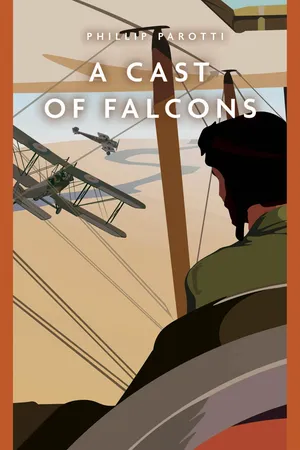
Phillip Parotti's new novel offers fast-paced action in the skies over the Sinai desert in 1916. Lieutenant Devlin Collins, an Irish-American flier in the Royal Flying Corps, expecting to fly on the Western Front, instead finds himself flying antiquated two-seater bomber and photo reconnaissance missions over the Egyptian desert against the forces of the Central Powers which are trying to capture the Suez Canal. Pitted against German machines which are up-to-date and well equipped, the men of the RFC fight at a considerable disadvantage as they go forth to meet their enemy, but committed to their cause and with aggressive spirit, no matter how great the stress of battle, they proceed and prevail, continually forcing the Turks and Germans back as the army moves slowly toward Palestine. Constantly endangered by superior German machines, facing incessant ground fire during their bombing and strafing attacks, Dev and his fellow pilot Crisp drive home their attacks with unremitting determination. In the off hours from combat, Dev discovers that he has a particular talent for planning his flight's air raids. This talent manifests itself completely in the campaign's culminating attack on the German redoubts at the battle of Magdhaba, an attack so successful that when the pilots are finally pulled back for a rest after a year of fighting, Dev is promoted and invited onto the staff at GHQ is order to apply his expertise to air planning as the army moves on Gaza with the intention of driving into Palestine.
- 288 pages
- English
- ePUB (mobile friendly)
- Available on iOS & Android
eBook - ePub
A Cast of Falcons
About this book
Information
Subtopic
Historical FictionIndex
Literature1
Standing beside the rail of the HMT Tribune, Lieutenant Devlin Collins Royal Flying Corps (RFC) glanced to starboard, where he saw the Royal Navy destroyer that had escorted them from Malta coming up on their beam. He wondered if the speeding greyhound would eventually move ahead in order to lead them into Alexandria, which remained only a few miles distant over the horizon. All things considered, their transit had been an easy one. Normally, Dev had been told, the Mediterranean could kick up more of a bother during the winter months, but in Dev’s limited experience, the opening winter days of 1916 had produced nothing but unruffled waters, even if the air had remained cooler than he had expected. Egypt, when he stopped to think about it, had been the last place on earth he had expected to wind up, and what it might bring struck him as wholly unknown. How, he could not stop from asking himself, had things come to such a pass?
First, he supposed, there had been Derry, Londonderry, his birthplace in Northern Ireland. The Collinses, his grandfather had told him, had settled on land east of there in the 17th century as a part of the Anglo-Irish Ascendancy, and as far as Devlin knew, remained in comfortable possession of Oak Hill, the family estate, ever since. Sir Colm Collins, the hereditary baronet who happened to be his grandfather, continued to enjoy a good return from the land—property which, owing to the laws of primogeniture, would eventually devolve onto his Uncle Ryan. His other uncles, Connor and Sean, and his father, Doyle, would continue to seek their own ways in the world, something all three had done together in a shirt factory that had enjoyed steady profits through the 1890s but entered a slow decline when foreign competition had started to develop around the turn of the century. There, at the age of ten, Devlin had been entered at Foyle’s College, an old and respected school which, after his year as a new boy, he had come to love, playing rugby owing to his size and occasionally keeping the wicket for his house on the cricket pitch. But in 1904, all of that changed—and changed abruptly.
“What has been wonderful for three,” his father said one evening at table when Devlin happened to be home during an end of term break, “is now only adequate for two, so I’ve sold up to Conner and Sean. At the beginning of June, we will move to the United States, to a place named New Brunswick, New Jersey, southwest of the city of New York where Liam Kelly and I have bought a motor business. We are going to sell Maxwells. They are made in Tarrytown, New York, and in Detroit, Michigan, and from all reports, they will provide us an excellent opportunity and set us up in the same style that we’ve enjoyed here.”
The move had given Dev something of a shock—the surprise announcement, the rapid packing, the hurried leave-takings, the swift voyage across what should have been a placid Atlantic, but which turned out to be a storm-tossed saga of sea sickness and ending finally with a quiet passage beneath the Statue of Liberty. After processing through Ellis Island and spending two nights beneath the towering skyscrapers of New York, the family finally disembarked from the train in New Brunswick. There they found themselves warmly welcomed by the Kellys—the Kellys who had moved months before and made prior arrangements for receiving them. And then, to Devlin’s additional surprise, he found himself fairly welcomed into the public schools he attended, replacing rugby with football and cricket with baseball, while adjusting to a wholly new style of teaching in classrooms which, to his additional shock, turned out to be co-educational and none so demanding as the curriculum in which he’d been immersed at Foyle’s. Occasionally, the friends he made commented on his accent, but considering the array of immigrants with whom he went to school—Irish, German, French, Italian, Polish, and even Russian—he was not singled out for his country of origin. He assimilated fairly swiftly to the atmosphere in which he found himself, excelled in both his studies and the sports to which he dedicated his time, and accommodated himself to his new surroundings with the ease that only the young can indulge.
In keeping with his father and Mr. Kelly’s business, Devlin learned to drive early—even before his 14th birthday—qualified for his license, and began spending his weekend and vacation time in his father’s automotive garage. It was there that two former blacksmiths, Todd and Pringle, taught him everything they knew about engines, so that, by the time he was ready for college, even his father considered him to be a skilled mechanic. As a result, when Devlin entered Rutgers in 1910, he opted for a course in Mechanical Engineering, continued to work for his father on weekends and during summer vacations when not otherwise engaged, and helped to support himself during his college tenure. It was not that he needed to—his father and Mr. Kelly’s business had thrived almost from the moment that they’d established it—but whether it had developed from an ingrained sense of responsibility or his sudden immersion in a culture where hard work and manual labor were taken for granted, Devlin had developed early on a serious turn of mind. That mind continued to equip him with what he believed necessary if, like his father, he was to be expected to make his own way in the world.
Socially, Devlin remained a fairly serious young man. Without ever indulging in what would have been considered “walking out together” in Derry, he escorted Colleen Kelly to the occasional New Brunswick tea dance, school events, promenades, and, after his entrance into Rutgers, to college functions. Colleen, an intelligent, pretty redhead, followed her own course of studies at Barnard in New York City. Their relationship, based largely on their fathers’ partnership, never passed beyond a comfortable friendship formed in their youth, and both seemed perfectly content that it should remain so. What might have been considered serious courting simply didn’t occur to either of them, so committed were they to their individual pursuits.
And then, on a summer afternoon in 1912, hearing a sudden sound overhead, Devlin looked up and spotted something that changed his life. Soaring like a bird, free on the air and directly over New Brunswick, Devlin saw his first airplane—what he believed to be a Wright Brothers Model B-Trainer, something he had only seen in one or two photographs that had appeared in the illustrated papers. The sight, when he first apprehended it, sent something like an electric shock down the back of his spine, and in the same instant he knew absolutely that he wanted to learn to fly, to pilot one of those machines which, he imagined, might take him anywhere he wished to go with the freedom of an eagle.
Without mentioning to his family what he was doing, Devlin made inquiries. He learned that the Wright Brothers maintained an aviation school in Dayton, Ohio, something which he determined to be out of his reach for both expense and distance; however, he also learned that they were running a summer course in Mineola, on Hempstead Plain on Long Island. So, equipped with monies accumulated through his work in his father’s garage, and still without telling anyone in the family what he was doing, Dev enrolled, making weekend trips to Hempstead Plain by train. He camped out overnight on the grounds on Saturdays and Sundays, completed the ground school with stellar marks, and, after three hours of dual-seat instruction, made his first solo flight at the age of 20 in August 1912, on a Wright Model B Trainer of the type that he had first seen in the air over New Brunswick.
“I think ya might be a bit of a natural,” Tedford Scott, his instructor, told him after he’d seen him solo twice more, “but I want to warn ya, Dev, being a natural can kill ya as sure as if you was an incompetent. Check your engine, check your rigging, and then, when ya gets behind them controls never, ever, let your concentration wander. These birds are dandy when they behave, but it don’t take ’em two seconds to go wrong, and if ya let your mind wander, two seconds is long enough for them to kill ya. Mind what I’m telling ya?”
“Yes, Sir,” Dev said.
Across the remainder of that year, Devlin Collins accumulated more than 12 hours of flying time in his log book, and then, in 1913, he accumulated 45 hours more, with even more hours following in 1914. Sometimes, he flew planes at the Wright Flying School or rented a plane from the Long Island Flying Club. By this time, he’d acquainted his family with his aspirations regarding flight. While he’d given his mother a fright with the news, his father, always one to seize an opportunity, had been supportive and given him encouragement, suggesting that while no one knew anything about the so-called future of flight, it might lead to business ventures in the future that had been as unforeseen as what the automobile had originally provided.
And finally, on a warm morning in early June, with both the Collins and the Kellys attending, Devlin walked across the stage at Rutgers, received his diploma, and graduated from his university as a fully qualified engineer. Two days later, the families reassembled to watch Colleen receive her diploma at Barnard. To everyone’s surprise, by means of connections she’d made through a classmate with whom she’d gone through her final two years, Colleen went almost immediately into a sub-editor’s position with a respectable publishing house in lower Manhattan. Dev, determined to consider his options before committing himself to a place, continued to work for his father and Mr. Kelly, spending six days a week in the garage and flying on Sundays. But that work only continued for four weeks, until his father sat him down one evening after supper, flashed him a smile, and said, “Your uncles wish to install an entirely new steam plant with which to run the factory. They’d like you to go to Derry, on salary, and oversee the installation. I doubt that the work will require more than three or four months to complete, and after your efforts at Rutgers and your work here, it might give you a vacation as a part of the bargain. Feel like visiting the family back in Ireland?”
Faced with such an unexpected opportunity, Dev felt delighted to be able to go. Dev arrived in Derry during the second week in July and went straight to work overseeing the new installations at the factory. In order to reacquaint himself with his uncles, his aunts, and his many cousins, he lived for the first month with his Uncle Conner, his second month with his Uncle Sean, and then moved to Oak Hill to live with his Uncle Ryan’s family not long after the Germans invaded Belgium, launching The Great War. Almost immediately, his uncles bid for and received government contracts that called for the production of an array of uniform shirts. The work went ahead even more swiftly than originally planned, while Uncle Sean oversaw the factory’s extension into an adjacent building so that production capacity could be increased. Dev designed and oversaw the power plant, while his uncles saw to the extension’s layout and the hire of additional staff.
On the streets, in the pubs, in the music halls and theaters, Dev detected what almost amounted to a euphoria about the war. Everything seemed to be festooned with the Union Jack or red, white, and blue bunting. Rallies and recruitment drives seemed to be going on daily, and there appeared to be a general feeling that the war would be quickly won and conclude within months, if not weeks. Marches and parades clogged one street or another at more than frequent intervals, and twice, after listening to recruiting sergeants deliver their spiels from elevated platforms and turning to walk away, sharp-eyed young women with looks of contempt on their faces had hurried up to him and deposited white feathers into the breast pocket of his jacket. America, as the newspapers were quick to point out, would not be entering the war, President Wilson committing the country to remain neutral. A part of Dev tended to treat the white feathers as amusing dispensations from ignorant girls who didn’t know the first thing about him, where he came from, of what he was doing there. But after a few weeks of this sort of thing, Devlin Collins began to feel a rub, a rub which soon began to chafe and then feel downright raw.
As Paris was threatened and the BEF dispatched to hold the line on the Marne, Dev began to feel more than a little conflicted about the war. New Brunswick was his home; his family was there, he’d largely grown up there, gone to school there, and planned his life there. But from the start, the family had maintained dual citizenship, meaning that no matter how he looked at it, he remained in some part a subject of the crown. Dev couldn’t deny that Derry, regardless of the distance that had for so long separated him from her, also remained his home—the place where he’d been born, the city in which he’d spent his tender years. Being back, almost accidentally at this particular moment, reminded him that he loved his first home as much as his second. And with that realization, he felt some kind of responsibility to defend her.
Meanwhile, work at the factory went on without a break, Dev sometimes laboring as many as 14 hours on a Saturday and even into Sundays as yet more government contracts accumulated, Uncle Conner landing a contract to expand production to manufacture webbing for such things as belts, knapsacks, duffle bags, and brailing loops for tents. Commensurate with the need for doing the job right and doing it safely, Dev rushed his own work as productively as he could, with the final result that the factory, now expanded into three buildings, had started working three shifts by the middle of November, Dev’s uncles declaring themselves more than satisfied with what he’d accomplished and awarding him a generous bonus to underwrite their thanks.
With the job concluded, Dev might have returned to New Jersey—but he didn’t. Instead, sitting down before the writing table in the room at Oak Hill in which Uncle Ryan had installed him, he wrote a long letter to his parents and concluded by saying, Being back in Ulster has reminded me that I’m as Irish as I am American and that I have a responsibility to defend our United Kingdom. I think I can contribute. I intend to join up. And then he went to have a talk with his Uncle Ryan.
By virtue of his position in society, having inherited the baronetcy from Sir Colm, Sir Ryan was particularly well connected and well placed to help Devlin when Dev finally approached him about entering the unformed service of his country. In the beginning, feeling a responsibility to his brother and motivated by a genuine liking for Devlin, Sir Ryan tried to talk him out of making the commitment.
“With your engineering expertise, Dev,” Sir Ryan said, “I think you could be of more help to the cause by staying right here in Northern Ireland or establishing yourself somewhere in the Midlands where you could help us increase our production of war materials.”
“That, if I’m rejected, I will most certainly do,” Dev said, “but if I don’t attempt to join and offer to take the risk, I fear that I will never be able to stand straight again and face myself in the mirror when this thing ends.”
They talked on, the two of them, for more than an hour, but when Sir Ryan knew finally that Devlin remained firm in his intention, he acceded to his nephew’s request for help, made the requisite telephone calls, and sent him to Victoria Barracks in Belfast for an interview with a major in the Royal Irish Rifles.
Major Mumford, when Devlin met him, at first treated Devlin’s request to become an officer candidate—what Mumford called a “temporary gentleman”—with skepticism, but after an hour’s interview and in consideration of Devlin’s background, education, and practical training, his view changed.
“Normally,” he told Devlin, we draw our officers from Sandhurst, Woolwich, or an OTC connected with public schools like Eton, Harrow, or Rugby. However, at Aldershot, an experimental company has formed, a Cadet Training Company, which the Army intends to expand into a battalion should more officers be needed later in the war. If you are agreeable, I think we might be able to fit you into it.
Devlin declared that he was indeed agreeable, and during the week following Christmas 1914, he took ship, crossed the Irish Sea, and made his way to Aldershot. There, he quickly passed his physical examination, held up his hand, swore his oath, and took the King’s shilling as an officer cadet in the training company. To his surprise, he found himself included in a mix of recent public school graduates, bank clerks, former sergeants and former warrant officers, all of them blended together for three months of square-bashing, classroom instruction, and rigid military discipline. Devlin found the course in no way difficult and passed out near the top of his class with his King’s commission as a second lieutenant. He returned to Victoria Barracks in Belfast just in time to be dispatched—again on an experimental basis, to see what a “temporary gentleman” could do—in a draft of replacements to fill officer gaps in his regiment that had resulted from the battle for Neuve Chapelle which had been fought in March.
Based on his three-month stint in the trenches, Devlin later found that he could not look back on them with pleasure. Aside from the drenching spring rains, the mud, and the rats, there had been the vermin, the smell, the noise, and what had sometimes seemed a never-ending stream of Bavarian bullets piercing the air immediately overhead. Then, finally, in the high heat of July, with nearly everyone soaked and bedeviled by their own sweat, his battalion had gone over the top in the battle of Fromelles, his own platoon losing three dead and seven wounded, including himself when a machine gun bullet shattered against a steel picket and threw a sliver into his thigh. The sliver had not been large and, in the field hospital to which he had limped, it had been quickly removed by a medical attendant who next poured in enough tincture of iodine to make him feel like his leg was on fire. Thereafter, bandaged but limping, he returned to his trench, resumed his duties, and three days later put himself forward when his battalion commander announced that the Royal Flying Corps had sent down a bulletin seeking recruits.
“Sorry, old chap,” said the lieutenant colonel, somewhat contemptuously, who had stopped at Division Headquarters to interview potential candidates for the RFC, “but we are not presently taking temporary gentlemen into the RFC.”
“Not even temporary gentlemen who are certified aviators with more than 80 flying hours in their log books?” Devlin asked, immediately producing his.
“Ah,” said the lieutenant colonel, pinching his lips even as his eyes narrowed, “spot of difference, there, if you see what I mean.”
“Quite,” Dev agreed.
Three days later, still limping slightly, Devlin Collins boarded ship at Calais, disembarked at Dover, took the train to London, and enjoyed a week’s convalescent leave before boarding yet another train which put him down at Montrose, Scotland, where he went through preliminary flight school and passed out first in his class. Four of the group of 20 with whom he had started the course failed to complete it, each of them killed in flying accidents before the course had half ended. At the time, Dev found the deaths distressing, but there were so many in the flying schools that he also knew he had to accept them as routine. From there, Devlin was dispatched to the Central Flying School at Upavon on the Salisbury Plain. There, graduating to more sophisticated planes and training, he not only learned to fly more demanding aircraft but also had to master a variety of associated skills, including bomb dropping, photography, artillery observation, distance flying, formation flying, fighting practice, and finally, machine gunnery. The course on machine gunnery lasted a full week in which the pilots sat on hard benches, memorized the parts of the Lewis gun, learned how to take them down and put them back together, how to load their ammunition canisters, and how to clear jams. Finally, months after he’d returned from France, Devlin received his passing-out certificate, granting him permission to sew on his RFC wings. This time, three more of his classmates had died in training—one when the wings on his plane folded back in a dive, one who flew into a tree, and one when his engine quit on takeoff and he made the unforgiving mistake of trying to turn back. Then, as fully prepared as the course could make him, Devlin once more prepared to return to France, where the Huns, as they were then known, seeme...
Table of contents
- Front Cover
- Half-Title Page
- Title Page
- Copyright Page
- Dedication
- Contents
- 1
- 2
- 3
- 4
- 5
- 6
- 7
- 8
- 9
- 10
- 11
- 12
- 13
- 14
- 15
Trusted by 375,005 students
Access to over 1.5 million titles for a fair monthly price.
Study more efficiently using our study tools.
Frequently asked questions
Yes, you can cancel anytime from the Subscription tab in your account settings on the Perlego website. Your subscription will stay active until the end of your current billing period. Learn how to cancel your subscription
No, books cannot be downloaded as external files, such as PDFs, for use outside of Perlego. However, you can download books within the Perlego app for offline reading on mobile or tablet. Learn how to download books offline
Perlego offers two plans: Essential and Complete
- Essential is ideal for learners and professionals who enjoy exploring a wide range of subjects. Access the Essential Library with 800,000+ trusted titles and best-sellers across business, personal growth, and the humanities. Includes unlimited reading time and Standard Read Aloud voice.
- Complete: Perfect for advanced learners and researchers needing full, unrestricted access. Unlock 1.5M+ books across hundreds of subjects, including academic and specialized titles. The Complete Plan also includes advanced features like Premium Read Aloud and Research Assistant.
We are an online textbook subscription service, where you can get access to an entire online library for less than the price of a single book per month. With over 1.5 million books across 990+ topics, we’ve got you covered! Learn about our mission
Look out for the read-aloud symbol on your next book to see if you can listen to it. The read-aloud tool reads text aloud for you, highlighting the text as it is being read. You can pause it, speed it up and slow it down. Learn more about Read Aloud
Yes! You can use the Perlego app on both iOS and Android devices to read anytime, anywhere — even offline. Perfect for commutes or when you’re on the go.
Please note we cannot support devices running on iOS 13 and Android 7 or earlier. Learn more about using the app
Please note we cannot support devices running on iOS 13 and Android 7 or earlier. Learn more about using the app
Yes, you can access A Cast of Falcons by Phillip Parotti in PDF and/or ePUB format, as well as other popular books in Literature & Historical Fiction. We have over 1.5 million books available in our catalogue for you to explore.