- 82 pages
- English
- ePUB (mobile friendly)
- Available on iOS & Android
eBook - ePub
About this book
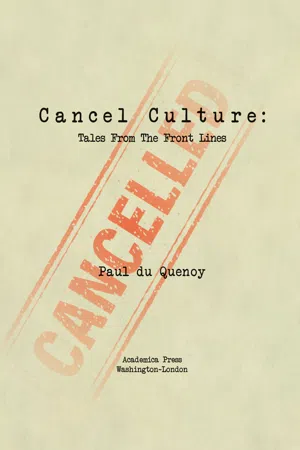
What is "cancel culture." A new phrase in popular circulation for less than two years, it has provoked passionate denunciations from observers concerned with civil liberties, especially rights of free speech and expression, and apologetic defenses from opponents who advocate equity and accountability in light of new mores. Still others deny that "cancel culture" exists at all, while many claim never to have heard of it.
In Cancel Culture: Tales from the Front Lines, noted historian and critic Paul du Quenoy presents a series of case studies that reveal the new phenomenon known as "cancel culture" as experienced or claimed in media, academia, the arts, public space, and other areas of ideological controversy. More than a bald denunciation or frustrated description of an unfamiliar new concept, this groundbreaking approach seeks to understand "cancel culture" as a process – how it starts and stops, where it comes from and leads, and how and, indeed, whether it might one day end. This penetrating and highly original analysis sheds light on a society grappling feverishly with fundamental issues of freedom and liberty.
Information
Section III: Entertainment
Cancel HBO:The New Censorship Comes For HBO
After the national race riots that followed the horrific death of George Floyd, hosts of wokevolk emerged to exploit the racially charged atmosphere to resume purging American culture to their liking. Remaining Confederate monuments have been toppled through means legal and illegal, while a fair number of statues of other white males on the nasty order of George Washington and Abraham Lincoln are under threat. The United States Navy and Marine Corps, and even NASCAR, have all banned the Confederate battle flag. The airing of dissenting opinions about how to handle the recent unrest has led to the swift ouster of major media figures whose broadmindedness is thought to have posed “danger” to their staff. Everyone else has been put on notice that merely failing to voice support for woke directives is an act of aggression. “Silence,” one common slogan succinctly puts it, “is Violence.”
As companies big and small rush to be on the “right side of history,” HBO Max removed the classic 1939 film Gone With The Wind from its new streaming service. Simply by having been a “product of its time” the 81-year old film set in and around Atlanta, which was again recently on fire, unpardonably sinned because it “depicts some of the ethnic and racial prejudices that have, unfortunately, been commonplace in American society.”
This censorious decision against a film that produced the first Academy Award bestowed on an African-American artist (Hattie McDaniel won for Best Supporting Actress) came down just three days after John Ridley, the director of the bludgeoning 12 Years A Slave, demanded Gone With The Wind’s removal in a Los Angeles Times op-ed. Ridley declaimed that it “glorifies the antebellum south. It is a film that, when it is not ignoring the horrors of slavery, pauses only to perpetuate some of the most painful stereotypes of people of color.” Made more than eight decades ago, Gone With The Wind appallingly fails to meet Ridley’s expectations today.
To add insult to injury, Ridley continued, it did not even have a warning or disclaimer to spare the delicate sensitivities of people who might unwittingly be exposed to the horror of Vivien Leigh but could blithely watch the looting of Lower Manhattan or violent seizure of downtown Seattle on every news channel. Ridley assured the reader that he does not “believe in censorship” – except when he does – and that he only wants to “make the world a better place” by using his celebrity to control what his fellow citizens may or may not view in their own homes via an optional media service for which they have paid. The CEO of HBO Max’s parent company, a man who will not go down in the annals of free expression, described the decision to remove the film as a “no-brainer.”
Given the nature of the invective, one could be forgiven for wondering whether any of Gone With The Wind’s cancelers has ever actually watched the film, especially in an era when millennials – who dominate streaming service usage – lack the time, interest, or attention span to sit through an old movie that clocks in at nearly four hours. Indeed, more than 75 percent of millennials surveyed in 2017 reported never having seen any film made in the 1940s or 1950s, let alone in the 1930s.
Education has not and is unlikely to remedy the situation. Screening Gone With The Wind has long been taboo on American campuses, where freedom of speech and expression are now themselves fading memories of a bygone age. When National Public Radio’s insipid All Things Considered program departed from its usual wallpaper paste-dull content to research a story on the film on the occasion of its seventy-fifth anniversary in 2014, it confirmed that many of its ostensibly well-educated younger staffers had, in fact, never seen it.
Their blistering ignorance was shared by a film class at Washington’s prestigious Georgetown University (my alma mater), in which most of the students confessed to NPR that they had not seen it, either. This did not stop them from having opinions about it, however. As one of these best and brightest of young American scholars so eloquently put it, “Everything I’ve seen about it says it, like, glorifies the slave era … and I dunno, what’s the point of that? I don’t see that as a good time in history … like, oh, sweet, a love story of people who own slaves.” (Even that dull witted observation is inaccurate: Rhett Butler is not a slaveowner, while Scarlett O’Hara’s father owns the family’s slaves, not she). Ridley’s complaint that simply seeing Gone With The Wind listed among hundreds of other films on HBO Max was so “painful” that he wrote an open letter to major newspaper demanding its removal suggests that he himself may never have found the intestinal fortitude to sit through it all.
Does Gone With The Wind really “glorify” the slave era and the Old South that was defined by it? For those vast multitudes who have not seen the film, it is a tempestuous love story set against the backdrop of that world’s total destruction during and after the American Civil War. At the time it was made, it was as far removed in time from that conflict as we are now removed from World War II. The film shows no heroic battle scenes, but rather devastated landscapes, long casualty lists, an epic panorama shot showing a sprawling field of ill cared for Confederate wounded, and, mercifully in the shadows, a horrific leg amputation conducted without anesthetic. It makes no heroic statement about the antebellum South and its fate, but fits neatly within the pacifist ethos of the interwar era in which it was made, in which a solid 75 percent of Americans opposed any involvement in the world war that broke out that same year.
Within the first thirty minutes, the film’s rebellious anti-hero Rhett Butler condemns the imminent war as hopeless folly to a large gathering of headstrong Southern gentlemen. His opinion is so unpopular that he is nearly challenged to a duel. Almost all of those present who are identified by name later die inglorious offscreen deaths while their splendorous surroundings lie in the path of Sherman’s devastating March to the Sea.
Rhett spends the rest of the film, even when romancing the vain and narcissistic Scarlett O’Hara – who refers to plantation life as “Hell,” – mocking the very “Cause” that so many of today’s woke warriors hate, along with all of the old South’s other social conventions.
The survivors are condemned to squalor, with Scarlett reduced to eating raw turnips while her sisters callous their hands picking cotton and her once proud but now insane father clutches worthless Confederate war bonds. She rebuilds the family’s blighted fortunes through hardnosed entrepreneurship in the commercial economy, doing business with the northern occupiers and employing not recently emancipated slaves but less expensive white convict laborers. Her crush Ashley Wilkes, the son of a neighboring plantation owner, opposes war in all its forms, abhors slavery, and we learn, planned to free his family’s slaves upon inheriting them had the Civil War not intervened.
While slavery is depicted in the film, nothing in it suggests that it was good or anything to be missed. The film’s vilest character by far is the O’Hara’s overseer, an unscrupulous Northerner, whom we first meet when Mrs. O’Hara disdainfully informs him of the death of his newborn child by a poor local girl he had impregnated and abandoned. The last time we see him, now a carpetbagger using his new allegiance to torment his former employers, Scarlett throws a fistful of dirt in his face after he tries to bully the impoverished O’Haras into selling him their family home at a cut rate, deriding them in the process for being Irish. Even the O’Haras’ slaves look down on this miscreant throughout the film as “no-count white trash.”
Even if the casual observer still thinks this ceaseless stream of death and degradation glorifies the antebellum American South, Gone With The Wind does not end at all happily. Rhett and Scarlett marry after she survives two lesser husbands whom she uses rather than loves, but their only child dies young in a horrible riding accident, her life cut short by the same cavalier horsemanship that defined a vanished culture of equestrian gentility. Still obsessed with Ashley, Scarlett drives the exasperated Rhett to leave, famously telling her that he “frankly” does not “give a damn” about her fate. Abandoned to her neuroses, she is trapped between an irretrievable past and an uncertain future.
This melodrama is hardly the stuff of glory. It is hard to imagine a militia band of even the most determined white nationalists using the film to inculcate racist values in the future builders of a white ethnostate, or anyone else viewing it as anything other than epic fantasy set in a universe that could no longer exist. Its popularity has never been in doubt. A smash hit upon release, it remained the top selling American film until The Godfather displaced it in the 1970s, and, adjusted for inflation, it has been rated the highest grossing film of all time. When it was first televised in 1976, an estimated 47 percent of American households tuned in. When Turner Classic Movies premiered in 1994, it was the first film broadcast on the network, which still regularly broadcasts today along with other films that might not be considered politically correct. According to a 2014 poll, 73 percent of Americans who had seen Gone With The Wind – and, ironically given the current context, an identical 73 percent of black Americans who had seen it – rated it “good,” “very good,” or “one of the best” films ever made.
After a well justified and encouragingly effective outcry, HBO Max returned the film to its service, albeit with “a discussion of its historical context and a denouncement” of its “objectionable” features in the hope that a preachy lecture to viewers will help “create a more just, equitable and inclusive future.” Jacqueline Stewart, a University of Chicago film and media studies professor, provides this discussion. She has stated that Gone With The Wind should “stay in circulation and remain available for viewing,” but mainly as “a prime text for examining expressions of white supremacy in popular culture.”
Disturbed by the film’s failure to show a sufficient amount of black suffering, her goal is to warn those who choose to watch it against “false pedigrees” with glamorous Southern aristos whose haughty bearing could deceive “working class and poor white viewers” from forming “beneficial alliances with their Black working class and poor counterparts.” Her fundamental goal is to transform an undisputed American classic into material for “re-education,” a term rarely associated with any democratic society. HBO Max’s executives may have imagined this light form of Maoism as a good marketing ploy or at least as a way to avoid being condemned for “silence.” Either way, until this incident I had never heard of their service, though news of HBO’s weak financial situation soon emerged. Now I have a reason not to subscribe to it.
Disclaimer:Mel Brooks is Canceled
No sooner had HBO Max, the financially troubled American cable television network’s new film streaming service, signaled its virtue by removing Gone With The Wind from viewing so that the classic film could be properly “contextualized” than attention fell on Mel Brooks’s smash hit 1974 comedy Blazing Saddles. Added to HBO Max’s streamed offerings since the Gone With The Wind dust up and known for its liberal use of the feared and loathed “n-word,” Blazing Saddles arrived with a similarly patronizing disclaimer already installed. In a three-minute introduction that apparently cannot be skipped over, film professor Jacqueline Stewart is there again, this time to inform viewers that “racist language and attitudes pervade the film,” while instructing them that “those attitudes are espoused by characters who are portrayed here as explicitly small-minded, ignorant bigots … The real, and much more enlightened, perspective is provided by the main characters played by Cleavon Little and Gene Wilder.”
Thanks, Aunt Jacqueline. If you have not seen Blazing Saddles – and if you are under the age of 40 there is an excellent chance some priggish authority figure sanitized it out of your cosseted millennial existence – it stands as one of the greatest, and the certainly the funniest, anti-racist films of all time. Based on a story by Andrew Bergman, Brooks conceived it as a scathing send-up of racism and the hypocrisy that still enabled it after the great civil rights victories of the 1960s. Brooks’s idiom was a parody of the classic Western, by then an exhausted genre that had, among other flaws, become inanely predictable and was much criticized for leaving out minorities and questions of race. A landmark of American film, Blazing Saddles was selected in 2006 for inclusion in the U.S. National Film Registry, which recognizes “culturally, historically, or aesthetically significant films” worthy of preservation.
Drenched in hilarity – and by my count using the “n-word” 17 times in its 93-minute run – the plot involves a conspiracy by an avaricious U.S. state attorney general who wants to drive white settlers off land he needs to complete a profitable railroad project. After having outlaws wreak mayhem on the townspeople, he recommends that the governor appoint a black sheriff to restore law and order, cynically assuming that their racism will cause them to reject the new lawman and give up. Despite a rough initial reception, the sheriff outwits attempts to get rid of him and, with the help of a washed up but sympathetic alcoholic gunslinger, leads the townspeople to victory, winning their love and respect before moving on to other brave deeds.
While HBO no longer wants to risk having its paying customers think for themselves (and what stale corporate outfit uneasily transitioning to a crowded new medium wouldn’t?), it could rightly be said that anyone dumb enough to miss the film’s message might be a recent product of American higher education.
I do not mean that at all facetiously. Decaying and run by a self-important clerisy whose demands to be taken seriously only become shriller as ...
Table of contents
- Cover
- Title Page
- Copyright
- Contents
- Introduction
- Section I: Academia
- Section II: The Arts
- Section III: Entertainment
Trusted by 375,005 students
Access to over 1.5 million titles for a fair monthly price.
Study more efficiently using our study tools.
Frequently asked questions
Yes, you can cancel anytime from the Subscription tab in your account settings on the Perlego website. Your subscription will stay active until the end of your current billing period. Learn how to cancel your subscription
No, books cannot be downloaded as external files, such as PDFs, for use outside of Perlego. However, you can download books within the Perlego app for offline reading on mobile or tablet. Learn how to download books offline
Perlego offers two plans: Essential and Complete
- Essential is ideal for learners and professionals who enjoy exploring a wide range of subjects. Access the Essential Library with 800,000+ trusted titles and best-sellers across business, personal growth, and the humanities. Includes unlimited reading time and Standard Read Aloud voice.
- Complete: Perfect for advanced learners and researchers needing full, unrestricted access. Unlock 1.5M+ books across hundreds of subjects, including academic and specialized titles. The Complete Plan also includes advanced features like Premium Read Aloud and Research Assistant.
We are an online textbook subscription service, where you can get access to an entire online library for less than the price of a single book per month. With over 1.5 million books across 990+ topics, we’ve got you covered! Learn about our mission
Look out for the read-aloud symbol on your next book to see if you can listen to it. The read-aloud tool reads text aloud for you, highlighting the text as it is being read. You can pause it, speed it up and slow it down. Learn more about Read Aloud
Yes! You can use the Perlego app on both iOS and Android devices to read anytime, anywhere — even offline. Perfect for commutes or when you’re on the go.
Please note we cannot support devices running on iOS 13 and Android 7 or earlier. Learn more about using the app
Please note we cannot support devices running on iOS 13 and Android 7 or earlier. Learn more about using the app
Yes, you can access Cancel Culture by Paul du Quenoy in PDF and/or ePUB format, as well as other popular books in Politics & International Relations & Politics. We have over 1.5 million books available in our catalogue for you to explore.