This book traverses the cultural landscape of Colombia through in-depth analyses of displacement, local and global cultures, human rights abuses, and literary and media production. Through an exploration of the cultural processes that perpetuate the "darker side" of Latin America for global consumption, it investigates the "condition" that has led writers, filmmakers, and artists to embrace (purposefully or not) the incessant violence in Colombian society as the object of their own creative endeavors. In this examination of mass-marketed cultural products such as narco-stories, captivity memoirs, gritty travel narratives, and films, Herrero-Olaizola seeks to offer a hemispheric approach to the role played by Colombia in cultural production across the continent where the illicit drug trade has made significant inroads. To this end, he identifies the "Colombian condition" within the parameters of the global economy while concentrating on the commodification of Latin America's violence for cultural consumption.
The Open Access version of this book, available at http://www.taylorfrancis.com, has been made available under a Creative Commons Attribution-Non Commercial-No Derivatives 4.0 license.
Stories about the life and times of Pablo Escobar (1949–1993)—the infamous drug cartel leader and popular folk hero—are a perfect example of how Colombian cultural products have been bought and sold by publishing and media conglomerates. More often than not, stories about drug-related violence in Colombia provide global audiences with the kind of Latin American dark exoticism that has now long been embraced and promoted by global publishing and media outlets. Such accounts foreground the historical value of personal experiences about the Colombian condition as they claim to offer international audiences a tighter connection between those who narrate stories of violence and displacement and those who actually suffer them first-hand. But, in so doing, they also perpetuate a dire outlook for the Colombian nation and the precarious nature of its irreparable violent condition, thus reinforcing a certain level of addiction to all bad things Colombian on the part of readers, critics, and media outlets. As such, violent drug-related scenarios emerging from Colombia are easily commodified in best-selling fiction, film and TV, and art, and successfully marketed in North America and Europe precisely because they provide international audiences with a sense of history, justice, and false proximity between them and localized marginal subjects.
Narco-stories, which I broadly define as storytelling about incessant violence in a lawless society ruled by paid assassins (sicarios/as) and drug cartels, have become one of the most profitable (and widely available) commodities in such global cultural markets. Examples can be found in large variety of cultural products that construct through words or images (as the case may be) stories about the drug trade, ranging over best-selling Colombian fiction (e.g., novels by Fernando Vallejo, Jorge Franco, Laura Restrepo, Juan Gabriel Vásquez), Hollywood films and television series (e.g., Netflix’s Narcos), and art (e.g., Fernando Botero), as well as other forms of mass popular culture. These have been encapsulated, as Aldona Pobutsky reminds us, under the umbrella term narco-cultura—a cultural expression of drug trafficking aesthetics and “narco lifestyles in television, literature, music, architecture, language, fashion, the female beauty ideal, and social rituals, including those associated with death” that has captured global audiences’ preoccupations with “mass commodities, excess, and instant gratification” (Narcoculture 3).
It is fed, for example, by the visual and artistic representations of Pablo Escobar that began to emerge since his death on December 2, 1993. Hunted down and shot in Medellín by a special group of the Colombian police and military (thanks to technological and intelligence support from the US), the photographs of Escobar’s killing are both a gruesome spectacle and an incredibly rich source from which writers, artists, and filmmakers have drawn their creations.1 In the photographs it is particularly disturbing to see the captors’ joyfulness as they pose in front of the camera with Escobar’s obese corpse turned into the coveted trophy of a global manhunt. Escobar’s bloodied dead body lies inert on a rooftop near his hideaway in Medellín while the army’s special forces smile to the camera in celebration of the hunted prey. This watershed moment for Colombia’s history marks the end of Escobar’s reign over the global drug trade. Surely, authorities needed to show Escobar’s body to the world (not unlike what had happened many years before with Che Guevara’s corpse in Bolivia) as a tangible proof that Colombia’s public enemy number one was forever gone. But that was not the end of Escobar in the cultural field, since his demise began his legacy in national and global imaginaries, quite the contrary. A proliferation of cultural products often designed for global consumption revived (as it were) the controversial drug lord as both a ruthless criminal and a benefactor for the poor who used his fortune to build homes and soccer fields.2
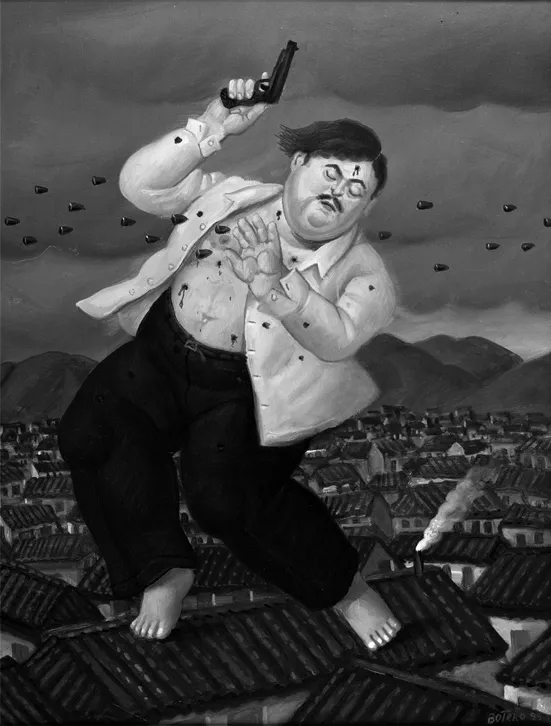
Escobar’s criminality has been captured visually in the artworks of Fernando Botero and local muralists from Medellín. Botero’s memorable narco-paintings of the late 1990s, such as Death of Pablo Escobar, Autobomba, and Massacre in a Better Corner, enhance the druglord’s legacy and iconic status. Similarly, James Mollison’s The Memory of Pablo Escobar—a photographic memoir of the drug lord through thousands of visual artifacts—features an extensive collection of kitschy art displayed in murals and paintings by local artists whose works try to capture Escobar’s double life: that is, the world’s most-wanted criminal and the revered modern-day Robin Hood that helped the lower classes. One of the most telling examples in Mollison’s book is Hernando Orozco’s oil canvas, in which Escobar’s hands, solidly grounded, reach out into the slums now connected through a wooden bridge that leads to a new soccer field and housing complex provided by the opportune philanthropist. Saintly representations of Escobar appear, for instance, in Germán Arrubla’s painting Heroes and Anti-Heroes where the drug baron is placed in an altar next to none other than Diana, Princess of Wales, as reproduced in the images published in Mollison’s book (18–20). But it is perhaps Botero’s iconic painting Death of Pablo Escobar that sums up quite graphically the imprint of Pablo Escobar’s legacy in Colombian cultural production and its repercussions for our global understanding of narcoculture. The painting shows a gigantic Escobar being showered with bullets over the tiny rooftops of Medellín while in the background there is an anticipation of serenity from the perfectly aligned abode homes and the greenery of the mountains. The narco-story told in this painting contrasts sharply with the gruesome photographs of the hunting down of Escobar by Colombia’s special forces that circulated as proof of his death, and, by extension, of his grip on the global drug trade (Figure 1.1).
Figure 1.1Death of Pablo Escobar (1999), oil painting by Fernando Botero (50cm x 38cm). Museo de Antioquia, Permanent Collection.
Botero’s depiction of the drug lord’s gigantic body is in sharp contrast with the miniaturization of Medellín in the background. At the moment of his death he is standing large, in excess, dodging many of the bullets targeting his body. Despite having been hit in the forehead and abdomen, the drug lord (magically) remains combative, holding up a gun on his right hand in a final act of defiance while remaining literally on top and ready to combat the final assault against his life and continue to reign in the drug trade. For Héctor Hoyos, in this painting “Botero renders his subject in the style of a grandiose, larger-than-life kingpin, annoyed at the insect-like bullets that bring him down” (132). Through this humorous and excessive portrayal, Botero actually alters and inverts the positionality and composition that we see in the photographs of Escobar’s killing, where the drug lord is gunned down and lying prone on the rooftop for the amusement of the army’s special forces and onlookers. Likewise, Botero’s painting provides us with a powerful composition that illustrates the durability of Escobar’s imprint onto the national imaginary six years after his death—a watershed moment that is almost impossible for Colombians to ignore, and, in particular, for cultural producers who keep on returning to this iconic moment of collective historical remembrance that defines the landscape of Colombian narco-stories.
Escobar’s demise (and the impending sense that he was no longer a threat for those who dare represent him in a negative light) became the catalyst for the proliferation and consumption of narco-stories in Colombia and beyond—in particular, those taking place in Medellín’s slums (comunas) and exploiting sexual desire, poverty, drugs, and desperation. Through the gripping visuals of Escobar’s death, international audiences were made to feel more aware of Colombia’s harsh realities, reassured in their knowledge, and “closer” to the struggles facing its marginalized communities. Such proximity and presumed familiarity reinforce the idea of “Colombia, the violent nation” overtaken by drug trafficking and suffering from chronic violence. Interestingly, the literary field has embraced Pablo Escobar as the emerging figure that informs much of the Colombian cultural production for the global market while other actors in the nation’s violent history, such as the FARC and ELN guerrillas, have not quite made it to the global cultural market as the kingpin’s iconic legacy has achieved.
But to understand the surge of narco-stories in contemporary Colombian cultural production, it is important to keep in mind the appropriation of dirty realism that became prevalent in the literary and cultural field of the 1990s and onwards (as discussed in this book’s introduction). Indeed, the commodification of dirty realism in the global market shaped the imprint of narco-culture that originates in and feeds on Pablo Escobar’s life and death. My main focus in this chapter is not to reconstruct the myriad representations of Escobar and how these may vary in historical accuracy or truth (if that is ever possible when examining narco-trafficking). Instead, I move away from reconstructing the capo’s life as the world’s most notorious kingpin in the 1980s and 1990s and turn to cultural production. Thus, I explore the role of Escobar in narco-storytelling as a global cultural phenomenon that precisely draws on the economic accumulation and excess that is characteristic of the illicit drug trade Escobar himself created. Obviously, it is hard to equate the profits from a global commodity like cocaine with those from cultural commodities such as narco-stories, but it is reasonable to propose that the commodification and distribution processes are not really that far apart—particularly when the global culture industry has had no qualms about appropriating such excess and economic accumulation in their guilt-free efforts to promote narco-stories in the international cultural market: “narconovelas,” Héctor Hoyos writes in Beyond Bolaño: The Latin American Global Novel, “are primordially about power and accumulation, about fabulously successful capitalists who, perhaps paradoxically, have no place in the established capitalist world order” (154).
In this regard, terms like narco-capitalism or narco-accumulation are very useful to understand the market’s logic behind Escobar’s cocaine trade, which originated in the cultivation of coca leaves in the rural enclaves of Latin America (e.g., Peru, Bolivia, Colombia) and moved up the ladder quickly into local economies and onto international money laundering thanks to transnational laissez-faire consumer capitalism characteristic of the neoliberal economies burgeoning in 1990’s Latin America. Gareth Williams illuminates us on this point when he affirms that
narco-accumulation is just one more name for the contemporary will to power of capitalism, in which capital projects itself, as always, in two directions simultaneously: (1) toward the absolutization of commodity and surplus value; and (2) toward the minimization […] of the value of labor.
(110)
As a result, narco-accumulation fosters the movement of commodities such as “drugs, guns, and bodies” (111) with the State’s tacit approval, without any legal intervention, and, in many cases, with the cooperation of rogue elements within the State’s apparatus. Relating to this idea, Hermann Herlinghaus sees in Escobar a confluence of late capitalism with a rupture in its own “geopolitical rules” that allows for a liberal and universal democratic model, in which violence and neoliberalism go hand in hand to disregard “the authority of the super-state” (Narco-epics 95–97; 107).
Narco-stories partake in this effort as they often promote and engage in a culture of deregulated capitalist excess, or more precisely, in excess consumption, as illustrated by lavish mansions, flamboyant lifestyles, haciendas that resemble theme-parks and zoos, or trophy women “beautified” with gallons of silicone. Unnecessary expenditure rules the excess consumption in the narco world, or at least, in the narco world being portrayed in cultural production and being consumed by readers and filmgoers worldwide. Michael Taussig aptly describes this type of expenditure affiliated with the narco world as indulging in dépense—a concept coined by Georges Bataille to refer to unproductive spending or “toomuchness,” whereby consumption exceeds what would typically be regarded as normal or sufficient consumption. The hilarious example Taussig provides to illustrate his point takes us to one of Escobar’s ringleaders, José Gonzalo Rodríguez Gacha, whose toilet paper at home was embossed with his initials in real gold: “That’s a lot of gold down the chute when you consider how many initials he had. JGRG” (Beauty 11). Examples like these are illustrative of what Taussig sees as today’s economy of delirious consumption—something that Pablo Escobar and his ilk engaged in on a daily basis and is now being shared as part of a global culture of “excess consumption.”3
Consumption is irremediably linked to a global economy that is anchored in (let’s call it) “instant capitalism,” in which monetary transactions and purchases are just a click away from handheld devices. This is also true for cultural commodities and, in the case of Latin America, it is often based on the extraction of peripheral localities that can easily circulate worldwide and be monetized. In this sense, Hoyos argues that the emergence of a global Latin American novel—to which I would add globalized narco-stories—coincides with international events such as the Fall of the Berlin Wall and the Tiananmen Square massacre in 1989 when supra-national spaces and a new understanding of globality “from the ground up” begin to take shape in earnest. From this historical juncture (at the height of Escobar’s grip on the drug trade), heretofore peripheral localities, such as the ones originating in Latin American enclaves like Medellín, cannot be ignored in the transnational canon of world literature (5–6). While marginal characters from Latin America’s periphery take center stage in such transnational canon, so does their monetization through cultural commodification, as is the case with Colombia’s sicarios and other marginal characters of the drug trade.
With this transnational and global economic context in mind, in this chapter I situate Colombian narco-stories in the literary field through global novels such as Fernando Vallejo’s La virgen de los sicarios (1994) and Juan Gabriel Vásquez’s El ruido de las cosas al caer (2011), which I see as exemplary cases of Pablo Escobar’s cultural, political, and socio-economic repercussions for Colombia’s national identity worldwide. Second, I examine the appropriation of narco-stories as a global literary genre that has been commodified beyond Colombia’s confines as in the case of Vietnamese-Australian writer Nam Le’s The Boat (2008). And third, I turn to film and television to explore how media outlets (HBO, Caracol) have appropriated narco-stories for popular consumption. In particular, I analyze Pecados de mi padre (2009) and Entourage (2009) as two distinct representational models of Escobar’s cultural and political legacy, and the proliferation of Colombian narco-soap operas and their penchant for (and promotion) of excess consumption through global media.
Locating Narco-Stories in Fernando Vallejo and Juan Gabriel Vásquez
Fernando Vallejo’s publishing success in recent Colombian narrative is particularly paradigmatic of the global publishing trend that seeks out specific marginal localities (e.g., Medellín) to be turned into cultural commodities. He is also a paradigmatic case of a new kind of “superstar author” in the global market, whose success has to do with the recurrent themes of violence and human despair in his works, the cinematic adaptation of his writings, his innovative narrative technique, and also the literary persona created by Vallejo himself: a homosexual who (provocatively) claims to be a pederast, a renegade of the Colombian intelligentsia, an outspoken critic of sacred cows like Gabriel García Márquez, and a fierce enemy of the political elite in Colombia.4
Considered a pariah by a segment of Colombia’s cultural elite due to his insistence in portraying an apocalyptic Colombia, full of corpses and murderers, Vallejo attempts in his novels to (re)create a collective memory that incorporates those corpses as an integral part of his personal memory. According to Javier Murillo, author of the prolo...
Table of contents
Cover
Half Title
Series Information
Title Page
Copyright Page
Dedication
Contents
List of Figures
Acknowledgments
Introduction: The Colombian Condition
1 Narco-Stories Globalized: Pablo Escobar and Excess Consumption
2 The Ingrid Betancourt Story: Memory in the Times of Mass Media
3 The Travelogue Boom: Dark Exoticism for Global Consumption
4 Affective Visuality: The Cinema of Conflict and Reconciliation
5 Epilogue: Post-Conflict Colombia?
Bibliography
Index
Trusted by 375,005 students
Access to over 1.5 million titles for a fair monthly price.
Study more efficiently using our study tools.
Frequently asked questions
Yes, you can cancel anytime from the Subscription tab in your account settings on the Perlego website. Your subscription will stay active until the end of your current billing period. Learn how to cancel your subscription
No, books cannot be downloaded as external files, such as PDFs, for use outside of Perlego. However, you can download books within the Perlego app for offline reading on mobile or tablet. Learn how to download books offline
Perlego offers two plans: Essential and Complete
Essential is ideal for learners and professionals who enjoy exploring a wide range of subjects. Access the Essential Library with 800,000+ trusted titles and best-sellers across business, personal growth, and the humanities. Includes unlimited reading time and Standard Read Aloud voice.
Complete: Perfect for advanced learners and researchers needing full, unrestricted access. Unlock 1.5M+ books across hundreds of subjects, including academic and specialized titles. The Complete Plan also includes advanced features like Premium Read Aloud and Research Assistant.
Both plans are available with monthly, semester, or annual billing cycles.
We are an online textbook subscription service, where you can get access to an entire online library for less than the price of a single book per month. With over 1.5 million books across 990+ topics, we’ve got you covered! Learn about our mission
Look out for the read-aloud symbol on your next book to see if you can listen to it. The read-aloud tool reads text aloud for you, highlighting the text as it is being read. You can pause it, speed it up and slow it down. Learn more about Read Aloud
Yes! You can use the Perlego app on both iOS and Android devices to read anytime, anywhere — even offline. Perfect for commutes or when you’re on the go. Please note we cannot support devices running on iOS 13 and Android 7 or earlier. Learn more about using the app
Yes, you can access Commodifying Violence in Literature and on Screen by Alejandro Herrero-Olaizola in PDF and/or ePUB format, as well as other popular books in Literature & Latin American & Caribbean Literary Criticism. We have over 1.5 million books available in our catalogue for you to explore.