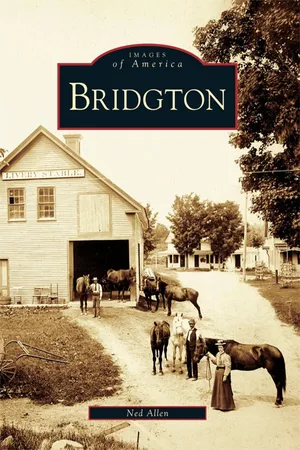
In 1768, Jacob Kimball moved to the shores of Long Lake in North Bridgton, building a store and providing boat service from Standish, at the southern end of Sebago Lake. Jacob Stevens soon followed, building a sawmill and gristmill on what became Stevens Brook in the center village. Ten power sites on this short brook ran lumber, textile, and other mills, as well as a tannery. Bridgton became the areas commercial center as retail stores and businesses sprang up to support the many mill workers and farm families. The first train on the narrow-gauge Bridgton and Saco River Railroad chugged into town in January 1883. Tourists and artists soon discovered Bridgton, and today the town remains a diverse mix of creative, hardworking people.
eBook - ePub
Bridgton
About this book
Information
Topic
HistoireSubtopic
Histoire de l'Amérique du NordTwo
MAKING A LIVING
BUSINESS, COMMERCE, AND AGRICULTURE

FOOT OF HIGHLAND LAKE, C. 1875. This is the outlet of Highland Lake (originally known as Crotched Pond), the start of Stevens Brook. Although in 1768, the proprietors granted Jacob Stevens “the privilege of building a dam at the outlet of Crotched Pond,” he actually built the first mill at the other end, where the brook empties into Long Lake. Nevertheless the village center developed from the Highland Lake end.

OUTLET OF HIGHLAND LAKE. This photograph was taken looking back across the outlet of Stevens Brook, the backbone of Bridgton’s industrial development, toward Main Hill from an area near the present town beach. The foreground is the area that is now Shorey Park, but the dam here provided power for several different mills. By the 1790s, there was a sawmill operating here, with a gristmill nearby, both owned by William Sears. Sears had moved to Bridgton from Beverly, Massachusetts, in 1789 and purchased the property and water rights from Asa Kimball over a period of several years. By the time this photograph was taken, the power site was occupied by Gibbs Mill, which, with its distinctive tower, is visible on the left. The building on the far right is the Gibbs Opera House, which stood in “the fork” on Main Street, which was eliminated when Shorey Park was created.

GIBBS MILL. Rufus Gibbs (1800–1892), one of Bridgton’s leading businessmen, got his start at Maj. Thomas Perley’s tannery in South Bridgton and later established his own tannery. He owned a great deal of property and controlled the first two power sites on Stevens Brook, operating a woolen mill, sawmill, and a shingle mill. He was one of the founders of the first bank in Bridgton and served in the Maine legislature in 1879. This mill was built by Rufus Gibbs and John Hall in 1857. Gibbs bought out Hall’s interest in 1858. The mill, which was known variously as the Cumberland Mill and the Little Gibbs Mill, was capable of turning out 200–250 wool blankets a day and did a very brisk business with the United States government during the Civil War. It was torn down in 1941.


THE PONDICHERRY WOOLEN MILL. This large building is shown here in the early 20th century, probably around 1920, at a time when it was already past its prime as a productive manufacturing facility. It was built in 1865 by Frederick J. Littlefield and his two brothers-in-law Alvin Davis and Frederick Storer. In 1873, Rufus Gibbs, who was related to Littlefield, organized the Pondicherry Company (as opposed to the Pondicherry Mills Company) and took over this mill. The new company operated both the Pondicherry Mill and the smaller Little Gibbs Mill on Main Hill. According to the 1904 Bridgton Town Register, between the two mills, the company had 60 looms in operation and produced 18,000 yards of cloth per week. The Pondicherry Company had 225 employees and a $7,000 monthly payroll. Clearly it made an important contribution to Bridgton’s economy.

PONDICHERRY MILL INTERIOR. This photograph illustrates the impressive industrial machinery at the heart of Bridgton’s woolen industry. Hundreds of bobbins of yarn were spun by machinery powered by belts on pulleys overhead. By the late 1890s, the machinery demanded more power than Stevens Brook could provide. The 100-foot tower was built, and the switch was made to coal. The building was torn down in 1965. Food City now occupies the site.
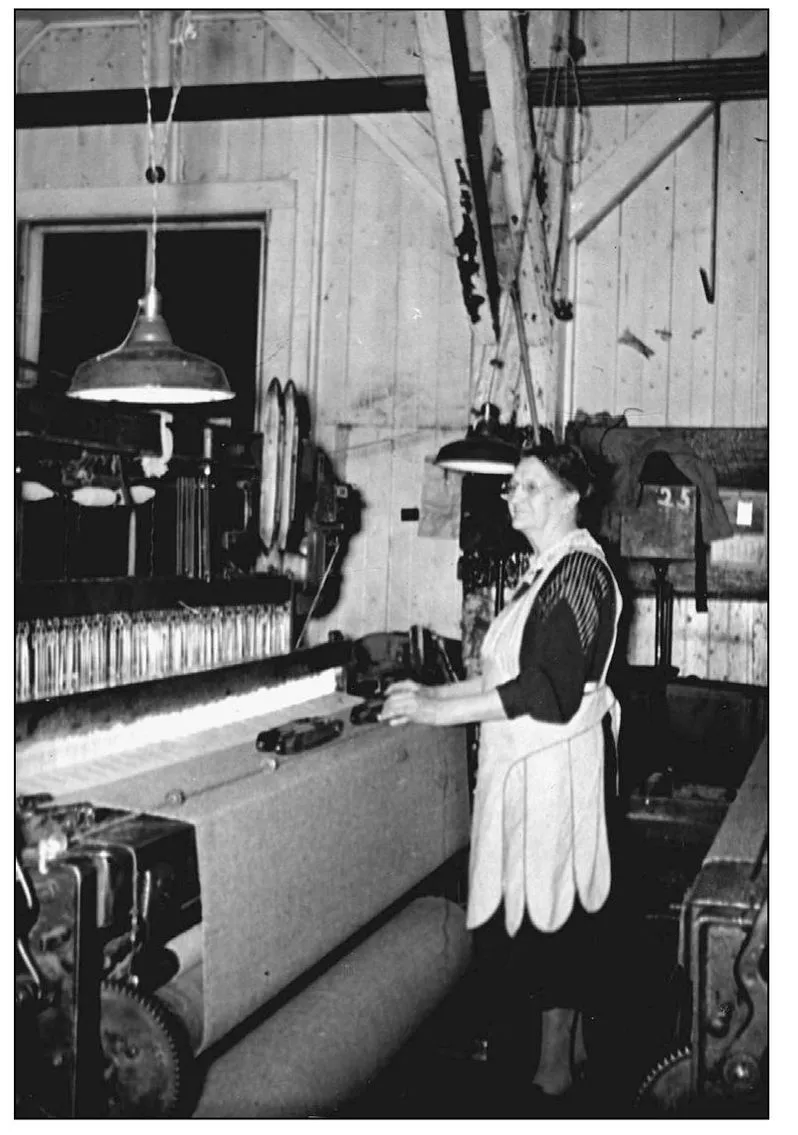
HATTIE NOYES, PONDICHERRY MILL, 1942. Bridgton’s textile industry continued to contribute to Bridgton’s economy throughout most of the 20th century. A number of companies operated in the old Pondicherry Mill up to the 1950s. The Bridgton Knitting Mill on Portland Street began operating in 1962 and continued, as part of Malden Mills, making polar fleece, until it shut down in 1998. (Photograph by John Leavitt, courtesy Bridgton Historical Society.)

CORN PACKING PLANT. In 1865, the J. Winslow Jones Corn Packing Company built a corn-packing plant on the corner of Main and Elm Streets. It was a large, sprawling complex, extending back as far as the present post office. Albion Hall Burnham, originally from Harrison, worked for J. Winslow Jones in his Portland-area plants for many years, acquiring a thorough knowledge of the business. When Jones decided to open a plant in Bridgton, he made Burnham its general manager. The land was extremely wet, described by some as a swamp, but the factory

remained there until 1889, wh...
Table of contents
- Title Page
- Copyright Page
- Dedication
- Table of Contents
- ACKNOWLEDGMENTS
- INTRODUCTION
- One - ROADS, RAILS, AND WATERWAYS
- Two - MAKING A LIVING
- Three - THE LIFE OF THE MIND
- Four - FUN IN THE SUN
- Five - LIVING TOGETHER
- BIBLIOGRAPHY
Trusted by 375,005 students
Access to over 1.5 million titles for a fair monthly price.
Study more efficiently using our study tools.
Frequently asked questions
Yes, you can cancel anytime from the Subscription tab in your account settings on the Perlego website. Your subscription will stay active until the end of your current billing period. Learn how to cancel your subscription
No, books cannot be downloaded as external files, such as PDFs, for use outside of Perlego. However, you can download books within the Perlego app for offline reading on mobile or tablet. Learn how to download books offline
Perlego offers two plans: Essential and Complete
- Essential is ideal for learners and professionals who enjoy exploring a wide range of subjects. Access the Essential Library with 800,000+ trusted titles and best-sellers across business, personal growth, and the humanities. Includes unlimited reading time and Standard Read Aloud voice.
- Complete: Perfect for advanced learners and researchers needing full, unrestricted access. Unlock 1.5M+ books across hundreds of subjects, including academic and specialized titles. The Complete Plan also includes advanced features like Premium Read Aloud and Research Assistant.
We are an online textbook subscription service, where you can get access to an entire online library for less than the price of a single book per month. With over 1.5 million books across 990+ topics, we’ve got you covered! Learn about our mission
Look out for the read-aloud symbol on your next book to see if you can listen to it. The read-aloud tool reads text aloud for you, highlighting the text as it is being read. You can pause it, speed it up and slow it down. Learn more about Read Aloud
Yes! You can use the Perlego app on both iOS and Android devices to read anytime, anywhere — even offline. Perfect for commutes or when you’re on the go.
Please note we cannot support devices running on iOS 13 and Android 7 or earlier. Learn more about using the app
Please note we cannot support devices running on iOS 13 and Android 7 or earlier. Learn more about using the app
Yes, you can access Bridgton by Ned Allen in PDF and/or ePUB format, as well as other popular books in Histoire & Histoire de l'Amérique du Nord. We have over 1.5 million books available in our catalogue for you to explore.