- 128 pages
- English
- ePUB (mobile friendly)
- Available on iOS & Android
eBook - ePub
About this book
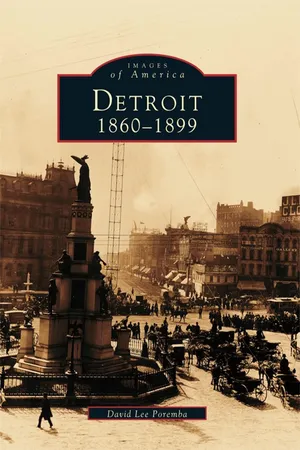
With over 230 photographs, Detroit 1860-1899 encompasses a visual history of the city before the birth of the automobile industry.
In this rare and unprecedented collection, discover Detroit as it once was, with the people and industries that flourished in this community prior to the twentieth century. With over 230 photographs, Detroit 1860-1899 encompasses a visual history of the city before the birth of the automobile industry. Join Mr. Poremba on a trip down memory lane to the beginnings of the "Motor City. " Witness its growth and change, and its lasting contributions to our nation's history. Detroit 1860-1899 will be enjoyed by young and old, resident and visitor alike.
Information
Four
The 1890s
HAZEN S. PINGREE—MAYOR OF DETROIT, 1889–1895. Born in Maine, Pingree was convinced to come to Detroit while a guest of the Confederate government at Andersonville Prison. The son of a shoemaker, he went into that business in 1866 and later formed a partnership with Charles H. Smith. By 1889, they had annual sales of $1 million, and Pingree grudgingly accepted the Republican nomination for mayor. Hazen Pingree was a reform mayor well before muckraking began and was always a champion of the common man. He first offered reform in public utilities and transportation as well as repaving the city’s streets with stone or asphalt on a permanent base. He lowered the streetcar fare from 5¢ to 3¢ and carried on the fight for reform for the next seven years.


THE FOOT OF WOODWARD AT THE RIVER, 1890. This is a scene from mid-river, looking straight up Woodward Avenue. To the right are some small boats at the dock, while to the left is one of the pleasure steamers that plied the river from Wyandotte to Port Huron. Some horse trolleys are lined up at the dock ready for their return ride north. Note the tall light towers used for illumination at night.

WOODWARD AND JEFFERSON AVENUES, 1890. A close-up of this busy intersection shows the telegraph and electric wires starting to bloom in the city. On the extreme right is one of the last horse-drawn trolleys, while on the left is a waiting line of hansoms and taxis.

WOODWARD AVENUE AND CONGRESS, 1890. Moving farther north up Woodward, there are many more wires; bigger, more permanent-looking buildings; and the same types of transportation. In the middle foreground is a person on a bicycle, a conveyance gaining rapidly in popularity. The Mabley & Company building and the Russell House are on the east side of the street.

WOODWARD AVENUE, NEAR CAMPUS MARTIUS, 1890S. A closer view of the area in the previous photograph shows some of the very first electric streetcars on the Woodward line. It now became a little more hazardous to cross the street. A better view is had of the light tower on the extreme right, which cast a faint light on the street below.

MICHIGAN AND WOODWARD AVENUES, 1890S. The northwest corner of these two busy streets shows some of the latest fashions that both men and women wore during the “Gay ‘90s.” The man in the left-center of the picture looks a little cross, while behind him there is quite a crowd in front of Sanders.

ON THE AVENUE, 1890S. Woodward Avenue was the street to show off the finest women’s fashions. An excellent illustration of women’s and girls’ clothing, these Detroiters stroll in front of Rolshoven’s Jewelers, which appears to have had a large clock at the corner of its entrance. Next door is an outlet selling Garland and Jewel stoves.

WOODWARD AVENUE, 1890S. A new building erected on Woodward just north of Michigan was the Home Savings Bank. Various delivery wagons were transporting goods to and from businesses daily. One can see the trolley tracks laid down the middle of the street.

STATE...
Table of contents
- Title Page
- Copyright Page
- Dedication
- Table of Contents
- Acknowledgments
- Introduction
- One - The 1860s
- Two - The 1870s
- Three - The 1880s
- Four - The 1890s
Trusted by 375,005 students
Access to over 1.5 million titles for a fair monthly price.
Study more efficiently using our study tools.
Frequently asked questions
Yes, you can cancel anytime from the Subscription tab in your account settings on the Perlego website. Your subscription will stay active until the end of your current billing period. Learn how to cancel your subscription
No, books cannot be downloaded as external files, such as PDFs, for use outside of Perlego. However, you can download books within the Perlego app for offline reading on mobile or tablet. Learn how to download books offline
Perlego offers two plans: Essential and Complete
- Essential is ideal for learners and professionals who enjoy exploring a wide range of subjects. Access the Essential Library with 800,000+ trusted titles and best-sellers across business, personal growth, and the humanities. Includes unlimited reading time and Standard Read Aloud voice.
- Complete: Perfect for advanced learners and researchers needing full, unrestricted access. Unlock 1.5M+ books across hundreds of subjects, including academic and specialized titles. The Complete Plan also includes advanced features like Premium Read Aloud and Research Assistant.
We are an online textbook subscription service, where you can get access to an entire online library for less than the price of a single book per month. With over 1.5 million books across 990+ topics, we’ve got you covered! Learn about our mission
Look out for the read-aloud symbol on your next book to see if you can listen to it. The read-aloud tool reads text aloud for you, highlighting the text as it is being read. You can pause it, speed it up and slow it down. Learn more about Read Aloud
Yes! You can use the Perlego app on both iOS and Android devices to read anytime, anywhere — even offline. Perfect for commutes or when you’re on the go.
Please note we cannot support devices running on iOS 13 and Android 7 or earlier. Learn more about using the app
Please note we cannot support devices running on iOS 13 and Android 7 or earlier. Learn more about using the app
Yes, you can access Detroit by David Lee Poremba in PDF and/or ePUB format, as well as other popular books in History & North American History. We have over 1.5 million books available in our catalogue for you to explore.