- 128 pages
- English
- ePUB (mobile friendly)
- Available on iOS & Android
eBook - ePub
About this book
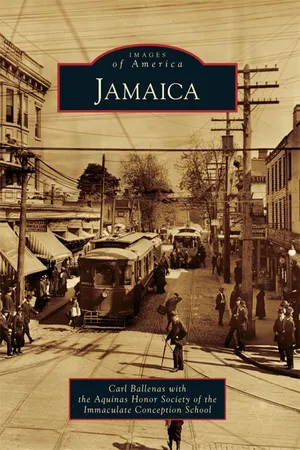
Jamaica is an astounding visual journey documenting the unique history of this remarkable community over more than 350 years.
Jamaica, Queens, has long occupied a commanding position in the political, social, and industrial life of Queens County. Indigenous people created a trail, used by various tribes to trade furs and other goods, through the woods that later became Jamaica Avenue, the main street of the village. Jamaica was witness to the evolution of change, receiving a charter from Dutch governor Peter Stuyvesant in 1656, becoming an English colony in 1664, and winning freedom in the American Revolution with the Jamaica Minutemen. The area is richly steeped in history: George Washington slept here; and Walt Whitman, Susan B. Anthony, Rufus King, Jacob Riis, and many more have left their mark on Jamaica. Jamaica is an astounding visual journey documenting the unique history of this remarkable community over more than 350 years.
Information
Two
PEOPLE, PLACES, AND EVENTS
MARKING A PLACE IN TIME

Crowds celebrate at the King Manor in 1921. Patriotic celebrations played an important role for generations. According to Queens in Olden Times on July 4, 1791, “At day-break, the bells of the churches in Jamaica rang. Thirteen platoons of Light Infantry announced the joyous day. At noon they proceeded to the Presbyterian church, where an eloquent oration was delivered by the Rev. Mr. Faitoute.” (Archives at Queens Library, Frederick Weber Photographs.)

The first settlers to Jamaica were mostly Presbyterians, and church affairs were considered and transacted at town meetings. In 1661, according to the History of Queens County, 1683–1882, “some of the inhabitants petitioned Governor Stuyvesant to send a Dutch minister from New Amsterdam to preach and baptize. Reverend Samuel Drisius came to Jamaica on Saturday, January 8th. He preached two sermons and baptized eight children and two women. In 1662 the town voted to erect a minister’s house, the following year they built a 20 feet square building to serve as church and town hall. In 1690 a new house, 60 by 30 feet, was built, and was succeed in 1699 by a stone building 40 feet square represented in this woodcut.” It stood on Jamaica Avenue, at the head of Union Hall Street (162nd Street)—which once was known as Meeting House Lane—and had three doors and aisles to correspond. The pulpit, surmounted by a sounding board, stood on the north side, facing the gallery. The structure also served as a courthouse. Razed in 1813, it had been host to Presbyterian, Episcopalian, and Dutch preachers.

The First Presbyterian Church of Jamaica was founded in 1662 and later used the stone church built in 1699 for services. In 1664, the colony changed hands from Dutch to English rule. Lord Cornbury became the New York governor in 1702 and had the Presbyterians removed from the stone church, declaring that it had been built by public tax and, therefore, belonged to the established Church of England, the Episcopalians. Pastor Hubbard was forever forbidden to preach again in the church. The Presbyterians then held services in a barn and later erected a building at the east end of the village. After many attempts, a lawsuit was presented in 1728, and the stone church was returned to them. It was torn down in 1813, and the stones were used for the foundation of the new Presbyterian church (pictured here), which once had a graceful spire that rose 102 feet. It was strained by the gale of 1821, which compromised the framework of the building, and the spire was shortened by 27 feet.

The Jamaica Presbyterian Church has a record of continuous activity from 1662 to the present. The church building dedicated in 1814 stood on the north side of Jamaica Avenue and Clinton Avenue (164th Street). When the village became part of a great metropolis, the noise of the automobile, trolleys, and elevated train caused the church and the parsonage (pictured above in 1866) to be moved farther back in 1920. (Archives at Queens Library, George Winans Collection.)

The First Dutch Reformed Church of Jamaica was established in 1702. The congregation first used the 1699 stone church. On June 15, 1716, a wooden octagonal building was erected and opened on Jamaica Avenue near 162nd Street. Its eight sides had a steep roof with a cupola and a bell cast in Amsterdam. In front of the church stood an old-fashioned hay scale.

The octagonal church building of the Dutch Reformed group stood for 117 years until a growing congregation rendered it necessary to erect a newer, larger building. On July 4, 1833, a Georgian church was dedicated at 153rd Street and Jamaica Avenue. A parsonage was built in 1853 at Jamaica Avenue and 149th Street. On November 19, 1857, a fire destroyed this church building.

The cornerstone for a new building was laid at the same site. Designed and constructed by Sidney Young and master mason Anders Peterson in the Romanesque Revival style, it opened on October 6, 1859. By the 1980s, the congregation moved to a new building at Ninetieth Avenue and 159th Street. The old church was made a landmark and is now the Jamaica Performing Arts Center. (Archives at Queens Library, F...
Table of contents
- Title Page
- Copyright Page
- Dedication
- Table of Contents
- ACKNOWLEDGMENTS
- INTRODUCTION
- One - FROM THE BEGINNING
- Two - PEOPLE, PLACES, AND EVENTS
- Three - ON THE STREETS
- Four - LEAVING AN IMPRESSION
- Five - JAMAICA’S OFFSPRING
- Six - JAMAICA’S VISION
Trusted by 375,005 students
Access to over 1.5 million titles for a fair monthly price.
Study more efficiently using our study tools.
Frequently asked questions
Yes, you can cancel anytime from the Subscription tab in your account settings on the Perlego website. Your subscription will stay active until the end of your current billing period. Learn how to cancel your subscription
No, books cannot be downloaded as external files, such as PDFs, for use outside of Perlego. However, you can download books within the Perlego app for offline reading on mobile or tablet. Learn how to download books offline
Perlego offers two plans: Essential and Complete
- Essential is ideal for learners and professionals who enjoy exploring a wide range of subjects. Access the Essential Library with 800,000+ trusted titles and best-sellers across business, personal growth, and the humanities. Includes unlimited reading time and Standard Read Aloud voice.
- Complete: Perfect for advanced learners and researchers needing full, unrestricted access. Unlock 1.5M+ books across hundreds of subjects, including academic and specialized titles. The Complete Plan also includes advanced features like Premium Read Aloud and Research Assistant.
We are an online textbook subscription service, where you can get access to an entire online library for less than the price of a single book per month. With over 1.5 million books across 990+ topics, we’ve got you covered! Learn about our mission
Look out for the read-aloud symbol on your next book to see if you can listen to it. The read-aloud tool reads text aloud for you, highlighting the text as it is being read. You can pause it, speed it up and slow it down. Learn more about Read Aloud
Yes! You can use the Perlego app on both iOS and Android devices to read anytime, anywhere — even offline. Perfect for commutes or when you’re on the go.
Please note we cannot support devices running on iOS 13 and Android 7 or earlier. Learn more about using the app
Please note we cannot support devices running on iOS 13 and Android 7 or earlier. Learn more about using the app
Yes, you can access Jamaica by Carl Ballenas,Aquinas Honor Society of the Immaculate Conception School in PDF and/or ePUB format, as well as other popular books in History & North American History. We have over 1.5 million books available in our catalogue for you to explore.