- 128 pages
- English
- ePUB (mobile friendly)
- Available on iOS & Android
eBook - ePub
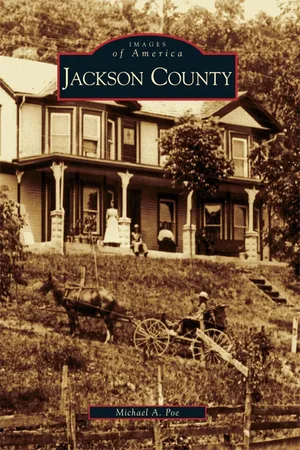
Jackson County
About this book
Discover the rich history of Jackson County, West Virginia through vintage images in this pictorial history.
On October 28, 1770, George Washington entered present-day Jackson County by traveling south down the Ohio River. The Sachem tribe camped with Washington's party and expressed a desire to barter with the Virginia traders. Washington made extensive notes of the terrain, animals, and timber. By 1772, Washington had patents on more than 6,800 acres in Jackson County. This led to the Ohio River being the source of trade, entertainment, and survival early in the history of Jackson County. Named after the seventh president of the United States, Andrew Jackson, Jackson County was established by an act of the Virginia General Assembly on March 1, 1831, out of parts of Mason, Kanawha, and Wood Counties. The terrain is sandy with fertile bottomlands along the Ohio River and gently rolling hills toward the east. Ripley is the county seat, situated in the central part of the county, and is named in honor of Harry Ripley, who drowned in Big Mill Creek in 1830.
Information
Three
OPEN FOR BUSINESS
The first business interest in Jackson County was as a direct result of the Ohio River traffic. The town of Ravenswood flourished as a result. Sawmills along the river provided wood for the boilers on the stern-wheelers. The town of Murraysville was where men went to seek employment. There were boatyards, a casket factory, and an oar factory. The Ohio River Railroad brought a new kind of business to the area. The stern-wheelers brought passenger traffic and entertainment, but the railroads brought commerce and people. The town of Ripley had sawmills that shipped out railroad ties to replace damaged track and lay new track. All up and down the Ohio Valley, the railroads provided a new means of transport for the farmers and businessmen to distribute products to new markets. By the 1890s, the oil and gas boom was developing in every hill and hollow of Jackson County. This new industry gave landowners a source of income on what was under the ground. Companies like United Fuel and Carter Oil profited, while employing local men to lay pipe and work the wells.
It was not until the late 1950s that Jackson County had a major industry that saw the potential of the Ohio River. When Kaiser Aluminum opened near Millwood, this gave Jackson County a boost in revenue and employment.

William G. Watts opened a general merchandise store on the corner of Virginia and Sand Streets in Ravenswood in March 1880. This picture is of his second store on Sand Street, which he shared with undertaker John Rudman. In 1887, Watts moved to Henrietta and Sand Streets, where he built a large, brick building. During this time, Ravenswood was a shipping point for farmers, trappers, and traders from the surrounding counties. The Watts store was the first store the travelers encountered as they entered Ravenswood. Family members are, from left to right, (first floor) unidentified, William W. Watts, Pearl Watts, Ruby Watts, baby Taylor Watts, unidentified, and John T. Watts; (second floor) Emma Rudman McConnell, three-year-old Fred Rudman, John Rudman, Elizabeth J. Rudman, child Harry Rudman, and Ella McKay. (Courtesy of Washington Lands Museum.)

The Ohio River traffic helped Ravenswood build a strong business climate. Along with the glass works and pottery kilns was the broom factory. In 1880, the owners of the broom factory were brothers Anthony and John Keller. From left to right are the following members of the Keller family: (seated) Ruth, Elizabeth, and Charley; (standing) Anthony, John R., and John. (Courtesy of Washington Lands Museum.)

The Sandyville Mill was modeled after the Cheuvront mills of Harrison County. By 1911, the mill was averaging 500 bushels of wheat and 500 bushels of corn each week. In 1914, the mill was owned by Jack Nutter, John Blosser, and L. D. Rush. Then, in 1936, Sherman Rutan operated the mill and closed it a year later. This photograph was taken in 1886 looking west toward Sandyville.

This photograph shows the Daniel Deming Rhodes store in Cottageville in the 1890s. The Knights of Pythias lodge was upstairs. The man on the right was Abraham McCoy, who was commissioner of revenue in Jackson County from 1856 to 1860. McCoy had his right leg broken during a horse riding accident, and the injury was so serious that the leg had to be amputated below the knee. (Courtesy of Don Flesher collection.)

In 1831, Cyrus McCormick started development of the reaper and mowing machine industry. William Deering became involved in the harvester business around 1870. On May 28, 1898, the Ripley Fairgrounds, which is now First, Second, and Third Avenues, promoted Deering Days. This was when all the new equipment and replacement parts were displayed for farmers and retailers of McCormick-Deering products. (Courtesy of Jackson County Library.)

George and Annie Leonard were merchants in Ravenswood for almost 30 years. As with every family business in the late 1800s, the four Leonard children worked at the store. George passed away in 1907, and Annie passed away in 1908. These ladies were seen leaving the Leonard’s store in June 1888. (Courtesy of Betty Fowler.)

One of the prominent store...
Table of contents
- Title Page
- Copyright Page
- Table of Contents
- ACKNOWLEDGMENTS
- INTRODUCTION
- One - CITY AND COUNTRY
- Two - READING, WRITING, AND ARITHMETIC
- Three - OPEN FOR BUSINESS
- Four - GETTING FROM HERE TO THERE
- Five - PEOPLE AROUND THE COUNTY
- Six - RELIGION AND CHURCH
- Seven - FLOOD AND DISASTERS
- Eight - FAIRS AND FESTIVALS
Trusted by 375,005 students
Access to over 1.5 million titles for a fair monthly price.
Study more efficiently using our study tools.
Frequently asked questions
Yes, you can cancel anytime from the Subscription tab in your account settings on the Perlego website. Your subscription will stay active until the end of your current billing period. Learn how to cancel your subscription
No, books cannot be downloaded as external files, such as PDFs, for use outside of Perlego. However, you can download books within the Perlego app for offline reading on mobile or tablet. Learn how to download books offline
Perlego offers two plans: Essential and Complete
- Essential is ideal for learners and professionals who enjoy exploring a wide range of subjects. Access the Essential Library with 800,000+ trusted titles and best-sellers across business, personal growth, and the humanities. Includes unlimited reading time and Standard Read Aloud voice.
- Complete: Perfect for advanced learners and researchers needing full, unrestricted access. Unlock 1.5M+ books across hundreds of subjects, including academic and specialized titles. The Complete Plan also includes advanced features like Premium Read Aloud and Research Assistant.
We are an online textbook subscription service, where you can get access to an entire online library for less than the price of a single book per month. With over 1.5 million books across 990+ topics, we’ve got you covered! Learn about our mission
Look out for the read-aloud symbol on your next book to see if you can listen to it. The read-aloud tool reads text aloud for you, highlighting the text as it is being read. You can pause it, speed it up and slow it down. Learn more about Read Aloud
Yes! You can use the Perlego app on both iOS and Android devices to read anytime, anywhere — even offline. Perfect for commutes or when you’re on the go.
Please note we cannot support devices running on iOS 13 and Android 7 or earlier. Learn more about using the app
Please note we cannot support devices running on iOS 13 and Android 7 or earlier. Learn more about using the app
Yes, you can access Jackson County by Michael Poe in PDF and/or ePUB format, as well as other popular books in History & North American History. We have over 1.5 million books available in our catalogue for you to explore.