eBook - ePub
The Eastland Disaster
- 128 pages
- English
- ePUB (mobile friendly)
- Available on iOS & Android
eBook - ePub
The Eastland Disaster
About this book
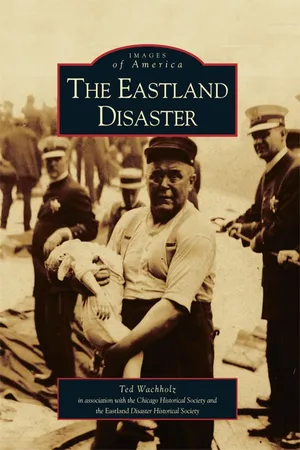
July 24, 1915 was supposed to be Chicago's social event of a lifetime, but turned into a tragedy unlike any other.
More than 7,000 people living in the Chicago area and Michigan City, Indiana, eagerly anticipated Saturday morning, July 24, 1915. This particular Saturday was going to be anything but a routine summer day. Plans had been carefully made for it to be the social and entertainment event of the year, and for some, a lifetime. The fifth annual midsummer excursion and picnic had been organized by the employees of the Western Electric Company's Hawthorne Works. Thousands of carefree merrymakers would enjoy a festive day including a lovely cruise across Lake Michigan to an awaiting parade and day-long picnic. The day would conclude with an evening cruise back to Chicago. For thousands of hard-working immigrant laborers and their families and friends, it was going to be a day to remember. Instead, the day's scheduled event turned into a tragedy never before seen. The SS Eastland, while still tied to the wharf, rolled into the Chicago River with more than 2,500 passengers on board. Nearly 850 people lost their lives, including 22 entire families. The ensuing struggle for survival, and the resulting death, heroism, cowardice, greed, and scandal gripped the city of Chicago.
Trusted by 375,005 students
Access to over 1.5 million titles for a fair monthly price.
Study more efficiently using our study tools.
Information
Seven
THE RESCUE, RECOVERY, AND RELIEF
“Tears falling from the sky.”—Frank Blaha
Western Electric responded to the disaster in an admirable fashion, and did all it could to ease the pain, suffering, and hardship of the victims’ families. Countless other organizations responded: the Chicago Fire Department, Chicago Police Department, United States Coast Guard, American Red Cross (local Chicago office as well as the national office), Cook County Coroner’s Office, Chicago Telephone Company, Commonwealth Edison, Marshall Field & Company, Sherman and LaSalle Hotels, Steffey Brothers Wholesale Commission, Boy Scouts of America, Oak Park Charities, Bohemian Aid Society, Chicago Department of Health, the churches, the undertaking establishments, the hospitals, Reid, Murdoch & Company, and the list goes on and on. Of course, thousands of individuals responded in one or more ways, too. It is impossible to identify all who helped during the aftermath of the tragedy. The aftermath that was unlike any other was only briefly about rescue and survival—it was mostly concerned with recovery.

A young woman wrapped in a blanket stands on the deck of one of the nearby ships. This is one of the more poignant images from the tragedy, and represents the group that was impacted the most—young women. She appears to be staring out at the chaos in front of her—probably numb and in shock. The deck chairs are folded and stacked, chairs that earlier were open and filled with hundreds of jubilant merrymakers. Now alone, she may already be aware that she has lost a family member, or perhaps a friend or co-worker. Perhaps she is wondering what her life and future will now hold for her. The scene is hazy and foggy, as if it was all a bad dream. (Courtesy Chicago Historical Society, Chicago Daily News negatives collection, DN-0064947.)

The rescue efforts began immediately. Earlier that morning, the tug Kenosha had been tied to the bow of the Eastland in preparation for towing her out onto Lake Michigan. Upon watching the Eastland roll into the Chicago River, Captain John O’Meara (standing directly below the letter ‘H’ in Kenosha) ordered his tug be secured to the wharf to form a bridge between the overturned hull of the Eastland and the safety of the wharf. (Courtesy family of Captain John H. O’Meara.)

Due to the quick and decisive actions taken by O’Meara and his crew (including Carl Mattson, among others), the survival rate of the passengers was significantly increased. (Courtesy Eastland Disaster Historical Society.)

Hundreds of passengers, most who simply climbed over the starboard rail as the ship rolled over, walked over the Eastland and the Kenosha to safety—many without ever getting their feet wet. When the Eastland rolled over, its bow was still tied by its forward breast line to the spile. In this photo and the next, note the bent spile; the forward breast line is still evident. (Courtesy family of Theodore Jahnke.)

The crews of other boats and tugs in the area responded quickly, even though there was risk of a boiler explosion on the Eastland. “My father shouted for every man about the place to get aboard the (Carrie) Ryerson,” said Ray LeBeau. “At that time I could see people beginning to jump off [the Eastland]. Seven of us piled aboard the tug and we tore up current as the Eastland went over. We were the first boat there except for the Kenosha, which was to tow the Eastland out. No, I couldn’t tell you how many people we got out. The river was full of them and we were too busy to count ‘em. I know there were 22 people on board the tug at one time. Henry Oderman, one of our shopmen, dived in and got one woman who was going down. It took us a long time to bring her to.” (Courtesy Chicago Historical Society, Chicago Daily News negatives collection, DN-0064936.)

At that hour of the morning, only three people were at the Dunham Towing and Wrecking Company plant along the Chicago River: Superintendent F. D. Fredericks, Charlie Hart, and Johnny Benson. Though these three did not have a license and none was a regular engineer, they commandeered the tug Rita McDonald. “Come on boys, I can run that old engine!” Supt. Fredericks shouted to Hart and Benson. He continued: “On the way up [stream] we got in where the people were the thickest. Then we started picking ‘em up. I don’t know how many. Too busy to count. I’m tickled to death to think we were able to help as many as we did. Fifty? Oh, I don’t know.” (Courtesy Eastland Disaster Historical Society.)

Captain Joseph Lamoreaux and his crew of the tug Indiana arrived at the scene and assisted in the rescue and recovery efforts minutes after the Eastland capsized. As a result of his horrifying experience in the rescue and recovery efforts, Captain Lamoreaux had nightmares about the tragedy for several months after the ordeal, and chose not to discuss it with...
Table of contents
- Title Page
- Copyright Page
- Table of Contents
- ACKNOWLEDGMENTS
- INTRODUCTION
- One - THE EARLY 1900S
- Two - THE BELL SYSTEM
- Three - THE WESTERN ELECTRIC COMPANY
- Four - THE HAWTHORNE WORKS
- Five - THE ANNUAL EXCURSION AND PICNIC
- Six - THE EASTLAND DISASTER
- Seven - THE RESCUE, RECOVERY, AND RELIEF
- Eight - THE CAUSE AND THE END
- Nine - FATE OR FAITH
- Ten - OUT OF OBSCURITY
Frequently asked questions
Yes, you can cancel anytime from the Subscription tab in your account settings on the Perlego website. Your subscription will stay active until the end of your current billing period. Learn how to cancel your subscription
No, books cannot be downloaded as external files, such as PDFs, for use outside of Perlego. However, you can download books within the Perlego app for offline reading on mobile or tablet. Learn how to download books offline
Perlego offers two plans: Essential and Complete
- Essential is ideal for learners and professionals who enjoy exploring a wide range of subjects. Access the Essential Library with 800,000+ trusted titles and best-sellers across business, personal growth, and the humanities. Includes unlimited reading time and Standard Read Aloud voice.
- Complete: Perfect for advanced learners and researchers needing full, unrestricted access. Unlock 1.5M+ books across hundreds of subjects, including academic and specialized titles. The Complete Plan also includes advanced features like Premium Read Aloud and Research Assistant.
We are an online textbook subscription service, where you can get access to an entire online library for less than the price of a single book per month. With over 1.5 million books across 990+ topics, we’ve got you covered! Learn about our mission
Look out for the read-aloud symbol on your next book to see if you can listen to it. The read-aloud tool reads text aloud for you, highlighting the text as it is being read. You can pause it, speed it up and slow it down. Learn more about Read Aloud
Yes! You can use the Perlego app on both iOS and Android devices to read anytime, anywhere — even offline. Perfect for commutes or when you’re on the go.
Please note we cannot support devices running on iOS 13 and Android 7 or earlier. Learn more about using the app
Please note we cannot support devices running on iOS 13 and Android 7 or earlier. Learn more about using the app
Yes, you can access The Eastland Disaster by Ted Wachholz,Chicago Historical Society,land Disaster Historical Society in PDF and/or ePUB format, as well as other popular books in History & North American History. We have over 1.5 million books available in our catalogue for you to explore.